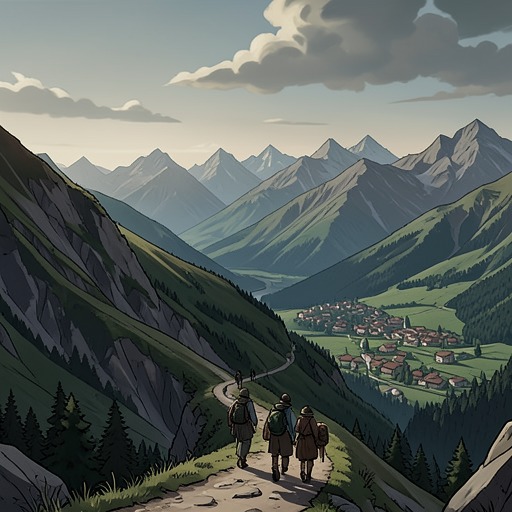
“This mountain has never done me any harm”
The Eight Mountains: A Novel“This mountain has never done me any harm” is Bruno’s answer when Pietro urges him to leave Grenon. Spoken after two failed attempts to rescue him in a few weeks, the sentence gives their decades-long disagreement its plainest form: Pietro sees staying as a danger from which Bruno should be brought down; Bruno sees the mountain as a place that has not wronged him. Its force lies in the unadorned confidence of the claim, and in the friendship that allows Bruno to answer an appeal with a reminder of how long it has been made.
The Expression in Its Scene
The exchange takes place after an avalanche has left dead fish by a lake. The morning is sunny, and the first warmth is loosening snow from the overhangs and gutters of Grenon. Above the two men, a helicopter passes without noticing them. Nearby, Monte Rosa’s ski slopes promise a bright day of recreation; on the shadowed side of a ridge, Pietro and Bruno are standing beside the landslide. The contrast makes Bruno’s phrase more than a general declaration of affection for mountains: he says it amid evidence of the mountain’s immediate power to disrupt and destroy.
Pietro has already said that he is going, for the second time in a few weeks, and acknowledges that both attempts to rescue Bruno have failed. Bruno agrees that going seems right, but Pietro then asks him to come down with him. Bruno’s brief “Again?” turns the practical request into a question about a familiar pattern. The quoted declaration follows not as a denial that danger exists—the avalanche and dead fish are before them—but as Bruno’s reason not to treat danger as proof that the mountain has harmed him.
A Friendship Measured in Years
Pietro answers Bruno’s question by calculating their friendship: he thinks the following year will mark thirty years. Bruno uses that duration to restate the persistence of Pietro’s appeal. His question—“And haven’t you been trying to get me down from here for the last thirty years?”—makes the present rescue attempt one more instance in a relationship shaped by this difference. The exact interval is uncertain by a year, but the point is clear: Pietro’s effort to bring Bruno down is nearly as old as their friendship.
The phrase follows that question as both reassurance and boundary. Bruno does not dispute that Pietro is worried, nor does he offer a new plan for leaving. Instead, he tells his friend not to worry about him and invokes his own experience of the mountain: it has never done him harm. The sentence’s absolute wording—“never”—is personal rather than a claim about what mountains can do to anyone. It expresses Bruno’s account of his relationship with this place, while Pietro’s repeated attempts express an incompatible assessment of what staying there now means.
Staying and Leaving
The exchange briefly makes the two men’s positions explicit. Pietro’s “I’m going” signals another departure from the scene and another attempt to draw Bruno away; his request that Bruno come with him is the rescue’s immediate objective. Bruno’s answer does not persuade Pietro to stay. Nor does Pietro’s appeal persuade Bruno to leave. Their friendship is evident in the directness of the conversation, but closeness does not resolve the disagreement: each recognizes the other’s position and continues to act from his own.
Afterward, Pietro remembers little of the morning. He is shaken and too sad to think clearly, and he cannot wait to leave the lake and avalanche behind. Once down in the valley, however, he begins to enjoy the descent, moving in great leaps on snowshoes through fresh snow. The change in his experience clarifies the difference between the men without settling it: Pietro can find release in leaving the mountain, while Bruno’s sentence gives no sign that he experiences departure as the answer. The narrative follows Pietro down; the remembered exchange remains the account of what Bruno has chosen to say.
The Sentence’s Lasting Weight
The declaration is powerful partly because it is so limited. Bruno does not say that the mountain is harmless, that avalanches cannot occur, or that Pietro has no reason to be afraid. He speaks only from his own history with it. Against the scene’s visible damage, that distinction makes the line sound at once like a reassurance to Pietro and a defense of Bruno’s decision to stay. The assurance cannot undo the avalanche or satisfy the person trying to rescue him.
The final image in Pietro’s recollection is not another argument but the river beneath the snow. He breaks through a thin, transparent crust and finds the water still coursing below, hidden from sight and sound on the path. That discovery belongs to Pietro’s descent rather than to Bruno’s statement, but it leaves the expression within a scene of surfaces and persistence: the avalanche has altered the visible landscape, while water continues underneath it. Bruno’s words have a similar firmness without promising safety. They say what the mountain has meant to him, not what it will do next.