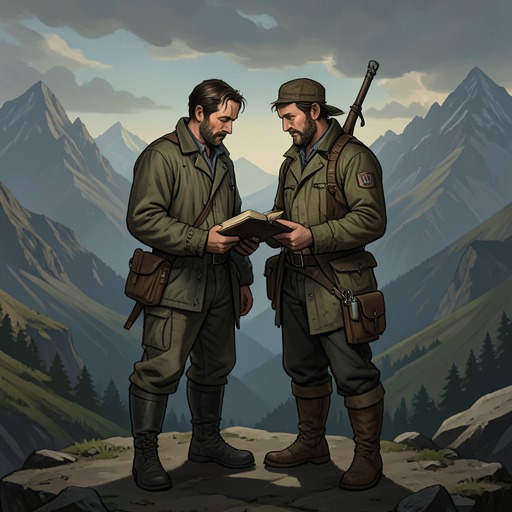
Bruno is invited to study in Milan and decides to leave Grana
The Eight Mountains: A NovelBruno’s invitation to study in Milan is a turning point in which education, family responsibility, and the pull of the mountains meet. Pietro’s parents offer Bruno a place in their home and the chance to attend school, but the decision acquires its force when Bruno declares that he is leaving Grana. Pietro, who would rather preserve their familiar life together, has to recognize that his friend’s future cannot be measured by what Pietro wants to keep.
Background: A Campaign for Education
Pietro’s mother approaches Bruno’s education with the same sustained attention she brings to her work and relationships. In the Veneto she had been a nurse; in Milan she became a health worker in the working-class Elms district, supporting women during pregnancy and monitoring infants in their first year. Her work could involve difficult judgments about children’s living conditions, and she acted with the support of other women working with families. That experience provides context for her determination to help Bruno: she sees education not as an abstract ideal but as a responsibility requiring persistence and cooperation.
In Grana, she recognizes that she cannot achieve this alone. Bruno’s mother, who spends her days tending onions and potatoes in an allotment and speaks with no one there, is not someone Pietro’s mother can enlist. Instead, she concentrates on Bruno’s aunt, repeatedly knocking on doors and returning in a friendly but firm manner until the aunt agrees to send him to school in winter and to Pietro’s house for homework in summer. The arrangement is a small but important opening in a life otherwise shaped by the mountain community and its routines.
The lessons take place in Pietro’s kitchen three times a week. Bruno arrives scrubbed and well dressed; Pietro’s mother has him read aloud from books by Stevenson, Verne, Twain, and Jack London, and lets him keep the books to practice while he is in the pastures. Bruno enjoys novels, but grammar overwhelms him. Pietro feels embarrassed on his behalf and resents the pressure, yet Bruno does not complain. He works at the lessons because he understands how much they matter to Pietro’s mother—and perhaps because being important to someone is unfamiliar to him.
The Offer and Its Terms
By the time Bruno tells Pietro that their parents have spoken to his uncle, the adults have already discussed the plan. Pietro’s parents propose taking Bruno to Milan in September, welcoming him into their home, and enrolling him in a technical or professional institute of his choice. They frame the first year as a trial: if he is unhappy, he can return to Grana the following summer; if it works out, he can stay until graduation and then decide what to do with his life. The offer provides support without presenting the move as irrevocable.
Bruno understands the proposal less sentimentally than Pietro’s parents do. He expects his uncle to agree because the arrangement costs the family nothing: Pietro’s parents will cover board, lodging, and school. His explanation brings the practical bargain beneath the generous offer into view. It does not establish what Bruno’s aunt thinks, or settle what the family’s motives are beyond the financial calculation Bruno identifies; the scene leaves that question open.
Bruno’s Decision and Pietro’s Resistance
When Pietro asks whether Bruno would like to go, Bruno says he cannot imagine what Milan would be like. Pietro knows the city already and is opposed to the plan, but his certainty about Bruno’s future is not knowledge of Bruno’s wishes. He fears that Milan would spoil his friend and cannot understand why the adults want to change him rather than let him spend his life tending cows. Looking back, Pietro recognizes the selfishness in that thought: it protects his own summers, companionship, and experience of the mountain more than it considers Bruno’s choices.
Pietro urges Bruno to tell the adults that he wants to stay. Bruno reacts with surprise and rejects the advice. He says he will not stay, that he has spent his whole life going up and down the mountain. Then he stands on the grass, cups his hands around his mouth, and calls across the lake, “Oh! Can you hear me? It’s me, Bruno! I’m leaving!” The slope of Grenon sends his announcement back as an echo. The cry makes his decision public in the landscape they share, even as Pietro is still struggling to accept it.
The shout startles five chamois on the scree. Bruno is the one who points them out; they cross a snowfield in single file, pause at the crest, and disappear over the other side. The animals’ brief passage follows Bruno’s declaration without explaining it: the scene places a departure among the movements of mountain life, while leaving the boys’ different responses to change sharply visible.
Significance of the Departure
The proposal grows out of care, but it also raises the question of who has the right to define what care should make possible. Pietro’s mother has secured an educational opportunity through practical persistence and an alliance with Bruno’s aunt. His parents offer a home, schooling, and time to decide. Yet Pietro initially experiences the plan as a threat to the companion and familiar mountain life he depends on. His resistance is affectionate, but the scene exposes how affection can become possessive when it assumes that another person should remain unchanged.
Bruno’s announcement marks a shift from being the object of other people’s plans to voicing a choice of his own. He has not claimed to know what Milan will be like; indeed, he says he cannot picture it. His decision instead rests on rejecting the life Pietro proposes for him, a life of staying where he has already spent his whole life. The scene does not describe the move itself or resolve its eventual consequences. Its decisive outcome is more immediate: Bruno declares that he is leaving, and Pietro sees that keeping their friendship intact cannot mean keeping Bruno in place.