Building a House as Reconciliation and Continuity
The Eight Mountains: A NovelBuilding a House as Reconciliation and Continuity is the meaning Pietro gradually finds in his inheritance: Giovanni Guasti has left him a ruin and an uncompleted plan, while Bruno has promised to build the house Giovanni designed. The project joins the father’s unfulfilled desire to Pietro’s uncertain future and gives Pietro and Bruno a way to resume a friendship that had been interrupted. Yet its meaning is not settled in advance. Pietro first sees the work as an obligation to his father; only through working beside Bruno does he begin to recognize it as a chance for something between them to continue.
A Ruin Chosen for a House
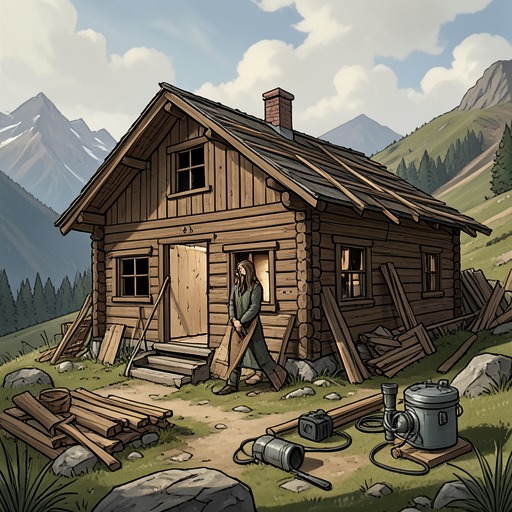
The inheritance is a stark, unfinished site rather than a completed home. Snow has altered the slope, but Pietro finds a wooded terrace below a high wall of unusually white rock. Three drystone walls remain: two short walls and a longer one, measuring four by seven meters, with the rock face itself serving as the fourth. The roof has disappeared, and a small Swiss pine has taken root among the stones. The scene makes the proposed house an act of making within what remains, not the recovery of an intact past.
Bruno explains that he and Giovanni had come across the place nearly three years earlier, after Bruno had accompanied Giovanni on searches for a suitable site. Giovanni chose it immediately. Finding the owners and persuading them to sell took Bruno time; as he observes, people in the high country might keep a ruin for a lifetime rather than sell it to someone who intended to do something with it. The obstacle underscores that the building depends on deliberate effort and agreement, not merely on inheritance. When Pietro asks what Giovanni wanted to do there, Bruno answers simply: build a house.
An Inheritance with an Unstated Purpose
For Pietro, the plan complicates the image he has of his father. Giovanni had spent his life fleeing houses, yet had cultivated the desire to build one in the mountains. He did not manage to complete it. In anticipating his death, however, he left the place to Pietro. Pietro can identify the facts of this arrangement but cannot determine what Giovanni wanted from him; the inheritance arrives with a purpose suggested by action, but not fully explained.
Bruno supplies one crucial part of that purpose. Giovanni had designed the house as he wanted it and made Bruno promise to build it. He asked while sitting on the very wall where Pietro now sits. This physical correspondence brings the absent father into the present without making his intentions entirely transparent: Pietro occupies Giovanni’s former place, but must decide for himself whether and how to answer the request. The house therefore passes between generations as both a concrete design and an unresolved question.
Work as a Shared Commitment
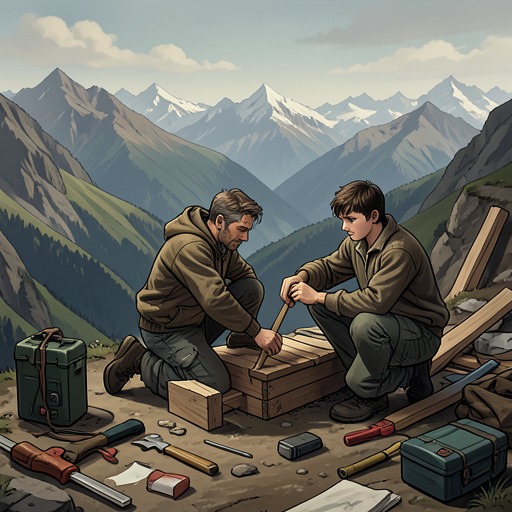
Bruno offers to work on the house during the summer, then clarifies that he expects no payment for the job. He says that with a laborer he could finish in three or four months and asks Pietro to help. Pietro has little money: the inheritance has already gone toward settling his disastrous finances, and what remains is not enough to build a house. He also has other deferred wishes. The proposal consequently cannot be accepted as an easy purchase or simple fulfillment of Giovanni’s plan; it asks Pietro to contribute labor when he feels he has neither the skill nor the means.
Pietro recognizes how different his response might have been elsewhere. Down in the plains, he thinks, he would have laughed and said he could do nothing useful. At the ruin, sitting in snow before a frozen lake at an altitude of two thousand meters, he instead feels that his father has brought him there for a reason, though he does not know what it is. His willingness to consider the work begins not in confidence but in the particular setting and in a sense of inevitability. He treats the task as another of Giovanni’s riddles: an opportunity to discover what there is still to learn.
Friendship, Repair, and Continuity
The meaning shifts as Pietro watches Bruno explain the use of a scythe stone through an imaginary demonstration. Their old game had involved entering unstable ruins through holes in the walls, walking on planks that moved underfoot, and treating wrecked objects as treasure. Remembering that they had repeated this play for years changes Pietro’s understanding of the project. Until then, he had believed he was there only for Giovanni’s sake, to carry out his wishes and ease his own guilt. Now the inheritance seems to him more like compensation, or a second chance for his and Bruno’s interrupted friendship. He wonders whether this was what Giovanni meant to give him, but the question remains open.
Small acts around the ruin echo that tentative possibility. Bruno tosses an old horn onto the woodpile, but Pietro retrieves and stores it, thinking he may find a future use for it. At the end of the day, Pietro digs the Swiss pine out of the rubble with its roots intact and replants it near the clearing, where the view of the lake is best. Its twisted trunk has struggled toward the light; in its new, exposed position, wind blows it from side to side, and Pietro asks whether it will survive. The tree’s uncertain transplantation does not prove that the house or friendship will succeed. It does give the scene an image of continuity that requires care: what has grown among ruins may be moved, but survival beyond its sheltered place is not guaranteed. The house, like the friendship it may help renew, remains a future made possible by shared work rather than a finished reconciliation.