Christmas Reunion and Avalanche at Barma
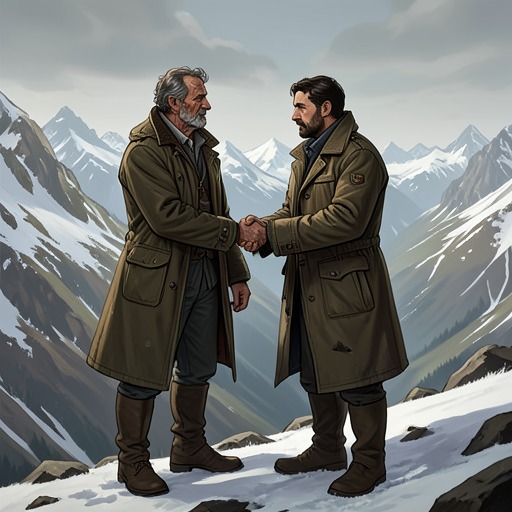
The Eight Mountains: A NovelChristmas Reunion and Avalanche at Barma brings Pietro and Bruno together again in a landscape made almost unrecognizable by snow, then places their renewed friendship beside the mountain’s sudden violence. Pietro reaches Barma hoping to draw Bruno back down to the valley; instead, the two men share an avalanche’s passage and its aftermath, and Bruno remains committed to the life he has chosen.
The Return Through a Buried Landscape
After learning that snow was falling at elevation, Pietro buys snow chains on the motorway and snowshoes in the first shop in the valley, then joins the traffic heading out of Milan and Turin. The other motorists have skis on their roof racks and are bound for the resorts. None takes the turn for Grana. Once Pietro leaves the busier road, the familiar route carries him back into his old world, now buried beneath deep snow.
Snow covers the stables, haylofts, tractors, sheds, wheelbarrows, and manure piles, and fills ruined buildings almost to their tops. In Grana, someone has cleared only a narrow passage between the houses. Pietro leaves his car where the snowplow has made just enough room to turn around, crosses the hard bank blocking the road, and sets off on snowshoes. A route that takes less than two hours in summer requires more than four. He sinks almost to his knees and navigates by remembered contours and the faint passage between snow-covered pines, with familiar tracks and landmarks hidden. The buried remains of the cable lift and old walls disappear beneath the snow; crossing the river, he falls forward into the drift without injury. Higher up, he repeatedly slips backward and has to climb with his hands as well as his snowshoes.
At Bruno’s farmstead, the snow reaches halfway up the stable windows. Wind has swept a narrow tunnel along the mountain-facing side, where Pietro stops to recover. The strip of visible ground is gray and lifeless against the white, and the snowfall continues. At the top, the lake has vanished beneath a smooth, snow-filled basin. For the first time in years, Pietro walks straight across it toward Barma rather than taking the route around its shore. Halfway over this concealed water, he hears someone call his name.
Bruno at Barma
Bruno appears high on the slope, above the treeline. After Pietro waves back, Bruno launches himself downhill on skis. His descent is ungainly at first, with his legs spread and arms extended, but he steers sharply to avoid the larches, crosses above the trees, and enters the main gorge of Grenon. Where a stream runs in summer, a broad snow-filled chute now leads directly toward the lake basin. Bruno points his skis down it, gathers speed, and reaches Pietro upright, braking on the flat at the bottom.
The skis are roughly thirty or forty years old, relics Bruno says he found in his uncle’s cellar while going down to fetch a shovel. Carrying them on his back, he leads Pietro along a route known from his own experiments on skis. The encounter has the ease of an accidental meeting, but its circumstances disclose how completely Bruno has settled into the isolated life at Barma: he has been there alone, found old equipment, and learned to move through the winter terrain.
The house is almost swallowed by snow. Bruno has cleared the roof and dug a trench around the walls, widening it into a small square before the door. Inside, the room feels like a burrow; the window is blocked by snow, and heavy thuds from the roof initially make Pietro fear it may give way. Bruno has added shelves, filling them with his books, clothes, and tools. The altered room feels more cluttered, but also more like a lived-in home. Over wine, Bruno apologizes for how things went at their last meeting and says he is glad Pietro returned, asking whether they are still friends. Pietro assures him that they are.
Bruno relights the stove and melts snow for water. He cooks polenta and salt-cured chamois with butter and wine, and they drink together as the smell of the food fills the room. This domestic welcome matters because it follows the arduous, solitary crossing: Pietro has arrived not at an empty refuge but at a home Bruno has actively maintained and made his own. Bruno explains that life has taught him what he can do: he knows how to live in the mountains and can manage by himself there. He says it took him until forty to recognize the value of that capacity. Pietro is moved by Bruno’s conviction, even as the idea of a person living alone through winter seems inhuman when imagined as anyone else’s life.
The Avalanche and the Lake
The mountain breaks into their conversation at night. A noise first like an airplane or distant thunder grows suddenly louder, shaking the glasses on the table. A crash follows, then the sounds diminish. Pietro and Bruno realize the avalanche has passed nearby rather than over the house. A weaker fall follows; once the noise stops, darkness prevents them from seeing what happened outside. Neither wants to talk. They go to bed, but about an hour later Pietro hears Bruno rise, put wood into the stove, and pour himself a drink.
By morning, the prolonged snowfall has ended and the basin is bright. They see that an avalanche has descended through the main gorge Bruno skied the previous day. It began three or four hundred metres farther up, at the steepest part of the slope, and fell roughly five hundred metres. The moving snow gouged into the ground, stripping rock and carrying earth and gravel down the gorge. Its impact in the basin broke through the frozen lake. The familiar soft expanse has become dirty snow and blocks of ice resembling a serac, while crows circle and settle across the debris.
The birds are feeding on dead fish thrown out of the dark water where they had been hibernating. The lake’s surface ice had been about half a metre thick; underneath, a new, thin layer has already begun to form. Pietro finds the crows’ feeding intolerable and scatters them with a few steps and a kick, leaving a crushed pink smear on the snow. Bruno calls the scene a sky burial. Neither has seen anything like it before. The description turns the avalanche from a sound in the night into a physical rupture in a familiar place: the lake is not merely covered or altered but broken open, its hidden winter life exposed.
A helicopter passes in clear morning weather without noticing them. Pietro imagines the nearby ski slopes on Monte Rosa, crowded cars, full car parks, and people enjoying fresh snow, set against the two men standing in shadow beside the avalanche and dead fish. The contrast connects their remote encounter to the busy mountain economy only a short distance away, while emphasizing that the same snowfall can mean recreation in one place and isolation, danger, and loss in another.
Another Parting
Pietro says he is leaving, explaining that twice he has tried to rescue Bruno and twice he has failed. Bruno accepts that leaving seems right for Pietro, but asks how long they have been friends. Pietro estimates that the following year will mark thirty years. Bruno points out that Pietro has been trying to get him down from the mountain for almost that long, then tells him not to worry: the mountain has never harmed him. His answer does not resolve their disagreement. It makes their different attachments explicit: Pietro sees Bruno’s isolation as something to interrupt, while Bruno understands his life at Barma as a hard-won form of competence and belonging.
Shaken and sad, Pietro is eager to put the lake and avalanche behind him. On the descent, however, the snowshoes let him make great leaps down even the steepest slopes, because the fresh snow holds underfoot. He stops at the river, climbs between its banks, and digs through the snow with his gloves. Beneath a thin, easily broken crust of ice, he finds a vein of water still flowing. The discovery leaves the river present but concealed, an image that echoes the hidden lake water and the layers of memory shaping the reunion. Bruno remains above; Pietro descends again, carrying the knowledge that their friendship endures without making their choices the same.
Memory, Home, and the Event’s Place in the Story
The reunion occurs in a house already charged with shared history. Pietro and Bruno built Barma together, and Pietro had earlier told Bruno that the house should belong to both of them. That shared claim helps explain why the winter encounter feels at once intimate and unsettled: the house is theirs, but the life inside it is now principally Bruno’s. His shelves and supplies make the refuge a lived-in dwelling, while its buried window and surrounding snow mark how far his chosen seclusion has taken him.
The mountain also carries Pietro’s memory of his father. Before this return, he had found his father’s old map on the kitchen wall, transformed over twenty years into a dense record of routes, and realized that its different-colored lines traced excursions made by his father, Pietro, and Bruno. He later found his father’s name in the summit notebook, beside a record of climbing from Grana in three hours and fifty-eight minutes. At Barma, Pietro had also made a memorial inscription for his father in the rock wall, declaring that memory is the most beautiful refuge. These earlier traces give the December encounter a broader pattern: people leave marks in routes, notebooks, stone, and houses, but those marks do not fix the living in one place or settle what they owe one another.
Pietro’s mother had described his father’s understanding of glaciers as the memory of winters that summer cannot erase. In this episode, snow hides the river and lake, then the avalanche violently exposes what lay beneath the ice. The landscape makes memory tangible without turning it into a simple comfort. Pietro and Bruno share the sight, the meal, and the danger, but the morning ends with Pietro descending and Bruno staying. Their reunion restores contact; it does not undo their long-standing divide over what a life in the mountains should be.