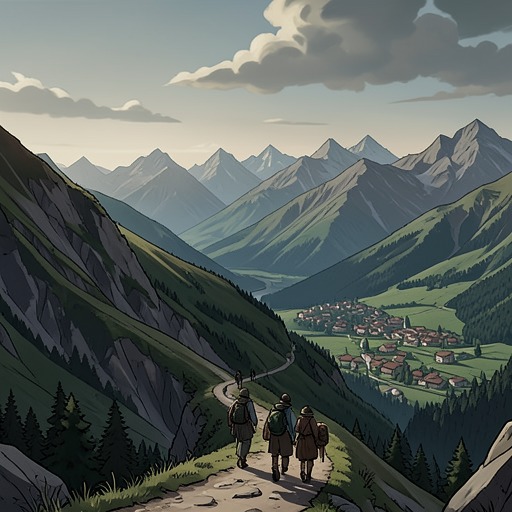
Dolomites
The Eight Mountains: A NovelThe Dolomites are the family’s mountain of origin: the place where Pietro’s parents first fell in love, where they married, and whose peaks remained charged with personal meaning after they moved to Milan. In the story, the range links childhood friendship and courtship to a family history that later generations inherit through remembered names and places.
A Landscape of Shared Memory
Pietro’s parents had migrated to Milan in their early thirties, leaving behind the Veneto countryside where his mother was born and his father had grown up as an orphan of the war. The Dolomites were their first mountains and, in Pietro’s account, their first love. Even when he was too young to follow their conversations, he sensed the force certain mountain names held for them: Catinaccio, Sassolungo, Tofane, and Marmolada. His father’s mention of one could make his mother’s eyes light up, turning place names into a private language of shared experience.
Their attachment to the mountains also took different forms. Pietro’s father treated an ascent as a contest, pressing ahead rather than stopping, while his mother preferred meadows, streams, and flowers and lingered at summits to look at distant peaks and remember earlier climbs. Their contrasting responses expressed, in Pietro’s interpretation, a common nostalgia. The Dolomites gave that nostalgia its earliest setting, even as the couple’s later mountain lives did not always mean the same thing to each of them.
Childhood Bonds in the Mountains
In the 1950s, Pietro’s father and his future maternal uncle, Piero, were close friends. Both were born in 1942 and were five years younger than Pietro’s mother. They had met as children at a campsite where the village priest took them, and spent a month each summer in the Dolomites. They slept in a tent, played in the woods, learned to live in the mountains, and learned to fend for themselves. Those repeated summers formed the basis of a friendship that became part of the family’s history before Pietro’s parents were married.
Piero excelled at school, while Pietro’s father was known for his stronger legs and character. Yet Pietro’s mother remembered a more complicated difference: his father could be fragile, imaginative, restless, and capable of making others share his enthusiasm. Living at boarding school, he became a regular presence in her family’s farmhouse. The mountains were therefore not simply a backdrop to his later marriage; they were already the setting of friendships and relationships that brought the families together.
Courtship and the Wedding
A priest had taken Pietro’s parents to the mountains when they were adolescents, and the same priest later married them at a small chapel at the foot of Tre Cime di Lavaredo. Their wedding, held on an October morning in 1972, became the family’s foundational story. The bride’s parents boycotted the ceremony for reasons Pietro says he never knew. A handful of friends attended; the couple wore anoraks rather than wedding clothes and spent their first night as husband and wife at the Auronzo refuge. Snow was already sparkling on the ledges of Cima Grande.
The wedding joined mountain life to the start of a different life elsewhere. The following day, the newlyweds packed their leather climbing boots and plus fours into the car, along with the pregnancy and the contract for the groom’s new job, and set off for Milan. Pietro describes the October Saturday as the end of that year’s climbing season and, for many years afterward, of this phase of their life. The departure did not erase the Dolomites from the family story: the names of its peaks remained a way for his parents to return to a shared past.
A Personal Range
For Pietro’s mother, the Dolomites also marked a limit she chose not to cross. She refused to climb glaciers, describing the mountain as ending for her at three thousand meters, the altitude of her own range. She preferred the lower country of meadows, rivers, and woods, and loved the villages at one thousand meters. Her preference gives the Dolomites a particular meaning within the family: they were not only the site of youthful climbs and a marriage, but also the measure of a mountain world in which she felt at home, distinct from the glacial heights her husband pursued.