Giovanni Guasti’s rock inscription
The Eight Mountains: A NovelGiovanni Guasti’s rock inscription turns the wall beside the house at Barma into a memorial to Pietro’s father and a lasting part of the home Pietro and Bruno built together. Cut into the rock, painted black, and read by Pietro’s mother on a September visit, it joins private mourning to the practical, shared work of making a refuge in the mountains. Its wording remembers Giovanni by name and dates, but its final line also gives the house a meaning beyond a marker of death: memory itself becomes a refuge.
Form and inscription
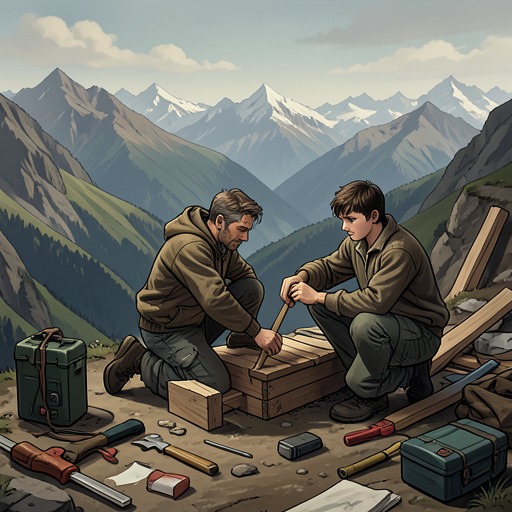
The inscription was made by Pietro with a mallet and chisel in the rock wall beside the house. He went over the cut letters with black paint. Its three lines identify the deceased as Giovanni Guasti, give his years as 1942–2004, and conclude with the statement:
GIOVANNI GUASTI 1942–2004 IN MEMORY IS THE MOST BEAUTIFUL REFUGE
The spare arrangement makes the name and dates a threshold to the final thought. Rather than recounting Giovanni’s life or listing his achievements, the epitaph offers a compact claim about what remains: memory can shelter the living. Its placement matters as much as its words. It is not set apart in a cemetery but carved into the rock beside a house made through sustained labor, among the lake, scree, and peaks of Grenon.
A memorial within a mountain landscape
The inscription is encountered at the end of a visit that gathers domestic and mountain life together. Pietro’s mother climbs from Grana mountain village in the leather hiking boots she has worn since his childhood, keeping a slow, steady pace for two hours. At the house, Bruno has lit the stove; the three sit indoors with tea, while the mother looks through the window and later steps onto the terrace to take in the lake, scree, peaks, and the appearance of the house. She studies the inscription at length. The memorial is therefore part of a landscape she is deliberately trying to remember, not an isolated object detached from its setting.
Pietro then asks his mother to witness his decision that the house should belong to both him and Bruno. He says that he believes Giovanni intended it to be shared, but also makes clear that he wants this arrangement himself because the two friends built the house together. The inscription and the declaration of shared ownership occur in the same gathering: remembrance of the dead is joined to an active promise between the living. The mother’s presence makes her a witness to that promise, while the carved name establishes the father whose wishes Pietro believes the house carries forward.
From inherited memory to chosen work
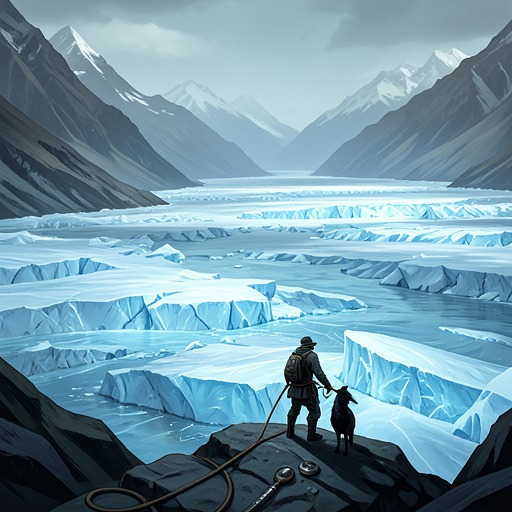
The epitaph’s phrase about memory gains force from Pietro’s belated understanding of Giovanni. After hearing his mother’s account, Pietro recalls that his father rarely retraced his steps or returned to unhappy times, yet glaciers could bring something back to him. Giovanni understood a glacier as snow preserved from winters long past: a memory that summer’s melting could not erase. Pietro now recognizes that the mountain-going father he had only partly known was distinct from the stranger with whom he had lived in the city. This second father, the lover of glaciers, had left him a ruin to rebuild; Pietro resolves to complete the work as a way of remembering him.
Other records of Giovanni’s mountain life help frame what the inscription does and does not preserve. In the old kitchen, Pietro finds his father’s mountain map still thumbtacked to the wall. Over twenty years, its colored routes have grown so dense that the valley-trail map has become almost illegible to anyone else, yet Pietro deciphers its marks as traces of Giovanni’s journeys with him and Bruno as well as alone. Later, on a summit, Pietro finds the Grenon summit logbook and recognizes Giovanni’s 1997 entry: he had climbed from Grana in three hours and fifty-eight minutes and noted that he was still in great shape. The map and logbook preserve routes, companions, dates, and a flash of his father’s humor. The rock inscription instead gives those dispersed traces a fixed place beside the house Pietro has chosen to rebuild.
Continuing the act of remembrance
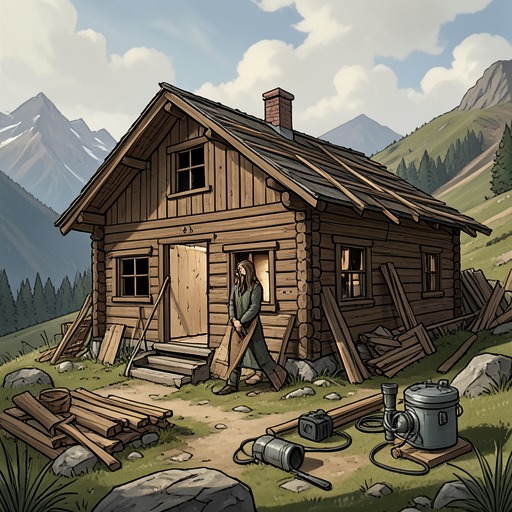
The memorial remains part of the house’s changing surroundings. On a later visit, Pietro repairs the building, and Bruno joins him on the roof; their old division of labor quickly returns, as one removes nails and the other fits and holds the replacement larch tiles. That morning Pietro has taken down prayer flags faded by sun and rain and torn by wind, burned them in the stove, and strung new ones between the rock face and a corner of the house. He has seen similar flags in Nepal and hangs these above the epitaph. From the roof, the flags move in the wind over Giovanni’s name, seeming to bless him.
The sequence makes commemoration a practice rather than a single completed gesture. The carved words remain, while the flags weather and are replaced; the house itself needs repairs, and its care draws Pietro and Bruno back into the quiet cooperation with which they built it. The inscription’s claim that memory is a refuge thus belongs both to mourning and to continuity. Giovanni is not restored to life, and the memorial does not resolve every absence; instead, his name remains present in a place the two friends maintain and share.