Lake at the foot of Grenon
The Eight Mountains: A NovelThe Lake at the foot of Grenon is a small, concealed basin whose sudden appearance on the climb makes it a defining place in the narrator’s history with Bruno. Its origin is geological: an ancient avalanche sealed the valley, creating a dam behind which snowmelt gathered before filtering through scree and re-emerging as the river below. The lake’s changing surfaces hold several strands of the story together: childhood discovery, a difficult return in spring, and the later work of making a home and memorial in the surrounding mountains.
Discovery and Formation
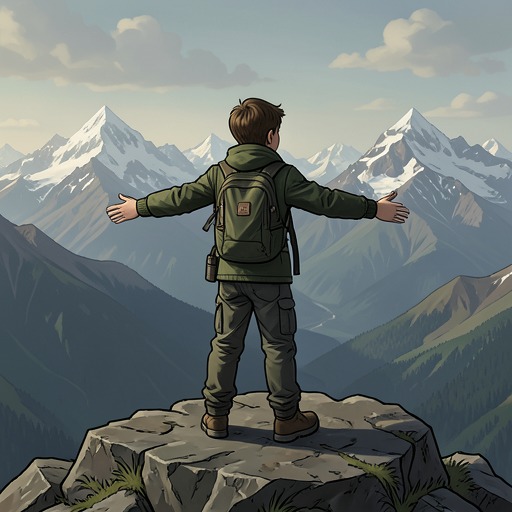
The lake first appears after Bruno and the narrator hear water moving beneath the scree. A cold wind stirs the fading plants, and the sound of water—deeper and more muffled than the sound of a surface stream—guides them uphill. Bruno lets the narrator go ahead, already knowing what they will find. The lake is hidden in a basin at the foot of Grenon, and its sudden opening beyond the ridge gives the discovery its force: the climbers have approached without seeing it, until the final step reveals a circular sheet of water roughly two or three hundred meters across, the largest either of them has seen in the mountains.
The setting changes visibly across the basin. On the sunlit side, scree gives way toward willows and rhododendrons; farther into shadow, woodland thickens. From this arrangement the narrator works out how the lake formed. An ancient avalanche, visible from the pastures below, blocked the valley like a dam. Meltwater from the surrounding snow accumulated behind it, then passed through the scree and surfaced downhill as the river familiar to the boys. The sequence makes the river’s origin part of the lake’s appeal: its water seems to begin in a hidden reservoir created by the mountain itself.
The lake’s name is less certain than its physical origin. When the narrator asks what it is called, Bruno says he does not know and answers with Grenon, noting that almost everything nearby carries that name. The exchange leaves the lake without a clear individual name; it belongs instead to a landscape in which the same mountain-region name recurs across places. The boys’ phrase, their lake, gives it a more intimate identity through shared experience rather than through a precise local label.
A Place Between Friends
The lake is a setting for a conversation the boys cannot easily have elsewhere. After their discovery, Bruno sits on the grass while the narrator remains standing. Neither looks directly at the other; a large rock projecting from the water gives them something else to fix their eyes on. Bruno then tells the narrator that his parents have spoken to Bruno’s uncle. The narrator says he did not know, though he is lying, and Bruno admits that he does not understand what is happening. The lake does not resolve their uncertainty, but its quiet, open setting makes room for the disclosure and the evasions around it.
The place is also bound to the boys’ wider childhood landscape. In Grana, they explore abandoned stables, haylofts, granaries, and other unused buildings, while keeping close to Bruno’s grazing cows. The village’s former population had reached one hundred, but in 1984 only fourteen people lived there. Above the woods, abandoned or partly abandoned settlements preserve the terraces, irrigation ditches, and cleared ground made by earlier mountain residents. The lake lies within this worked and increasingly neglected terrain: not a wilderness untouched by people, but a feature of a valley shaped by generations of habitation and labor.
That human presence is temporary. Bruno’s uncle predicts that the pastures, once wooded, may return to weeds, shrubs, and eventually forest, erasing ditches, dry-stone walls, paths, and houses. The lake’s basin itself presents a contrast of scree, vegetation, woods, and water, while the surrounding settlement bears the marks of departure and regrowth. The narrator’s first view of the lake is therefore also a view into a landscape whose human uses may disappear even as its natural processes continue.
The Spring Return
The lake is revisited in April, when its familiar form appears under very different conditions. Snow persists across the north-facing side of Grenon, tracing the mountain like a negative image: sunlit rock is dark, while snow remains in shadow. The lake still reveals itself suddenly, as it did in summer, but it is sealed beneath opaque white ice veined with fine blue cracks. The fractures have no regular geometry; in places, the force of the water has lifted slabs of ice, while the sunlit banks have begun to darken with the first signs of summer.
Seasonal change gathers around the basin without resolving into a single season. Scree, juniper, and rhododendron occupy one side; woods and snow mark the other. An avalanche track descends along Grenon and ends in the lake. Bruno heads toward it, and the pair climb the slope on a frozen crust that usually holds but sometimes collapses beneath them. When it gives way, they sink as deep as their thighs and struggle free step by step. After half an hour of this halting ascent, Bruno stops on a stone wall emerging from the snow to knock the snow from his boots. The return makes the lake a demanding physical place as well as a remembered one: its beauty is encountered through cold, unstable footing, and exhaustion.
Home, Landscape, and Remembrance
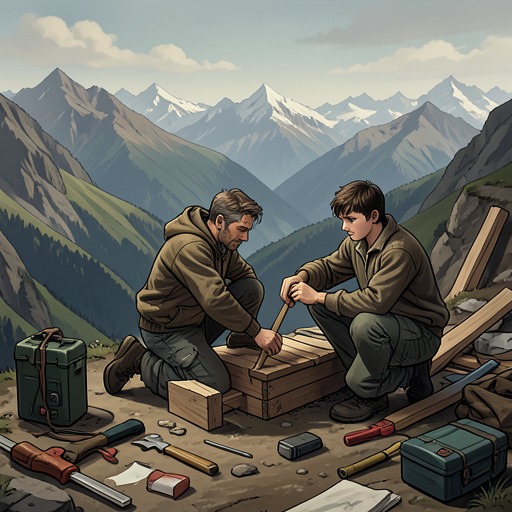
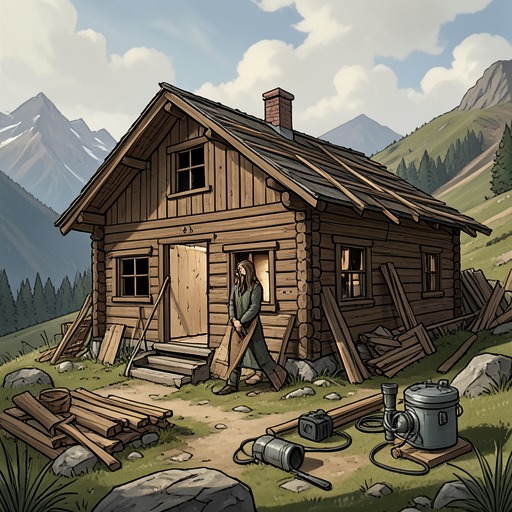
The lake later becomes part of the view from the house the narrator and Bruno build together. When the narrator’s mother visits, Bruno has lit the stove, and she looks out from the window before going onto the terrace. She studies the lake, scree, peaks of Grenon, and the appearance of the house, as if committing the whole scene to memory. The lake is thus not only a remote discovery reached on foot; it belongs to the prospect of a shared home and to a landscape the family wants to retain in memory.
The visit also brings remembrance of Giovanni Guasti into the setting. The narrator has carved Giovanni’s name and dates into the rock wall and painted the inscription black. After looking at it, the mother calls Bruno and the narrator to sing the song traditionally sung for a lover of the mountains who has died. The narrator then says that the house should belong to both him and Bruno, not to him alone. His decision connects the place to their joint labor and to the belief that Giovanni had left it between them. The lake and the surrounding mountains frame that act of inheritance without reducing the house to a private possession: the narrator makes it a home shared with his friend.
Across these appearances, the Lake at the foot of Grenon links hidden origins to visible traces. Its water records the force of an ancient avalanche; its frozen surface makes winter legible in spring; its shore provides a setting where childhood confidences and adult unease meet. Seen later from the house and alongside Giovanni’s memorial, it also becomes part of the landscape through which the living preserve relationships with the absent. Its significance lies in this recurrence: the lake remains physically changed by season, but each return gives the place another layer of shared memory.