Lara and Anita's Mother-Daughter Relationship
The Eight Mountains: A NovelLara and Anita’s mother-daughter relationship is formed in the demanding routines of mountain life and tested when the farm and Lara’s partnership with Bruno fail. Lara’s pregnancy unfolds alongside the seasonal work of tending cattle; after Anita’s birth, the girl grows up close to animals and the farm. When the adults’ shared life becomes unsustainable, Lara leaves with her daughter, carrying their relationship into a more ordinary and uncertain future.
Pregnancy and the arrival of Anita
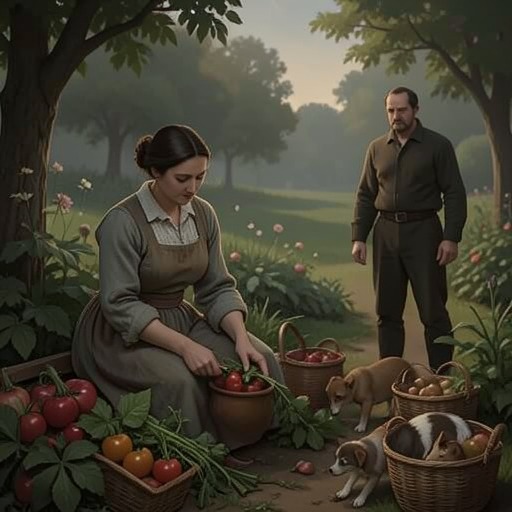
Lara was five months pregnant when Pietro’s mother learned of it during a visit to Grana. Pietro was away in Mustang, and his mother sent him updates through the summer. Lara continued working in the pasture and carrying cheese down the mountain twice a week by mule, even as the pregnancy made the work harder. Bruno suggested hiring someone to help, but Lara refused, reasoning that the cows were pregnant too and that watching them remain calm helped her relax. Her response sets the terms of her life at that time: care for the animals and the work of the farm were not separate from the family she was preparing to welcome.
Pietro’s mother took an active interest in Lara’s wellbeing. She visited on foot and accompanied her to the hospital each month, while also urging her to rest. In August, a scan established that the child would be a girl. The account places this routine of attention against the physical demands Lara continued to meet: she watched the herd from beneath a tree when movement became difficult, while the cows’ pregnancy provided her own comparison for the gradual approach of birth.
At the end of September, the cows descended to the valley in a formal procession, their coats brushed and their collars and bells prepared for the occasion. Bruno settled them into a rented winter stable, and Anita was born soon afterwards, in autumn. Pietro, then in Nepal, heard the news while travelling in lower Dolpo. He stayed awake thinking about Bruno, now a father. The birth thus reaches the narrator through distance and recollection, but it also marks a change in the relationship between Lara and Bruno: their household now includes a child whose life will be bound to the choices they make about work and home.
A child shaped by farm life
As Anita grew, Pietro’s mother became closely attached to her and regularly helped care for her in Grana. In summer she often kept the child with her, easing the strain on Lara and Bruno, who were both working excessively. Her letters to Pietro described Anita as wild and fearless. The care offered by this older woman became an important support around the mother-daughter bond, especially as the adults’ work left them with little room to reduce their burdens.
When Pietro later visited Lara, Anita was in her first year of school. Lara showed him a photograph of a blond, smiling child embracing a black dog much larger than herself. School required Anita to adapt to rules that did not come easily: at first she might fight, scream, or sit apart without speaking. Lara described this gradual adjustment with laughter, while also recalling the farm as the place where her daughter seemed most at ease. Anita liked visiting farms, let calves lick her hands, and felt comfortable around goats and horses. Lara hoped this affinity would last and that her daughter would not forget it. The contrast is telling: school asks Anita to learn a shared set of rules, while animals and farm visits offer a setting in which she appears naturally at home.
Work, separation, and the future
The family’s closeness was increasingly burdened by the farm’s economic difficulties. Lara and Bruno worked harder even as debt and the business’s prospects worsened. Pietro’s mother watched Anita during the summer partly to relieve them of childcare, but her reports also registered the deepening crisis between the parents: Lara was exasperated by the debts, while Bruno withdrew into silence and work. In autumn 2013, Bruno declared bankruptcy, shut down the agricultural business, and handed the farm keys to the bailiff. Lara went to live with her parents with Anita. Pietro’s mother understood the sequence differently, believing Lara had decided to leave first and Bruno had then given up; either way, the shared farm life had ended.
When Pietro met Lara in December, she was working in a restaurant at a small ski resort. Anita remained with her and was beginning school, while Lara described the child’s difficulty conforming to school routines and her ease around farm animals. The restaurant also represented Lara’s own return to a place where she had worked as a teenager, during winters when her friends went skiing. Her account linked the practical consequences of the breakup to the future she had chosen for herself and her daughter.
Lara believed there had been alternatives before the farm failed completely: the cows could have been sold, the farm rented out, and both parents could have found other work until circumstances improved. She had been willing to accept a more ordinary life temporarily. Bruno, she felt, could not imagine another way of living, and she concluded that neither she nor Anita mattered as much to him as the mountain he had chosen. By the time she recognized that difference, she had begun to picture a future with her daughter and without him. The relationship between mother and daughter is therefore not presented as separate from their surroundings: it is carried through labor, shared affection for farm life, practical support from Pietro’s mother, and Lara’s decision to leave a failing partnership while keeping Anita with her.