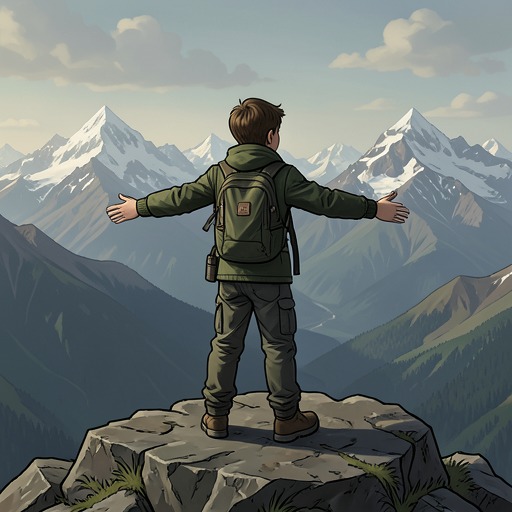
Pietro Returns to Grana and Discovers the Barma Inheritance
The Eight Mountains: A NovelPietro’s return to Grana after his father’s death uncovers an inheritance that is also a concealed history: Giovanni Guasti had privately bought a ruined mountain property, chosen it as the site of a house, and arranged for Bruno to build it. The discovery gives Pietro a new way to understand his father, whose life in the mountains had remained largely separate from the strained relationship they had in Milan. It also sets Pietro and Bruno on the path to rebuilding the ruin together.
The Inheritance and the Return
In the calm after the funeral, Pietro and his mother find that Giovanni had prepared for his death with practical care. A paper in his desk lists his bank accounts and instructions for inheritance. It leaves his half of the Milan apartment to Pietro’s mother and names Pietro as the recipient of the property in Grana, without a farewell or explanation. The bare legal wording makes the mountain property more mysterious, not less: Pietro’s mother knows only that Giovanni had recently bought inexpensive land up there, without asking her or inviting her to see it.
Among Giovanni’s papers, Pietro finds the purchase contract and land registry document. They establish that the inheritance is an agricultural building measuring four by seven metres, set within an irregular plot. The official map shows the property but not the altitude or paths, and gives no sense of whether woods or fields surround it. When Pietro’s mother says Bruno will know where it is, she identifies the human connection that the documents cannot supply.
Pietro is uncertain whether returning will restore his childhood attachment to Grana or make the place seem diminished. Curiosity about the property wins out, and at the end of April he drives there alone in his father’s car. From the road, he sees changes that make the valley seem damaged by development and decline: widened roads, protective netting on slopes, felled trunks, Tyrolean-style villas, and gravel extraction that has confined the river between cement banks. Closed hotels, dark second homes, and idle construction machinery contribute to his bleak impression. Snow still covers the mountains above the valley, however, and their unexpected brightness consoles him. The ascent makes him feel the difference between the advanced spring of Milan and the colder season that persists at altitude.
The Map and the Father’s Hidden Life
Inside the old house, familiar objects carry the trace of both parents. His father’s mountain concoctions remain there, while his mother’s taste is visible in the kitchen’s copper pans, wooden spoons, and arrangements. A photograph of Pietro and Bruno, seated back to back on a larch stump with their arms folded, makes them look like brothers. Against this domestic background, Pietro notices that the map thumbtacked to the wall has changed from the valley-trail map he remembers.
Over twenty years, Giovanni has marked almost every summit, alpine pasture, and refuge. The dense web of routes resembles a biography written in coloured lines: black, red, and green, sometimes in combination. Pietro works out the code by recalling a glacier excursion when he, his father, and Bruno were together. The red and green lines stop where the black route continues, indicating that Giovanni completed the remaining climb alone. He identifies black with his father, red with himself, and green with Bruno. The many routes marked in black and green reveal that Giovanni and Bruno had walked together repeatedly, perhaps more often than Giovanni had walked with Pietro. Pietro feels jealousy, but also relief that his father had not spent all those years in the mountains alone. The map offers no explanation in words, yet its routes make a previously hidden relationship legible.
The Ruin and Bruno’s Account
Bruno comes to collect Pietro early the next morning. He is now a man Pietro no longer knows well, though Pietro recognizes the boy he remembers within him. They travel to the property, and Bruno identifies the snow-covered site as Pietro’s place. The ruin matches the land registry’s dimensions: three remaining dry-stone walls stand on a wooded terrace below a pale rock face, which forms the fourth wall. The roof has disappeared, and a small Swiss pine has grown up among the stones. The inheritance is not a finished house but a rock face, snow, shaped stones, and a young tree.
Bruno explains that he had been accompanying Giovanni on searches for a suitable site. Nearly three years earlier, Giovanni had seen this place and immediately decided it was the one. Bruno then tracked down the owners and persuaded them to sell, a difficult task in a community where owners tended to keep even ruins rather than sell them to someone who might put them to use. Pietro thus learns that his father’s purchase was not a passing acquisition: it was the result of a considered search shared with Bruno.
Sitting at the site, Pietro reflects on the contradiction between the father who had fled from houses throughout his life and the man who had wanted to build one in the mountains. Giovanni had not completed the project, but he had left the property to Pietro. Bruno then reveals that Giovanni designed the house as he wanted it and made Bruno promise to build it. He had asked him at that very spot. The map and the ruin now converge: the father’s mountain life included both routes with Bruno and a plan that would join their work to Pietro’s inheritance. Pietro initially resists the responsibility because his finances are already depleted and little remains for construction.
From Inheritance to Remembrance
The meaning of the return develops beyond the initial discovery. Pietro later understands his father as two distinct figures: the distant man with whom he had lived in the city, and the mountain walker who followed him on paths and loved glaciers. His father’s account of glaciers as the snow and memory of winters long past becomes intelligible to him as a way of describing what persists when ordinary recollection fades. The ruin becomes a work through which Pietro can remember the father he had only partly known.
Other records strengthen that understanding. On a later ascent, Pietro finds Giovanni’s entry in the Grenon summit logbook, dated 1997: the climb from Grana had taken three hours and fifty-eight minutes, and Giovanni had noted that he was still in good shape. The brief entry gives a public, physical trace of the same mountain life suggested by the map, while its casual pride makes the absent man momentarily specific. Pietro does not remove the page; the record belongs where it is, at the summit.
Pietro and Bruno eventually build the house. When Pietro’s mother visits, she sees their finished work and studies the lake, scree, peaks, and house as if committing the place to memory. Pietro has carved Giovanni’s name and dates into the rock and added the words that memory is the most beautiful refuge. He then tells Bruno that the house should belong to both of them, because they built it together and because Pietro believes his father intended it to be shared. The return therefore ends not with possession alone, but with a decision that turns Giovanni’s private inheritance into a home and a continuing bond between the two men.