Pietro's Relationship with His Mother
The Eight Mountains: A NovelPietro’s relationship with his mother is a lasting thread of practical care, gentle persistence, and belated understanding. She repeatedly acts where he hesitates or withdraws: encouraging him to approach Bruno, working to secure Bruno’s education, and keeping communication alive when Pietro leaves home. Their intimacy changes over time. As a child, he speaks little and inhabits a world she cannot easily enter; as an adult, he writes to her, confides his plans, and eventually discovers how differently each of them remembers their life together.
Care as Work and as Temperament
His mother’s care is evident both in her profession and in the way she responds to the people around her. A nurse in Veneto before moving to Milan, she took a newly created health-worker position in the city’s working-class western outskirts. At a new family clinic, she supported women during pregnancy and followed newborn children through their first year. Her work also required visits to assess children’s living conditions. In serious cases she had to refer them to juvenile court, a decision that brought anguish and sometimes insults and threats. She nevertheless trusted her judgment, supported by a wider solidarity among social workers, educators, and teachers who shared responsibility for the children.
That attention to other people was not confined to her employment. In the Grana mountain village, she sought out Bruno’s mother, a woman who kept to herself in her allotment. Pietro’s father had wondered whether Bruno’s mother spoke at all; Pietro’s mother rejected that assumption and made the effort to sit with her. Her approach to care was active: she did not wait for others to ask for help, and she was willing to cross the distance between households.
The same impulse shaped her response to Pietro’s isolation. When she saw him and Bruno maintaining a wary distance on opposite banks of the river, she asked Pietro why he did not try to make friends. He said he did not know what to say and later insisted that making friends did not matter because he liked being alone. Rather than accepting that explanation as final, she questioned whether he was sure and decided to help. A few days later, Bruno was at the family’s table for breakfast. Her intervention brought the boys together before either had found a way to bridge the distance himself.
Guiding Without Replacing His Choices
Her intervention in Bruno’s life also affected Pietro, who witnessed the persistence behind it. She believed his friend’s education mattered, but understood that she could not secure it alone. After judging that Bruno’s mother would not help, she built an alliance with his aunt, repeatedly visiting until the aunt agreed to send Bruno to school in winter and to have him do homework at their home in summer.
Bruno then came to their kitchen three times a week, washed and dressed for lessons. Pietro’s mother had him read aloud from the books available there and let him keep them to practise in the pastures. Bruno enjoyed novels, but grammar and spelling were difficult. Pietro felt embarrassed on his behalf and resented the demands his mother placed on him; Bruno, however, did not complain. Pietro understood that Bruno knew how much the effort mattered to her. This episode shows a strain within her care: she could be determined enough to press a course of action that Pietro himself regarded as unfair, yet her persistence also offered Bruno sustained attention and a chance to learn.
Her care for Pietro was less a matter of directing his future than of remaining available to him. When he moved away, their connection took the form of letters. Because he rarely spoke much on the telephone, she began writing; she soon found that he would answer. He told her about enrolling in film school in Turin and about his interest in documentary filmmaking, which grew from what he understood as a vocation for observing and listening. Her reassurance—that these were abilities he had shown for a long time—affirmed a path unlike the mathematical future his father had imagined for him. For years she sent him money, while he sent her portraits of people and places and short films he was proud of, even though nobody else saw them.
Distance, Letters, and Unequal Memories
The letters offered a form of closeness that suited Pietro’s reserve. He could tell his mother what was happening in his life and describe the pleasure he took in the life forming around him, while avoiding her questions about relationships with girlfriends, which tended to end when they became serious. Their correspondence was neither full disclosure nor estrangement: it let him decide what to reveal, while giving her a continuing place in his life.
She also used the letters to tell him about his father. She described his increasing workload during the factory’s financial crisis, his long drives between plants, and his anxiety and exhaustion. She conveyed what she saw in him more fully than she spoke about herself. In this way, Pietro’s mother remained a source of family knowledge during the years when the distance between father and son persisted. Her accounts did not erase their conflict, but they let Pietro hear about his father from someone who lived alongside him.
After Pietro’s father died, the old house in the mountains became a setting for a different kind of closeness. His mother arrived with a friend, and Pietro noticed the ease and silent understanding between the two women. Their companionship made a striking contrast with his father’s loneliness, and led Pietro to consider whether the ability to cultivate relationships could be learned. Now, when he came down from the mountain, there were two women to care for him: meals were laid out and clean sheets waited, replacing the beans and sleeping bag of his solitary routine.
The two generations did not remember their earlier evenings in the same way. Pietro told his mother that talking together now felt like returning to old times. She recalled those earlier years differently: he had hardly spoken, she said in effect, and had seemed enclosed in a private world from which she received little communication. Her present happiness at their conversations came partly from the chance to make up ground between them. Their renewed intimacy therefore depends not on a shared, seamless memory but on acknowledging that his inward childhood had felt different from her side of the relationship.
Memory, Inheritance, and Reconciliation
His mother helps Pietro interpret the traces left by his father. Returning to the old kitchen, he sees the mountain map his father had marked over two decades. Its overlapping black, red, and green routes turn it from a practical trail map into something like a biography. Pietro works out that black records his father’s routes, red accompanies Pietro’s climbs, and green marks Bruno’s; the map reveals that his father had continued walking in the mountains with Bruno. His mother had told him that the two men went walking together, giving context to the pattern Pietro discovers for himself.
She also supplies an account that changes how Pietro understands his father. After hearing her finish it, he thinks again about his father’s way of speaking about glaciers: summer erases memories as it melts snow, while a glacier preserves the snow of winters past. Pietro recognizes two versions of his father—the distant man of his city childhood and the mountain walker he had only partly known. His mother’s stories make that second figure legible without pretending that the estrangement between father and son never happened. Pietro decides to rebuild the ruin his father left, making the work itself a way to remember him.
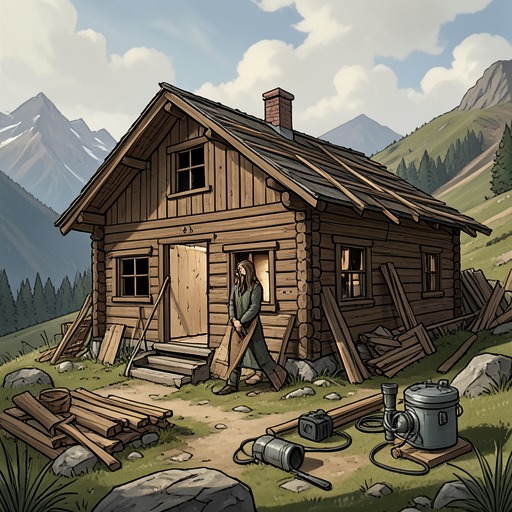
When the house is complete, Pietro brings his mother up to see it. She climbs in the leather boots she has worn since his childhood, keeping a slow, steady pace for two hours. Inside, she enjoys the window and tea by the stove; outside, she studies the lake, scree, peaks, and house as if committing them to memory. She pauses at the inscription Pietro has cut into the rock wall in his father’s name, ending with the words “IN MEMORY IS THE MOST BEAUTIFUL REFUGE.” Her presence makes her a witness to the act of remembrance and to the place her son and Bruno have built from their shared labor.
Pietro then tells his mother that the house should belong not only to him but also to Bruno, because the two friends built it together. He believes this is what his father wanted, but stresses that he wants it himself as well. The declaration joins inherited feeling to a choice made in the present: his mother hears him give the friendship and the house a place in the family’s future. Across the relationship, she has repeatedly helped him connect with people and histories he might otherwise have left at a distance. Their bond does not remove his reserve or rewrite the past; it makes conversation, memory, and care possible across those limits.