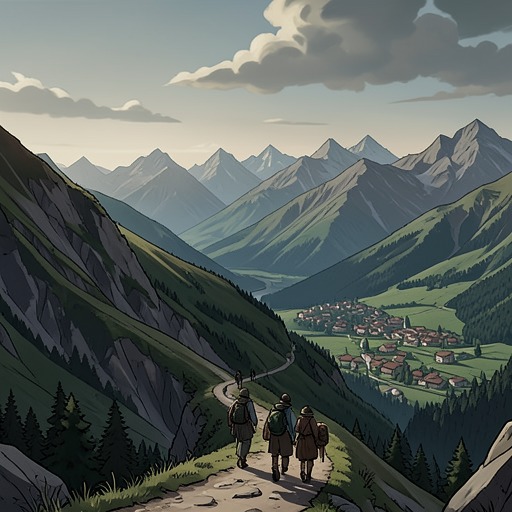
The Grenon Avalanche Breaks Through the Frozen Lake
The Eight Mountains: A NovelThe Grenon avalanche transforms a quiet winter night into a scene of violent destruction: snow plunges down the mountain’s main gorge, tears through the frozen lake, and exposes its wintering trout. Pietro and Bruno are close enough to hear and feel the event but escape its path. In the morning, the damage becomes visible—and, against the bright, busy ski day nearby, makes their isolation and their unresolved conflict newly stark.
Background and the Night of the Avalanche
Before the avalanche, Pietro listens as Bruno explains what he has learned about his life. Bruno says that he knows how to live in the mountains and can cope there alone, though it took him until he was forty to recognize the value of that ability. Pietro is drawn to Bruno’s integrity and purity, and, in the warmth of their small house, nearly accepts his account of solitary mountain life. That reflective mood is broken by a rumble unlike the usual thudding of snow on the roof. It begins like an airplane or distant thunder, then grows deafening enough to shake the glasses on the table.
A crash follows, as though something has collided and exploded. Pietro and Bruno look at each other; neither is prepared, and both are terrified. As the noise subsides, they realize that the avalanche has passed nearby rather than over the house. A weaker fall follows, then silence. They go outside to inspect the scene, but it is already night, moonless and too dark to reveal what has happened. Back inside, neither feels like talking. About an hour later, Pietro hears Bruno get up, put wood in the stove, and pour himself a drink. The disruption has ended, but the night leaves them with no view of its consequences.
The Gorge, the Lake, and the Trout
In the morning, after prolonged snowfall, the light reveals the scale and route of the slide. The avalanche began three or four hundred meters above the basin, at the steepest point of the main gorge of Grenon—the same gorge Bruno had skied down only hours earlier. As the snow plunged, it dug into the ground, stripped away the rock beneath it, and carried earth and gravel downhill. The emptied gorge now looks like a dark wound. After a fall of five hundred meters, the avalanche struck the basin with enough force to break through the lake’s frozen surface.
The lake’s former expanse is replaced by dirty snow and blocks of ice piled like a serac. The surface ice had been half a meter thick; beneath the shattered slabs, the water is already beginning to freeze again, forming a thin, dark, transparent layer. The destruction has reached into the lake’s winter life: small silver trout, dormant in the dark water, have been flung onto the snow. Crows circle and land among the ice, feeding on the fish. Pietro finds their squabbling over a trout intolerable, drives them off with a few steps and a kick, and leaves a pink mush on the snow. Bruno names the scene “Sky burial,” a brief phrase that gives the exposed fish a stark ritual shape without diminishing the violence of what has happened.
The Ski Day Beyond the Ridge
The physical damage is not the only revelation of the morning. A helicopter approaches under a cloudless sky as the first warmth of the sun loosens snow from Grenon’s overhangs; small avalanches drop from the gutters while the mountain seems to free itself from the prolonged snowfall. The helicopter passes overhead without noticing Pietro and Bruno. Pietro then recognizes how close they are to the ski slopes on Monte Rosa: it is December 27, with sunshine and fresh snow, an ideal day for skiing.
From the imagined aerial view, the contrast sharpens. Cars line the roads, car parks overflow, and ski establishments operate at full capacity, while just over a nearby ridge, on the shadowed side, two men stand beside an avalanche amid dead fish. The same snowfall that offers fresh conditions to visitors has buried and transformed the basin. The helicopter’s passage links these adjoining but separate worlds without bringing the men into view; the mountain refuge remains outside the day’s apparent celebration of winter.
Aftermath and Narrative Significance
After seeing the devastation, Pietro says, “I’m going,” for the second time in only a few weeks. He acknowledges that he has tried twice to rescue Bruno and failed twice. The avalanche does not cause the underlying disagreement between them, but it interrupts their conversation about Bruno’s chosen solitude with a reminder that the mountain can exceed both men’s expectations. Their shared fear during the night also unsettles the image of Bruno as someone who can simply cope alone: in the face of the rumbling, he is no more prepared or less terrified than Pietro.
Bruno agrees that leaving seems right. Pietro asks him to come down with him, leaving the immediate outcome of that invitation unresolved. The event thus ends not in a completed rescue but at the threshold of another attempt. Its central reversal is from apparent safety and intimate conversation to a landscape violently remade, then to a decision to leave that the two men have not yet carried out. The broken lake, exposed trout, and passing helicopter place Bruno’s isolated mountain life beside forces and forms of life beyond his control, while Pietro’s departure remains bound to the question of whether Bruno will follow.