
Home, Exile, and the One-Way Crossing
The EmigrantsThis flow traces how departure transforms Sweden from home into memory and turns the ocean crossing into a nearly irreversible separation.
increasing Bearing strength in each event
 decreasing
Bearing strength in each eventdecreasingLeaving as a Funeral

Leaving as a Funeral
A family divided
Nils and Märta remain on the porch as Karl Oskar Nilsson and Robert Nilsson leave. Their stillness makes the farewell resemble a funeral procession.
Loss before departure
The sons do not promise to return. Separation begins while both generations are alive, making emigration a grief as well as a search for opportunity.
Sweden Recedes
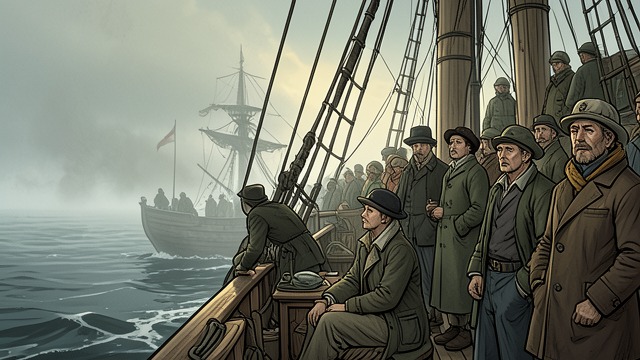
Sweden Recedes
The last shore
Passengers watch the coast disappear into mist. Some speak bitterly about poverty and authority; others remember the happiness and family they have left.
Ambivalence in motion
Their rejection of home does not erase attachment to it. The departing travelers carry Sweden as a relative they may never see again.
A Home Without Land
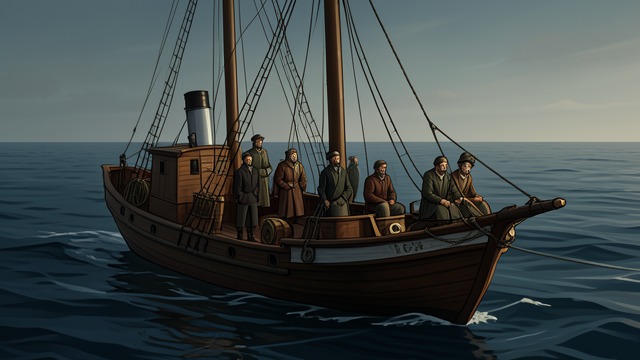
A Home Without Land
Between old and new
The emigrants have left their farms but have not reached new homes. The ship becomes their only refuge in a landscape that offers no stable ground.
Identity unsettled
They still call Sweden home even though they have no home there to return to. Their belonging becomes suspended between memory and expectation.
The Returning Swedish Ship
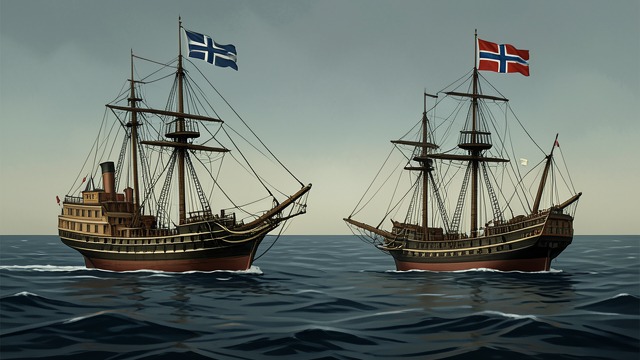
The Returning Swedish Ship
A glimpse of homeward travel
The Charlotta passes a vessel flying a Swedish flag and traveling in the opposite direction. The emigrants realize how far they feel from the land they left.
The separation made visible
The other ship is going home; theirs continues away. The encounter turns the idea of departure into a visible, directional divide.
No Return in Mind
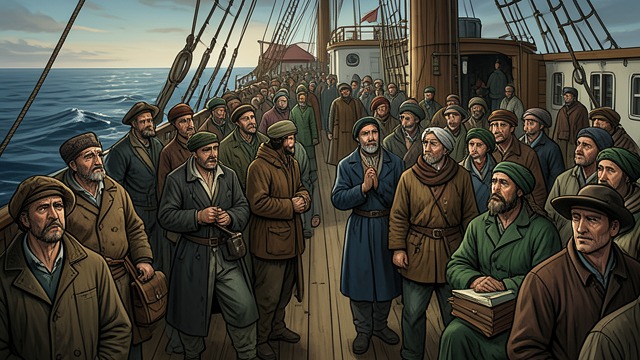
No Return in Mind
Distance becomes final
The long crossing convinces passengers that they cannot easily travel back. Their move feels like an undertaking for the rest of their lives.
Home carried forward
The old country remains emotionally present even as the emigrants accept the one-way nature of their journey. Memory becomes part of what they bring ashore.
The morning the sons depart from Korpamoen
April 1850, as the Charlotta leaves Karlshamn
After the English coast disappears
A few weeks into the Atlantic crossing
After two months at sea, approaching the final weeks
