Åke Svensson
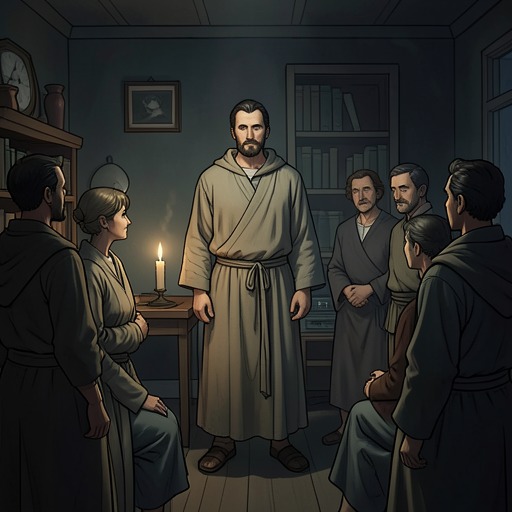
The EmigrantsÅke Svensson, remembered as the founder of the Åkian sect, is a dead man whose teachings outlive both his confinement and the apparent extinction of his community. His story establishes the perilous conflict between dissenting faith and church and civil authority; decades after his death, his nephew Danjel Andreasson believes Åke has summoned him to resume the work.## Identity and TeachingsÅke Svensson was from Östergöhl in Elmeboda Parish. Around 1780, the religious movement associated with him began in the neighboring parish and spread into Ljuder. Its adherents, called Åkians after their founder, sought to imitate the early Christian church and return to the apostles’ way of life. They separated from the state church and recognized neither temporal nor spiritual powers within their community. They considered distinctions of caste and property contrary to God’s word, and practiced communal ownership: no member claimed any object as his or her own. They also held their own services and Communion.The group’s rejection of institutional authority stood in sharp contrast to the religious order enforced in the parishes. Church law and the royal Resolution and Order of January 12, 1726, sought to sustain Lutheran doctrine and Christian unity; the Åkians instead claimed the right to organize worship and property according to their reading of apostolic practice. Around forty people in Elmeboda and Ljuder joined the sect, many of them members of Åke’s extended family. In Ljuder, the community was based at Kärragärde, owned by Åke’s brother-in-law, Andreas Månsson.## Suppression and DeathThe church first summoned the dissenters for questioning and issued strong warnings. They remained firm in their beliefs and did not recant when the church pronounced its ban. The case then moved into the civil courts: the group was brought before Konga County Court in Ingelstad and admonished to obey the law and the established church. Åke and his followers refused to return to its fold. The conflict was thus treated not simply as a disagreement over belief but as a threat to religious and civil order.The Göta Crown Court reviewed the case on grounds of church peace and civil security. It deemed the sect members to have lost their sound minds and ordered that, for the sake of peace and the dissenters’ welfare, they be confined in an asylum. In 1786, Åke and seven other leaders were handed over to the sheriff and transported to Danvik asylum in Stockholm. Åke, Andreas Månsson, and two others died within two years. Åke was thirty-five at the time of his death; the official rationale of care therefore ends in a consequence that deepens the region’s fear of the sect. The narrative records the court’s judgment and the deaths, without resolving the dispute over how Åke died.## Memory and RevivalAfter the leaders’ removal, the other dissenters were gradually released and returned to their homes, described as cured. They lived there quietly, and for years it seemed that the movement had been extinguished. Yet its reputation remained. More than fifty years after Åke’s death, hostility toward him was still strong enough that his relatives did not boast of their connection to him. Nils and Märta, for example, raise the matter with their son Karl Oskar when they learn that his wife Kristina is related to Åke: her mother was Åke’s niece, and her uncle Danjel owns Kärragärde. Karl Oskar says he knows of the connection and refuses to let it be held against her.The apparent end of Åkianism proves temporary. In the 1840s, rumors spread that Åke’s heresy had been revived in Kärragärde by Danjel, his sister’s son. In a nocturnal vision, Danjel sees Jesus Christ with a lantern and hears Åke identify himself as his maternal uncle, dead young after being taken to Danvik. Åke tells him that the Saviour has awakened him to continue his work on earth. The vision gives a personal and spiritual form to the historical inheritance: the teachings that had seemed buried with their founder return as a summons to his relative.## Narrative Role and SignificanceÅke is defined in the story both by the historical record of institutional punishment and by the later community’s religious memory. In the account of his confinement, courts and church authorities classify the sect’s resistance as madness and prescribe institutional control; among the people of Kärragärde, his teachings become a model for renewed religious life. Danjel’s response is not merely to repeat the name of a dead relative. He resumes Åke’s teachings through household Bible talks, prayer, independent Communion, and the sharing of possessions with poorer neighbors.The contrast between the two accounts gives Åke’s legacy its significance. The order that once appeared to have silenced the sect cannot prevent its ideas from returning, though revival does not erase the consequences of the earlier persecution. Åke’s brief appearance in Danjel’s vision connects the eighteenth-century suppression to the novel’s later conflicts over religious authority, communal property, and the right to practice faith outside the established church.