Åkians
The EmigrantsThe Åkians are a dissenting religious community whose effort to model the apostolic church placed shared property, independent worship, and allegiance to God above the authority of established institutions. Suppressed once in the late eighteenth century, the movement returned in Ljuder under Danjel Andreasson; its history links religious conviction to household life, legal persecution, and the painful testing of belief during emigration.
Origins and Communal Principles
The movement began in the neighboring parish of Elmeboda around 1780 and spread to Ljuder. Its adherents took their name from its founder, Åke Svensson of Östergöhl, Elmeboda. Seeking to imitate the early Christian church and return to apostolic practice, they separated from the state church and recognized neither temporal nor spiritual authority within their community. They regarded distinctions of caste and ownership as contrary to God’s word: no member claimed an object as exclusively his or her own, and the group lived communally, holding its own services and Holy Communion.
By the time authorities acted, about forty people in Elmeboda and Ljuder Parishes had joined. Many belonged to Åke Svensson’s widely dispersed family. Kärragärde, owned by Åke’s brother-in-law Andreas Månsson, served as the movement’s home in Ljuder. Its doctrine of common possessions was thus not merely an abstract challenge to property distinctions; it shaped a community gathered around a particular household.
The dissenters lived in a parish ordered by a different religious settlement. People were raised in evangelical Lutheranism under the church law of 1686, while a royal Resolution and Order of January 12, 1726, sought to preserve parish order and unity in teaching by guarding against ideas deemed dangerous or heretical. Against this system, the Åkians’ refusal of church authority and their separate sacramental life made their beliefs a public institutional challenge.
Suppression and Return
The bishopric of Växiö summoned the Åkians for questioning and issued strong warnings. They did not recant, and the church pronounced its ban. Civil proceedings followed: at Konga County Court in Ingelstad, the dissenters were admonished to obey the law and the established church’s regulations, but Åke Svensson and his followers remained unwilling to return to its fold.
The Göta Crown Court recast their dissent as insanity and ordered confinement in the name of church peace, civil security, and the dissenters’ welfare. Eight members, including Åke Svensson, were handed to the sheriff and taken to Danvik asylum in Stockholm in 1786. Åke, Andreas Månsson, and two others died within two years; Åke was thirty-five. The remaining dissenters were gradually released and returned to their homes, where they lived quietly. For a time, it appeared that the movement had been extinguished, but it reappeared in Ljuder in the 1840s.
The novel’s account places the repression within a conflict over who could define sound belief. The court’s judgment treated the Åkians’ convictions as a loss of reason, while their refusal to recant presented their separation as a matter of religious fidelity. The outcome was not simply a doctrinal defeat: confinement removed the movement’s leaders, while the return of former inmates to parish life helped make its apparent disappearance seem complete.
Danjel’s Community at Kärragärde
More than fifty years after Åke’s death, rumors spread that his heresy had been revived at Kärragärde by his sister’s son, Danjel Andreasson. At forty-four, Danjel was described as good-natured and previously quiet and blameless; his home, once associated with Åkianism, had long been declared cleansed. His revival of the teaching therefore reopened an older local history rather than introducing an entirely new dispute.
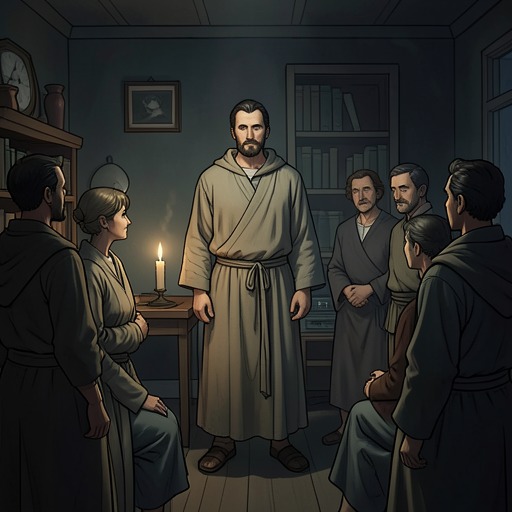
Danjel made religious practice part of the household’s ordinary routine. Every Sunday he gave Bible talks to his wife, children, and servants, welcoming a neighbor who happened to call. He attended church at Communion, prayed while working in the fields or barn, and knelt even in the course of his labor. At times he prayed aloud, prompting nearby people to come to see whether he needed help. The movement’s faith was expressed not only in opposition to church authority but through repeated acts woven into work, family life, and hospitality.
A small congregation formed around him. Paupers living at Kärragärde and some neighbors embraced the teaching and regarded Danjel as a new apostle. His wife, Inga-Lena, was troubled by the return of Åke Svensson’s principles: a community in which the Holy Ghost, rather than the King, reigned and earthly possessions belonged to all. The earlier leader’s death in confinement remained a warning within the household’s own understanding of what such a revival might cost.
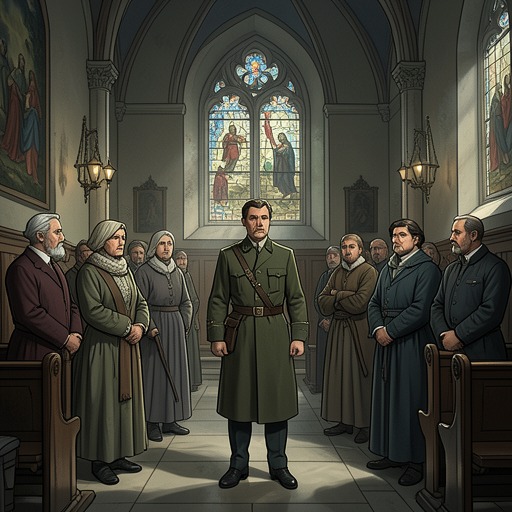
The authorities learned that people were gathering at Danjel’s home under the appearance of devotion. After earlier efforts to correct him through warnings and gentle admonitions, Dean Brusander interpreted the continuing meetings as evidence that his patience had allowed the dissent to spread. He had excluded Danjel from the Lord’s altar; reports that the household now held Communion among themselves marked a further breach with the established church.
Communion, Punishment, and Belief Under Strain
One February, churchwarden Per Persson reported that Danjel was gathering his household and neighbors behind locked doors for night meetings and administering the Lord’s Supper. For the participants, the gathering was not a repudiation of Christ. They had come together in the belief that Christ had suffered for their sins and that faith had made them redeemed, cleansed, and reborn. At Danjel’s table, the shared bread and wine enacted their conviction that a transformed life could be lived within the community, even as the church treated their unauthorized sacrament as a violation of its authority.
The legal consequences were concrete. At the spring court of 1849, Danjel was fined two hundred daler in silver for violating the sacrament law and the ordinance against unlawful meetings. Each person who had received Communion in his house was fined one hundred daler. Most could not pay; their fines were converted to prison terms, and each served twenty-eight days on bread and water. The household practice that had gathered adherents thus exposed the poor among them to punishment they could not meet with money.
The movement’s claims were tested again after its adherents joined the voyage to America. During a storm, Inga-Lena admitted that she had wondered whether followers of Åke Svensson’s teachings would be spared seasickness. Watching the waves and feeling ill, she could no longer rely on that promise. Danjel answered that God could save her if He wished, then turned to scripture: he read the ninety-third Psalm’s assurance that the Lord is mightier than the waters and, for fellow passengers, the Gospel account of Christ calming the storm. These readings offered comfort, but the question raised by bodily experience remained unresolved by assertion alone.
Inga-Lena later told Kristina that Danjel had confessed to spiritual vanity: he had believed himself permanently forgiven, beyond sin and above the law. Seasickness had brought him down among the sick and the unredeemed, and he had changed. The confession gives the voyage a consequence beyond physical hardship: it unsettles the certainty with which he had understood his own righteousness.
Even as the Åkians crossed the sea, their faith shaped how they imagined arrival. Elin studied English with Robert, although she believed that the Holy Ghost would enable her and the others to speak the new language upon reaching America. Learning beforehand seemed a way to lessen the work required of that divine help, not a denial of it. The belief carried the movement’s expectation of spiritual intervention into a practical act of preparation.
The Åkians’ history therefore moves between communal conviction and the pressures brought against it: separate worship becomes a legal case, apostolic sharing becomes a challenge to property and authority, and confidence in divine protection meets illness and doubt at sea. The movement is neither reduced to the institutions that condemn it nor presented as untouched by experience. Its adherents’ beliefs organize how they gather, pray, share Communion, and imagine the future; the punishments and the voyage, in turn, reveal the cost and vulnerability of living by those beliefs.