America as an imagined Promised Land
The EmigrantsAmerica as an imagined Promised Land is the disputed promise at the heart of the emigrants’ departure: a country imagined as a place of work, land, freedom, and a better life, yet also feared as unknown and condemned as spiritually chaotic. The contrast is not simply between Sweden and America. It is between sharply different claims about what makes a life possible—and between visions that the journey’s material hardships both challenge and sustain.
A destination shaped by different pressures
The emigrants from Ljuder Parish do not share one motive for leaving. Crop failure, persecution by civil authorities, religious dissent, personal troubles, social ostracism, and unfair employment practices supply distinct pressures. America gathers these varied hopes into a common destination, but the group’s reasons make clear that no single ideal explains the migration.
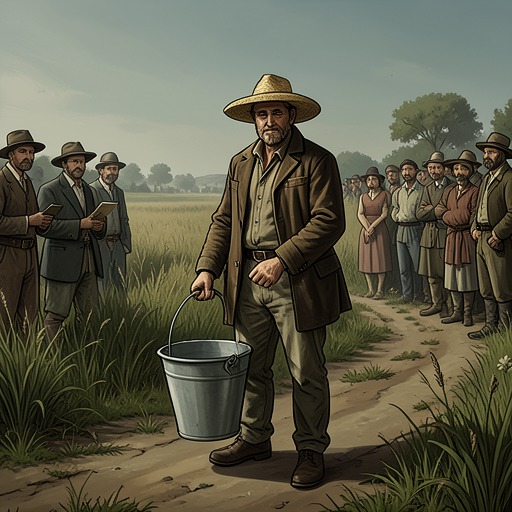
For Karl Oskar Nilsson, the attraction is practical. After four years at Korpamoen, he and Kristina are several hundred riksdaler poorer, despite having spent their strength working the farm. He fears that remaining will leave them worn out, with nothing to show for years of labor but eventual dependence on the reserved room and meager provisions owed to his parents. His stated purpose is to find a land where work can support himself and his family. America’s promise is therefore tied to effort and independence, not to wealth arriving without labor.
That hope takes shape against the terms on which Karl Oskar acquired Korpamoen. The purchase price of 1,700 riksdaler included an 800-riksdaler mortgage; his parents, Nils and Märta, retained lifelong rights to a room, fodder, land, use of the farm team, and twelve bushels of grain each year. The arrangement provided for them, but made their son’s small holding a continuing burden of debt and obligation. The American ideal answers a specific predicament: work at home has not produced the security Karl Oskar expects it to earn.
Hope and the problem of proof
Kristina’s hesitation exposes the uncertainty beneath the vision. She can imagine following her husband if his account of America is true, but asks what guarantees it. No American authority has promised them cultivable land; they have no deed awaiting them, and they know no one who has visited North America and can report from experience. Newspapers and books do not satisfy her need for reliable testimony. To her, a migration of this scale requires more than a compelling picture of the future.
The practical reckoning after the sale of Korpamoen sharpens that doubt. Karl Oskar receives 1,200 daler after debts are deducted, but the family’s passage costs 675 daler for three adults and three children. About 500 daler will remain for the entrance fee and onward travel to an unknown settlement at an unknown distance, as well as the eventual purchase of tools and cattle. Karl Oskar hopes to obtain land almost free, yet little capital will be left to make a farm productive. Nils and Märta see the cost as nearly half the amount needed to buy a farm: in their view, their son is throwing half a farm into the sea.
Even the money that survives the sale has to be protected against the hazards of travel. At Karl Oskar’s request, Kristina sews the family’s remaining 500 daler into a sheepskin bag that he can fasten to his belt and carry next to his body. The hidden cash is a compact measure of the gap between promise and capability: the family can embark, but its imagined new beginning depends on preserving a limited reserve through the passage and finding its way after arrival.
Competing portraits of America
When Karl Oskar asks Dean Brusander for his emigration papers, the dean challenges both his knowledge and his judgment. He warns that the family is undertaking an adventure with a wife and children without knowing the truth about the land that attracts them. Brusander then supplies a counter-image: America, he argues, has long drawn people who defy the laws and authorities of their homelands, including religious dissenters and those seeking to escape punishment or debt. In his account, the country’s promise of safety is inseparable from its reputation as a destination for those rejected or distrusted at home.
Brusander also interprets honest emigrants as morally suspect. He allows that some have broken no law, but attributes their departure to worldly desire, impatience with honest labor, and a wish for riches and pleasure. Against their hopes of material improvement, he sets Sweden’s hardships and its traditions of obedience and religious unity. His speech does not merely dispute whether America is prosperous; it contests the emigrants’ right to treat prosperity as a sufficient reason to leave.
His religious indictment turns the United States into a warning rather than a refuge. Brusander describes its many religious sects and permissive authorities as a new Babel, predicts that God will destroy the country, and insists that durable order depends on unity in the Augsburg Confession. His forecast that the United States will disappear within fifty years makes the imagined Promised Land the object of a counter-prophecy: the same distance that permits Karl Oskar to envision escape allows Brusander to portray America as doomed disorder.
Private visions and shared expectation
The ideal is not held by Karl Oskar alone, nor is it understood in the same way by everyone. Kristina accompanies her husband with hesitation and regret, while Robert Nilsson’s reason for emigrating is that he dislikes masters. His motive gives the American destination another meaning: not only a chance to acquire land, but a possible release from subordination. The shared voyage thus brings together people whose hopes overlap without becoming identical.
Robert’s conversations with Elin show how readily the unknown destination can be filled with confident invention. She admits that America frightens her because it is unfamiliar and she cannot be sure newcomers will be treated kindly. Robert reassures her with an extravagant picture of women’s standing there: he claims that women are treated like queens, spared difficult work, allowed fine clothing and hats, and protected by laws governing men’s behavior. These are his assertions, not verified facts about the United States. Their effect is immediate, however: Elin feels more comfortable, hopeful, and ready to like her future country.
Religious expectation supplies another imagined guarantee. Elin believes Danjel Andreasson’s teaching that believers reborn in Christ will receive the ability to speak English upon landing, as the apostles received languages at Pentecost. Robert, who plans to buy a book to learn the American language, is astonished by her literal confidence. Their exchange places miraculous speech beside practical preparation: she trusts in spiritual intervention, while he turns toward study, even as both anticipate a new life on the far shore.
The ideal tested by passage
Robert’s language book makes the distance between imagining America and preparing to live there tangible. Its title promises guidance to immigrants seeking necessary knowledge of English, but after weeks at sea he has managed only a few pages. The book’s paired spellings—ordinary written words followed by phonetic versions in parentheses—confuse him rather than resolve the difficulty. English is not simply a symbol of arrival; it is a skill the emigrants may need to find work and manage in a place they do not know.
As Robert and Elin study together, her confidence in receiving English miraculously gives way, at least in practice, to curiosity about the lessons. Robert argues that studying beforehand cannot hurt. They reach the chapter on seeking employment, which identifies an immediate demand: both may need to earn their living on their first day in America. The Promised Land therefore comes with obligations that begin at once. The crossing does not remove the need to work; it relocates the work into unfamiliar conditions.
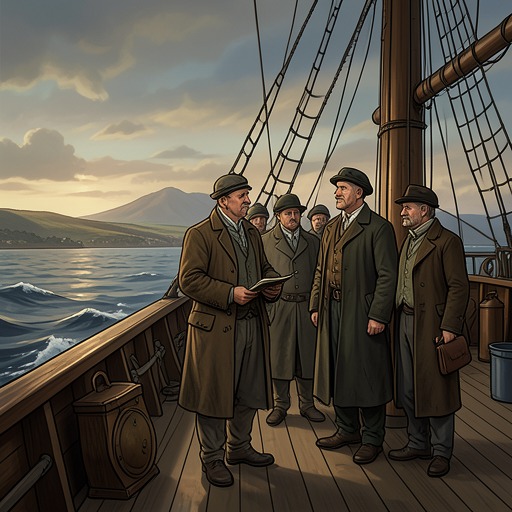
At New York, the first sight of green earth gives the vision a powerful, concrete confirmation. After storms, illness, confinement, and weeks of monotonous life aboard the Charlotta, the emigrants recognize that they have crossed the sea and see living ground before them again. Their renewed energy and hope are real consequences of arrival, even though the sight cannot establish that land will be affordable, work available, or life secure. The green shore answers the immediate longing to reach land; the larger promise of America remains to be tested through what the emigrants can actually do there.
Significance
The imagined Promised Land operates both as an attraction and as an argument. Karl Oskar’s hope rests on the possibility that labor can finally yield independence; Kristina demands evidence; Robert and Elin fill uncertainty with contrasting practical and religious expectations; Brusander turns America’s pluralism into proof of spiritual danger. These competing accounts prevent the destination from becoming a single, settled ideal.
The novel also distinguishes aspiration from the means of realizing it. Passage money, remaining capital, language, employment, family consent, and the physical strain of the voyage shape who can move and what arrival can promise. The sight of green ground renews the emigrants’ spirits, but it does not erase those constraints. America can function as a Promised Land in their imagination precisely because the old home has failed to provide security; whether the promise can be made real is left to work, resources, and experience beyond the crossing.