Anna
The EmigrantsAnna, the four-year-old daughter of Karl Oskar Nilsson and Kristina Johansdotter, dies after eating most of the barley porridge prepared for a christening feast. Her short life and death become a turning point for her parents: the loss deepens the family’s grief, alters Kristina’s view of whether emigration endangers her children, and leaves a trace in the worn shoes Karl Oskar packs for the journey to America.
Identity and Life at Korpamoen
Anna is one of the children growing up in a household strained by hunger and the limited prospects of a small farm. The wider parish has a growing population and increasingly divided holdings: by 1846, many independent farms consist of only a fraction of an original homestead. For Karl Oskar and Kristina, the future of their children is bound up with that scarcity. They fear that those who do not inherit the farm will have little choice but hired farm labor or life as squatters.
Within the family, Anna is especially close to her father. Karl Oskar thinks of her as his constant companion at work, and he has promised to take her to the shoemaker to have her feet measured for new shoes. Her old pair is worn out. That ordinary promise, made on the day she disappears, gives her death a painful closeness to the routines of family life: she is not remembered only as a child lost, but as a child expected to walk beside her father again.
The Christening Porridge and Her Death
In a winter of scarcity, Kristina prepares a special christening meal with barley she had saved in a small sack, adding a little butter and sugar. The porridge is set aside in an earthen bowl in the cellar until the godparents return from church with the newly christened child. While Karl Oskar and Kristina attend to work in the byre, the children are left inside. When the parents return, Anna is missing; she has not gone to the neighbors or left the farm without permission.
Kristina finds her after hearing a faint cry from the cellar. Anna lies beside the bowl, from which most of the porridge has been eaten. She explains that hunger and the food’s appeal drew her down to the cellar: she first meant only to smell it, then to taste a little, but could not stop. Frightened after eating, she stays there rather than face her parents. The porridge proves too rich after the famine food of the winter, and the resulting illness becomes severe.
The family seeks help from Berta of Idemo, who tries remedies including warmed wool and mare’s milk, but Anna does not improve. During the night she becomes delirious at intervals. She hears Berta warn that God might take her if she is no better by morning, and says she wants to remain alive. As her suffering worsens, she calls for Karl Oskar and asks to go with him to the shoemaker, holding to the promised visit even in her distress. Anna dies early the next morning.
Grief and the Decision to Emigrate
Karl Oskar withdraws into silence after Anna’s death. When his father asks whether he should make a coffin, Karl Oskar answers that he will make it himself. Kristina, meanwhile, is crushed for weeks and reproaches herself for leaving the porridge where Anna could find it. The parents avoid speaking their daughter’s name; silence becomes their means of keeping grief from becoming still more unbearable.
About a month after the funeral, Kristina tells Karl Oskar that she has changed her mind about emigrating. Before Anna’s death she feared that taking the children across the ocean would put their lives at risk. Now she recognizes that danger and loss can reach them at home, too, despite her care. She is willing to entrust the children to God and leave with her husband. The couple agree to seek passage the following spring. Anna’s death does not simply resolve their doubts; it transforms the grounds on which Kristina weighs them, helping turn an abstract debate about danger into a shared decision about the family’s future.
Memory Carried in the Family’s Belongings
As the family prepares to leave, Karl Oskar and Kristina’s old clothes chest is brought down from the attic and repurposed as an America chest. The chest has accompanied the family across generations and been opened for baptisms, weddings, and funerals. Its new role as a packing case makes the departure a break with home, but also a continuation of family memory through the objects carried forward.
During the final packing, Kristina finds Anna’s first and last pair of shoes among the bedclothes. She had thrown them away because they were too worn for the other children; Karl Oskar must have retrieved them and put them in the sack. The shoes recall how Anna, once she learned to walk, followed him on long journeys. Kristina understands something new about her husband from this quiet act and carefully returns them to the sack. Anna cannot make the journey with the family, but the shoes carry the fact of her place beside her father into the life they are beginning elsewhere.
A Loss That Travels Beyond the Farm
The family’s departure preserves a stark image of separation: Karl Oskar looks back to see his parents standing on the porch as the younger generation rides away. The choice to leave belongs to the living, but it has been shaped by Anna’s death and by the prospect that the children remaining at Korpamoen would face poverty and restricted choices. Her loss therefore sits at the intersection of intimate grief and material circumstance, without becoming a simple explanation for the family’s migration.
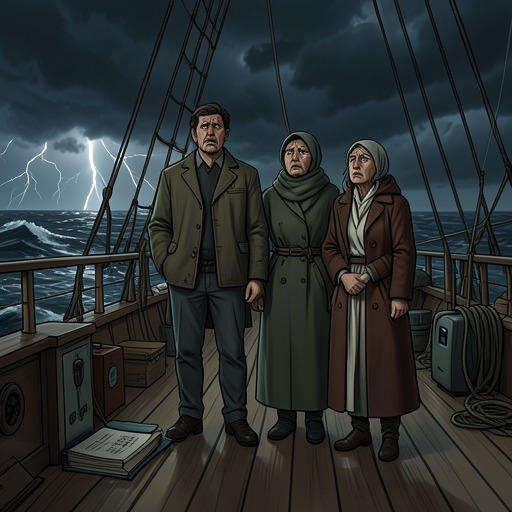
The book later gives the family’s Swedish soil a place in an at-sea funeral ritual. The captain uses a small scoop to scatter three portions of the homeland earth over a dead body, as the prayer recalls that dust returns to dust. This ritual is not Anna’s funeral, and the text does not identify the body as hers. Her significance instead rests in the domestic objects and decisions associated with her: the bowl that exposes the depth of the household’s hunger, the shoes that preserve her father’s attachment, and the changed resolve with which her mother joins the emigration. Through these distinct traces, Anna’s brief life continues to shape the family’s understanding of home, danger, and departure.