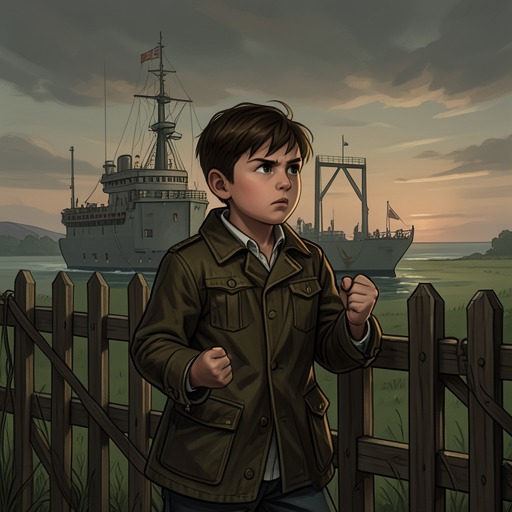
Aron of Nybacken
The EmigrantsAron of Nybacken is the farmer who employs Robert Nilsson under the Swedish servant law, and his importance lies in how his household makes that law tangible. Robert is bound to work for him because his parents have agreed to the service and received earnest money; Aron then treats the boy’s time and obedience as his own to command. Their relationship moves from Robert’s first, thwarted escape to an escalating conflict over discipline, flight, and whether a servant may refuse a master who has beaten him.
Identity and Authority
Aron is introduced as a large farmer with thick fox-red hair, a smooth face, and small, piercing eyes. When he finds Robert hiding at the mill, his appearance reinforces the difference in power between the adult employer and the young farmhand who has tried to avoid him. Aron is not merely an individual master: Robert’s parents have hired their minor son to him, accepted earnest money, and been told the contract cannot be undone. The arrangement gives Aron a claim backed by the servant law and leaves Robert with little say in where he works.
Aron promises good wages: for the first year Robert is to receive thirty daler, a wadmal suit, and a pair of short-legged boots. His parents point to these terms as reasons Robert should be grateful and accept the service. Yet the arrangement is made within a household already constrained by poverty and limited means: Robert’s parents cannot keep him at home, his sister Lydia is already in service, and his older brother Karl Oskar cannot afford another servant. The contract therefore joins subsistence need to legal obligation; Robert’s reluctance does not cancel the family’s agreement.
Robert’s Service and First Escape
When Aron finds Robert at the mill, he initially speaks mildly, calling him his little boy and saying he will show him the way to Nybacken. He takes Robert by the shoulder and directs him to collect his belongings. Once they are alone beside the wagon, however, the tone changes. Aron accuses him of trying to run away and of making people believe he had drowned, and frames the attempted escape as a failure to honor both parents and master. Robert is returned to Nybacken, where the contrast between the farmer’s gentle approach in public and his reproach in private establishes the unequal terms of their relationship.
The everyday service is demanding. Aron wakes Robert at four in the morning and urges him to hurry, while the youngest worker is sent from one task to another by the farmer, the mistress, the old mistress, and the maids. Robert tends four horses, filling their mangers morning and evening, currying them, cleaning their stalls, fetching hay and oats, cutting fodder, and carrying water. The animals are tied in their stalls, and the farmhands, in turn, are bound to the animals’ needs. A service year lasts 358 days, with just one free week. Robert decides during his first week that he must escape from all his masters, human and animal alike.
The story also distinguishes the household’s difficult service from the question of food. In good years the workers may eat as much bread as they wish, although the fare can include spoiled or poor-quality provisions; Arvid, who has served elsewhere, says that other farms can be worse. This comparison does not make Robert’s situation free or easy. His work is controlled by others, his days are ordered around the animals, and his legal commitment limits his ability to leave.
Discipline and the Servant Law
Aron’s authority is backed not only by the contract but by a recognized right to discipline servants. When Robert takes a brief rest while cleaning a ditch, Aron catches him lying at the bottom and rebukes him for idleness. Robert accepts the resulting blow as punishment he has earned, keeps silent about it, and understands that the household and the parish teaching treat a master’s correction as lawful. Dean Brusander repeats at the yearly examinations that a master must correct a lazy servant through suitable chastisement. Robert accordingly tells himself that Aron has not wronged him and that the punishment is sanctioned by God’s ordinance.
That belief does not remove the violence from the relationship; it shows how completely its authority has been explained to the servant. Robert has seen Aron himself struck by his wife, and the memory leads him to pity the farmer rather than hate him. For a time, he interprets submission as the proper order of service, even when discipline hurts. But when Aron later beats him after a wagon hits a gatepost, Robert leaves Nybacken without permission. He returns to Korpamoen with marks across his back and reports that he will not go back.
Flight and Family Opposition
Karl Oskar examines Robert’s back and tells him that no one in their family need accept flogging: they are as good as Aron. When Aron comes to Korpamoen, he tries to make light of the dispute, asking whether Karl Oskar will take his brother’s place as a more useful hand. Karl Oskar confronts him directly, rejects his description of the beating as minor correction, and says that Aron will get no more servants from his family. The disagreement is no longer only about Robert’s obedience; it is about whether a master’s legal authority can justify treating a young worker as inferior.
Aron seeks help from the authorities to bring Robert back into service. Sheriff Lönnegren explains that the servant law allows suitable chastisement and that Robert was expected to accept it with submission; the beating does not, in the sheriff’s account, give him the right to desert. The official response thus makes the contract’s force clear even after Robert has left. Karl Oskar nevertheless stands by his brother rather than send him back, and the family conflict becomes a challenge to a system that gives the employer recourse to law while restricting the servant’s freedom of movement.
Work, Escape, and Narrative Significance
Aron’s household also shapes the practical possibilities of Robert’s later plans. Robert and Arvid discuss emigrating in secret, and Robert devises a way to use Aron’s timber wagon to travel toward Karlshamn, so that the employer would indirectly contribute to their passage. The plan depends on turning the means of service into a means of escape. But when the timber begins moving, Aron goes with his team himself, saying he is too concerned about Robert to let him make the long journey. A route that had seemed open is closed, and Robert’s departure remains bound up with the restrictions he is trying to outrun.
The episode gives the novel a concrete measure of what freedom means to Robert. Farm service is hard, but at sea he later recognizes that seamen, too, are confined by their work; the comparison does not make Aron’s authority disappear, but places Robert’s flight within a wider search for control over time, movement, and labor. Aron is therefore both a particular employer and the human face of a legal and economic arrangement in which a poor family’s need for wages can bind a child to work, while the master’s discipline is defended as lawful. Robert’s resistance begins as an attempt to escape one household and becomes part of the larger decision to seek a life elsewhere.