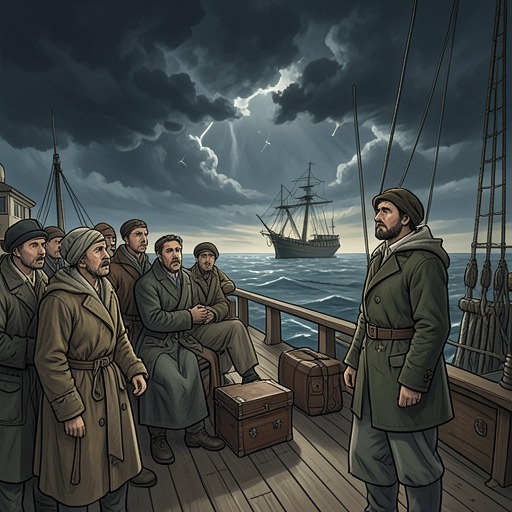
Captain Lorentz
The EmigrantsCaptain Lorentz, master of the brig Charlotta, embodies the sea’s hard authority in the emigrants’ passage from Karlshamn to New York. He regards life at sea as a calling and land as a degrading prison, yet his command carries an unwelcome burden: he must convey crowded families across the ocean and may have to bury some of them there. His contempt for the emigrants coexists with a practical, private act of care—a bushel of Swedish soil reserved for their sea burials.
Identity and Command
The Charlotta sailed from Karlshamn on April 14, 1850, bound for New York, with Captain Lorentz in command. The brig measured 124 feet long and 20 feet wide, carried 78 emigrants alongside a crew of fifteen, and had a total of 94 people aboard. It was her seventh voyage as an emigrant ship, and her cargo included pig iron and sundries as well as the families making the crossing.
Lorentz was about sixty and had spent nearly fifty years at sea, the last ten commanding the Charlotta. Stocky, weather-beaten, and marked by a blunt, pike-like face, he spoke with the far-reaching authority of a seasoned master. His voice issued directions at the harbor mouth as the ship eased away under a light southeast wind; his work was to judge her movement and keep her on course, not to promise passengers a smooth or speedy passage.
A Sailor’s View of Land and Migration
To Lorentz, the sea was the proper place for a grown man. The Charlotta’s time in harbor felt humiliating: he had been detained eight days in Karlshamn for cargo, provisions, and crew business, while emigrants and their belongings crowded aboard. He preferred the ship under sail to the indignity of being tied to land, and considered steering a vessel the only occupation worthy of a human being.
That conviction shaped his view of the people he carried. He regretted that the Charlotta had become an emigrant ship rather than a merchantman and resented the peasants, families, chests, boxes, sacks, baskets, and cradles filling its spaces. In his eyes, the passengers overloaded the vessel and brought a nursery aboard. He could not understand why farmers would undertake a costly journey across the world merely to till another patch of soil: dry land, he thought, was much the same everywhere, while farming itself was a degrading chore. His explanation for emigration was unsympathetic, reducing the peasants’ crowded homes and lack of room to their own fault.
The emigrants’ circumstances, however, made the journey more than a choice between equivalent fields. They came from Ljuder Parish for varied reasons: crop failure, religious persecution, dissent, personal trouble, social exclusion, and unfair employment. The Nilsson household had spent four years at Korpamoen and emerged several hundred riksdaler poorer; remaining seemed to promise years of exhausting work and, eventually, only a reserved room and meager bread. Kristina, by contrast, feared that the promised American future might be a wild-goose chase: no land deed awaited the family, no trusted person who had seen North America could vouch for it, and newspapers and books were not enough to reassure her. Lorentz’s belief that one patch of earth was much like another thus throws into relief the emigrants’ sharper distinction between the prospects they were leaving and the ones they hoped to reach.
Responsibility for the Passengers
The emigrants encountered that dependence in the ship’s cramped arrangements. Canvas partitions divided the hold into spaces for families, unmarried men, and unmarried women. Dust rose as they laid out bedding for seventy-eight passengers; the low overhead, choking air, bundles, baskets, and tubs left scarcely room to walk. Even Karl Oskar had no place in the family compartment and shared a two-man bunk with Robert. The narrow quarters made Lorentz’s dislike of the human cargo tangible, but also made its treatment a matter of command and safety.
Shipboard rules made that command explicit. Each family was to collect its weekly share of unprepared provisions, cook in turn at the galley, and dispose of refuse to leeward. Each person received only half a gallon of fresh water a day for drinking and washing. The passengers had to clean the hold each morning before water was issued; they were warned against unprotected lights and smoking below deck and required to obey the officers’ orders. At sea, Lorentz’s authority governed necessities as intimate as water, sanitation, cooking, and fire.
The rules could not remove the hardships they regulated. After nights when seasickness and darkness left the quarters dirty, men carried water and women scrubbed, washed, and hung wet clothes on deck. The thirsty could not drink until the cleaning was done, and passengers complained that the ration had to stretch across food preparation, drinking, washing, and care of their children. The second mate explained that reserves had to last through a crossing that might take three months in poor weather. Lorentz was not shown personally directing each chore, but these conditions formed the system aboard the ship he commanded—and the responsibility he understood could not be wished away.
The Burden of Mortality and Swedish Earth
Lorentz’s awareness of that responsibility came with a foreboding he could not dismiss. The Medical Adviser for Seafarers, open on his table, described the dangers of carrying so many passengers as cargo. Lorentz believed he could bring the Charlotta safely into port, but did not expect every emigrant who embarked to reach New York. He anticipated that funeral prayers would have to be read and one or more bodies lowered into the sea.
An earlier cholera voyage had shown him what that duty meant in practice. He had repeatedly conducted burials at sea and thrown three shovelfuls of galley ashes over canvas-shrouded bodies because he had no earth aboard. Afterward, he decided to carry Swedish soil for future funerals. The provision was only a bushel, but its meaning was deliberate: emigrants attached to the soil, he reasoned, would want their mouths full of earth when they died. Those buried in the ocean could not have a churchyard grave, so he would give them three shovelfuls of their own country’s earth instead.
For the Charlotta’s seventh emigrant voyage, he already knew the bushel would be used. His expectation turns the soil from an ordinary cargo into a quiet preparation for loss. The passengers do not know it is aboard; Lorentz has made this provision without their request or knowledge, as a form of care that sits uneasily beside his impatience with them. At sea, where land is absent and the dead cannot be returned home, the small measure of Swedish ground marks both the distance they have traveled and the home they have left.
Navigation and Narrative Significance
Lorentz’s authority could not master the elements. For several cloudy days he could not establish the ship’s position by the sun and had to estimate the course by dead reckoning. The Charlotta moved slowly across Kattegat. When a farmer suggested that God had given them calm weather, Lorentz answered that a favorable wind would be better. His response reflects a sailor’s practical measure of conditions, not the emigrants’ hope that calm itself might signify providential care.
Later, contrary winds prolonged the crossing, and the passengers grew anxious about how far they had traveled and whether they had been misled about the distance. They had been told the passage might take at most eight weeks, yet weeks accumulated, and no one could give them a firm location. When a passenger asked when they would reach New York, Lorentz replied that he could name the date if they could tell him what the weather would be, day by day, and from which direction the wind would blow. The questioner returned chagrined; the exchange exposed how little certainty a captain could offer when wind and weather controlled the voyage.
Lorentz could have pressed the Charlotta harder, but feared straining her over-rigged masts and rigging. His preference for a moderate breeze was not mere indifference to the passengers’ longing for land: it was also a judgment about the limits of the vessel. Still, he privately dismissed their impatience, expecting them soon to return to digging in the earth. To the emigrants, each day at sea lengthened the distance from home while their destination remained uncertain; to Lorentz, the sea was the sane domain, and the farmers’ return to land was only a matter of time.
The contrast makes him more than a harsh obstacle or a simple protector. He mocks the emigrants’ attachment to land, yet carries their soil; resents the living cargo, yet recognizes the captain’s duty to care for it; trusts his seamanship, yet knows neither speed nor arrival can be guaranteed. His vessel is their route to a hoped-for future and, at the same time, a confined world in which water, movement, and survival depend on the ship and its command. Captain Lorentz’s stern outlook and unadvertised provision of earth hold those opposing truths together.