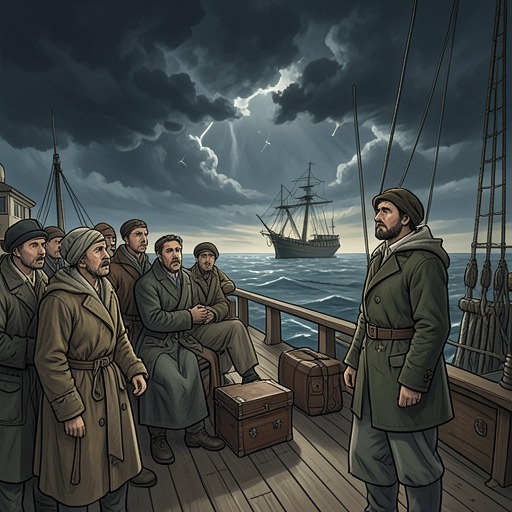
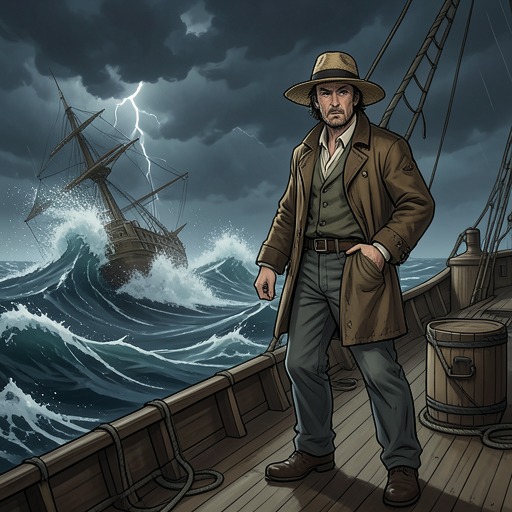
Charlot encountered the Beihai storm
The EmigrantsThe Charlotta’s first North Sea storm exposes the peril beneath the emigrants’ hopes of reaching America: a crowded ship becomes a place of helpless waiting, while Robert experiences the sea not as a route between lands but as a force that seems to swallow him. The episode makes the risks of migration concrete, turning the ordinary facts of shipboard life—tight bunks, restricted movement, and dependence on the vessel—into conditions of mortal vulnerability.
Causes and Conditions
The storm came during the Charlotta’s passage from Karlshamn toward New York. The brig had sailed on April 14, 1850, carrying 78 emigrants among a total of 94 people. Its hold had been divided into small compartments, and the passengers’ bedding, food, and belongings left scarcely any room to move. Karl Oskar Nilsson could not fit into the family compartment and shared a two-man bunk with his brother Robert Nilsson in the unmarried men’s section. The cramped arrangements were not incidental to the storm: below deck, the emigrants had little space to escape the motion or the fear it brought.
The immediate change came as the vessel encountered its first rough weather in the North Sea. The wind began to rise in the evening; by midnight, Captain Lorentz assessed it at force nine on the Beaufort scale. The Charlotta’s topsails were reefed, and the first mate entered a single stark word in the log: “Storm.” What had been a passage across water now became an ordeal governed by wind and waves rather than by the emigrants’ plans.
The Storm Aboard Ship
On deck, Robert saw the sea’s character change. A wave swept over the deck and soaked his trousers; the ship listed sharply, making the deck seem to tilt downhill, then rolled the other way. The first mate ordered the main hatch battened down. Robert wanted to remain on deck rather than appear afraid, but dizziness and nausea overcame him, and he went to lie in his bunk. The scene shifts from the exposed deck to the confined hold, where the storm’s force is felt without being seen.
In the dark, Robert could not move freely beneath Karl Oskar’s weight as his brother rolled across him with the ship’s motion. Around them, passengers groaned, prayed, cursed, and were sick. As the bunk seemed to sink, Robert mistook the ship’s movement for a descent beneath the sea and called to his brother that they were sinking. Karl Oskar, half-awake, answered that it was only storming and told him to keep quiet. His brief reassurance does not end the storm; it marks the distance between the physical danger outside and Robert’s terror within.
The narrative enlarges that terror beyond Robert’s private experience. Nearly a hundred people were shut inside the vessel, unable to control its course or help one another in any meaningful way. The storm is rendered as a struggle between a small ship and a vast, violent sea, while the people aboard are reduced to waiting. In the darkness, two kerosene lanterns—one green on the starboard side, one red on the port—burned on deck. Their weak light emphasizes the fragility of the world aboard the Charlotta: the ship remained afloat, but it was only a small moving refuge surrounded by water and darkness.
Robert’s Experience and the Limits of Help
The storm’s decisive effect on Robert is not merely fear of an accident. He feels that he is taking part in death for the first time in his life. The crowded bunk, the inability to move, the sounds of others suffering, and his belief that the vessel was sinking collapse the distinction between imagining death and being caught up in its approach. The sea’s motion produces a bodily crisis, but the episode also makes him confront how little control any passenger possesses.
That helplessness extends to everyone aboard. If the Charlotta sank, the passengers could disappear without leaving a trace or a known grave; there was no practical action they could take to ensure rescue. The narrative gives this thought its own bleak force: the emigrants cannot make the storm stop, direct the ship, or secure an account of their deaths. In the face of that powerlessness, the possibility of appeal narrows to God, even as the scene offers no assurance that human suffering will be prevented.
When Robert continues to be sick, Karl Oskar reaches him and carries him back to his bunk. He identifies Robert’s condition as seasickness, giving his terror a bodily explanation without denying the violence of the night. The storm passes without the Charlotta being lost, but the episode does not turn survival into mastery. The ship remains at sea, and the passengers have endured rather than controlled the danger.
Shipboard Vulnerability and Narrative Significance
The storm belongs to a broader crossing defined by rules and material limits. Passengers were allotted provisions by the week, had to take turns cooking, and were told to conserve water; each person received only half a gallon of fresh water a day. The emigrants also had to clean their quarters before receiving their water. These arrangements reveal how completely their lives depended on the ship’s organization and the crew’s authority. In the storm, that dependence becomes more absolute: practical routines and allotted supplies cannot protect them from the sea.
The episode’s contrast between land and ocean also sharpens the meaning of departure. Before reaching the harbor, the emigrants had looked across water without seeing land on the other side, an unfamiliar prospect for people accustomed to seeing land around them. Once the voyage was under way, their hopes of a new home depended on continuing across that expanse. Later, contrary winds and fog stretched the passage into a succession of days, leaving the emigrants to measure distance by time and to wonder whether they had been misled about how far North America lay. The North Sea storm is the first forceful warning that the route to a desired home can also become a place of confinement.
The storm therefore alters the emotional meaning of the emigration without ending it. The Charlotta survives the night and continues carrying its passengers, but Robert has learned that the sea can make a ship feel like a sinking bunk and a life-threatening enclosure. The emigrants’ movement toward America remains possible; their power over the conditions of that movement does not.