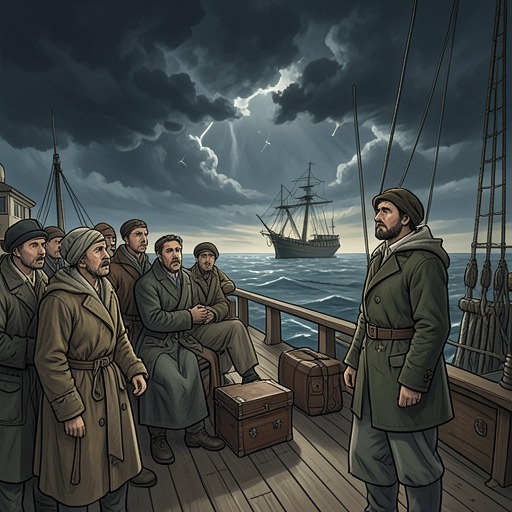
Charlotta
The EmigrantsThe Charlotta is the brig aboard which the emigrants from Ljuder Parish cross the Atlantic in 1850, and its voyage turns migration from an imagined route to America into a prolonged material ordeal. A merchant vessel carrying both cargo and people, it connects the passengers’ separate reasons for leaving Sweden to a common passage; once aboard, however, they exchange familiar land for a crowded space governed by the sea, shipboard rules, and the limits of their provisions.
Ship and Passage
The Charlotta was a 160-last brig, 124 feet long and 20 feet wide, commanded by Captain Lorentz. It sailed from Karlshamn for New York on April 14, 1850, carrying pig iron and sundries as well as 78 emigrants. With a crew of fifteen, the total number aboard was 94. The voyage was the Charlotta’s seventh as an emigrant ship. Before departure, Karl Oskar and Robert had arranged passage through a firm in Karlshamn: a payment of one hundred daler secured transport for six people, and the ship was expected to leave in the second week of April and sail directly to New York.
The Charlotta’s place in the migration is made visible before the emigrants reach its deck. Their movement from scattered homes and parishes becomes a collective undertaking through practical arrangements: passage is booked, fare is paid, and people gather on the road and at the port. At Åkerby Junction there are sixteen emigrants—nine adults and seven children—traveling in several wagons. Danjel’s party includes his wife, four children, and Ulrika; two people from Kärragärde, Arvid and Elin, travel with Jonas Petter. The group’s differing circumstances converge on the same ship, making the Charlotta the shared link between distinct household decisions rather than evidence that everyone left for the same reason.
A Change from Land to Sea
For the passengers, boarding is a decisive change in the conditions of everyday life. They have lived on solid ground and worked the soil; on the Charlotta, the deck shifts beneath their feet, and they cannot command their movements as they could on land. Their heavy boots, useful on farms and stony ground, become awkward on the deck. The rail encloses them, and the sea—unfamiliar and beyond their control—carries them toward another continent. The narrative casts this transition not as uncomplicated freedom of movement but as dependence: the emigrants have chosen to leave, yet the conditions of their passage are now determined by the ship and the water around it.
The ship’s accommodation gives that dependence a close, domestic scale. Canvas divides the hold into spaces for married couples and children, unmarried men, and unmarried women; rough-board partitions form small family compartments, while other passengers sleep in berths strung between the supports. Bedding, baskets, food, and bundles crowd the low-ceilinged hold, leaving little room to move. There are berths for seventy-eight people, and the air and space are strained by the passengers’ belongings as well as their bodies. With no room for Karl Oskar in the family compartment, he shares a two-person berth with Robert among the unmarried men; Jonas Petter sleeps above them, and Arvid has a berth nearby. The arrangement separates the family by sleeping quarters even as the voyage binds them together.
The family bunk is also the only room Kristina and the children have. She lays a mattress and her bridal cover on the floor and places the family’s large willow food basket on top of the bunk, where the children also have to fit. The objects brought from home do not restore the space or privacy of home: the basket, bedding, and children all occupy the same cramped enclosure. With more than thirty people in the family compartment, even ordinary family care and changing clothes take place in the presence of strangers. The Charlotta thus makes the crossing intimate in a way the emigrants have not chosen, turning the household into a small, exposed unit within a crowded common space.
Rules, Water, and Daily Routine
Life aboard the Charlotta is organized through shared provisions and orders from the ship’s command. The mate explains that food will be issued weekly in fixed portions, unprepared, and collected by one representative from each family. Passengers must make the allotment last and take turns using the galley and its utensils. They are instructed to throw refuse overboard to leeward, not windward, and to keep the hold clean. The rules make the passengers responsible for managing their own food and domestic routines, but only within limits set by the vessel.
Water makes those limits especially clear. Each person is allotted half a gallon of fresh water a day for drinking and washing, and the passengers must economize. The daily supply is withheld until the hold has been cleaned, so cleaning comes before washing or drinking. The emigrants, accustomed to drawing freely from full wells, complain that the ration is too small for cooking, drinking, and washing themselves and their children. The second mate warns that the crossing may take three months in unfavorable weather, and that the supply might have to be reduced further. When rainwater is collected in a sail and some passengers follow the sailors’ example in washing, Danjel interprets the water as a gift from the Lord; the same event is at once a practical response to scarcity and an occasion for religious meaning.
The ship’s rules also concern safety and obedience. Passengers are told to handle fire carefully; smoking below deck and using unprotected lights are forbidden. They must follow the captain’s orders, with punishment possible for disobedience. These instructions place the emigrants under a new authority at the same time that the sea makes them physically vulnerable. The Charlotta is a route toward another country, but it is also a tightly regulated living environment in which ordinary needs—food, water, cleanliness, light, and space—are administered or constrained.
The Captain and the Human Cargo
Captain Lorentz understands that reaching New York safely does not mean every passenger will survive the passage. His Danish medical handbook warns that when passengers are treated as cargo, they constitute a particularly unhealthy cargo and require the captain’s attention. Lorentz expects to bring the ship into port undamaged, yet foresees that one or more emigrants may die before arrival and that he will have to read the funeral prayers and commit their bodies to the sea. His responsibility therefore extends beyond navigation: on an emigrant voyage, he may have to serve as minister as well as master.
That burden is sharpened by his memory of an earlier voyage when cholera was aboard. He recalls having used ashes from the galley in place of earth for burial, because he had no soil in the hold. The recollection gives the Charlotta’s role a grim practical dimension: the ship transports people, but cannot provide the familiar land or customary materials associated with their burial. The medical handbook, the captain’s anticipated prayers, and the memory of ash used in place of earth all make mortality part of the voyage’s structure rather than an unforeseen abstraction.
Near the end of the crossing, Lorentz reckons with the passage’s actual losses. The voyage has had moderate storms and seven deaths among the seventy-eight passengers. As the ship approaches the end of its route, he anticipates that another death may make the toll eight, requiring him once more to perform the duties of minister. The Charlotta’s history as an emigrant ship is therefore measured not only in departures and arrivals but also in the number of people who do not reach shore.
Crossing and Arrival
The Charlotta sails across the Atlantic through changing weather, but contrary winds often hinder her progress. To the passengers, the recurring waves seem to lift and toss them again and again, while two months at sea deepen their sense of distance from home. They come to understand that the return journey is almost beyond conception: whatever awaits them in the new country, the crossing has made departure feel permanent. The ship is not simply a temporary conveyance between ports; for its passengers, its vast interval of water gives migration the character of a one-way break with the life they have left.
The voyage also concentrates danger in moments when the ship itself is threatened. During rough weather, Karl Oskar leaves Kristina to seek help for her severe bleeding. He struggles across the wet deck in darkness and reaches the hatch leading to the captain’s cabin. Lorentz consults his medical handbook for instructions on treating dangerous bleeding. The episode shows how completely the emigrants’ welfare depends on the vessel’s command and whatever resources are available aboard; the captain’s book serves as a practical medical guide where no doctor is present.
After ten weeks’ sailing, the Charlotta reaches New York on Midsummer Eve, 1850. The passengers, worn down by confinement, illness, and the long monotony of the crossing, crowd onto deck when land comes into view. Their attention settles on green trees and grass: signs of living ground after weeks surrounded by water. The sight renews their energy and hope, and even those weakened by illness feel a change in their outlook. When they go ashore, Kristina walks up the gangplank under her own strength, and Harald is set down to walk beside Karl Oskar. The arrival is a genuine threshold, but not an effortless resolution: Karl Oskar finds that the solid ground seems to roll beneath him, and recognizes that he must begin again in a country still unknown to him. The Charlotta has delivered the emigrants to America; it has not yet supplied the certainty or security for which they left.