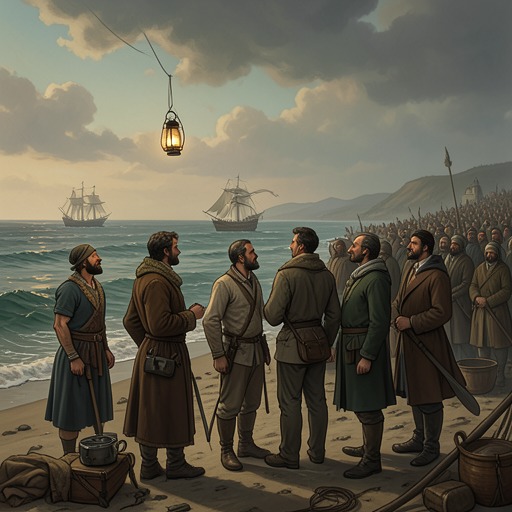
Charlotte arrived in New York
The EmigrantsThe arrival of the brig Charlotta in New York on Midsummer Eve, 1850, closes the emigrants’ ten-week sea passage and opens the uncertain next stage of their lives. For the passengers, the harbor is at once a destination imagined through rumors and pictures, a return to the earth after months at sea, and a threshold crossed by weakened bodies. The relief of landfall cannot undo the voyage’s losses: of the seventy-eight emigrants who embarked at Karlshamn, seventy reach New York, while the first steps on American soil remain precarious.
The voyage and its costs
The Charlotta sailed from Karlshamn on April 14, 1850, bound directly for New York. A brig 124 feet long and 20 feet wide, she carried pig iron and other goods as well as 78 emigrants; with her crew of fifteen, there were 94 people aboard. This was her seventh voyage as an emigrant ship. The arrival scene is therefore the culmination of a planned passage, but not an uncomplicated triumph: the ship that brings the passengers to a new continent has also been their crowded, regulated home for ten weeks.
That confinement was tangible in the hold, where canvas partitions divided passengers by family and marital status, and berths and belongings competed for space. The air was close, the overhead low, and passengers had scarcely room to move. The ship’s rules made daily survival a matter of organization: provisions were issued in weekly portions, families took turns using the galley, and each person received half a gallon of fresh water a day. Passengers had to clean their quarters before receiving water. These arrangements explain why the sight of land could affect not only the emigrants’ hopes but their bodies and spirits: the end of the passage meant release from a narrow, demanding shipboard life.
The crossing’s illnesses and deaths sharpen the contrast between arrival and loss. Two of the nineteen children aboard died during the voyage, and sickness also left other passengers weak. Inga-Lena’s prolonged illness, with dizziness, fainting, and severe weakness, shows the bodily cost of the journey; Kristina feared that she too had contracted scurvy. As the Charlotta neared New York, Captain Lorentz consulted his medical guide while trying to treat Kristina’s dangerous bleeding. The arrival does not erase these dangers. It comes after a passage in which survival has remained uncertain, and it brings the emigrants to land carrying the consequences of that ordeal.
America comes into view
The first announcement reaches Robert at daybreak, when Arvid wakes him with the news that America is visible. Robert hastily pulls on his trousers and emerges through the main hatch. Many passengers have already gathered on deck, standing in silence. At first, the shore is fragmentary in the mist: the passengers can tell that land rises on either side of the ship, but cannot yet judge whether it is fertile or barren, rich or poor. The knowledge that they have reached America is enough.
As the Charlotta travels up the bay, the view gradually resolves. Ships of many kinds fill the waterway, replacing the brig’s long isolation at sea with the traffic of a harbor. The mist lifts to reveal clustered roofs, rows of houses, and steeples that remind the emigrants of home. Then the harbor itself becomes recognizable as New York. The second mate, the Finn, tells Robert and Arvid that the island before them is Manna-Hata, and recounts what he has heard about its name and earlier history. His explanation accompanies the emigrants’ first encounter with a place they had known only through accounts of the New World.
The passengers look for something beyond buildings, piers, and roads: the green earth. They finally see trees with thick foliage and grass near the shore. That patch of living ground matters because the voyage has separated them from soil and subjected them to the ship’s confinement. Their arrival is not merely a geographical sighting; it is the moment when the land they crossed the ocean to reach becomes visible as ground on which life might begin again.
Land-frenzy and disembarkation
The sight of green earth brings what the narrative calls land-frenzy. The long passage has worn down the passengers’ bodies and spirits, but the view of land restores energy: the sick imagine recovery, the weak feel strength returning, and the despondent and timid regain initiative and courage. Their response is collective. Crowded together on deck, they resemble people emerging from confinement into the prospect of open ground. The transformation is emotional and physical, but it is also provisional: the passengers have reached America, not yet established homes there.
When the Charlotta anchors at the pier, the gangplank is lowered and the emigrants begin to disembark into a hot summer day. Kristina insists on walking ashore under her own strength, although her limbs are weak and she leans heavily on Karl Oskar. She does not want it said that she was unable to enter America on her own feet. Harald, too, is put down from his father’s arms and walks beside him. These deliberate steps make the crossing’s end a personal act as well as a collective arrival: the family enters the new land on foot, even while its members remain frail.
The scene holds hope alongside evidence of hardship. The children are pale and gaunt after the passage, and the emigrants’ clothing is worn; their chests, bundles, baskets, and boxes gather in a heap on deck. Yet North America admits them. Kristina’s unborn fourth child remains protected within her, and the account identifies this child as the first among the Charlotta’s passengers who will gain citizenship in the North American republic. The family’s arrival thus looks forward as well as back: the parents and children have reached the shore, while a new life is already part of their passage into the country.
Survivors and the unstable threshold
The losses are counted in two ways. Of the sixteen people who left Ljuder Parish and gathered at Åkerby Junction in early April, fifteen arrive in America. Of the seventy-eight passengers who embarked at Karlshamn, seventy reach land. The Charlotta has given eight passengers to the ocean. Against those numbers, Karl Oskar’s relief that his whole family is with him is particular and hard-won. He is healthy and satisfied that they have crossed safely, but the survivors’ arrival cannot be mistaken for an untouched beginning.
Karl Oskar has prepared for the road ahead by polishing his high boots, made from oak-tanned oxhide and greased until the leather shines. He believes he is well shod for travel overland, even if the American roads are poor. But at his first steps on solid ground, he becomes dizzy and stumbles: the earth seems to roll like the deck, although he had not felt this way at sea. The reversal complicates the apparent certainty of landfall. The firm ground he has longed for does not immediately feel secure; he wonders whether he must learn to walk again, as he must begin his life anew.
The ending fixes the event in time and gives its promise a deliberately unsettled shape: on Midsummer Eve, 1850, after ten weeks from their home port, the Charlotta ties up at the New York pier. The emigrants have arrived, and the green earth has renewed their hope, but the first steps remain unstable. New York is the end of the sea voyage, not the end of the journey; the land beneath their feet is firm, while their place in the new country is still to be made.