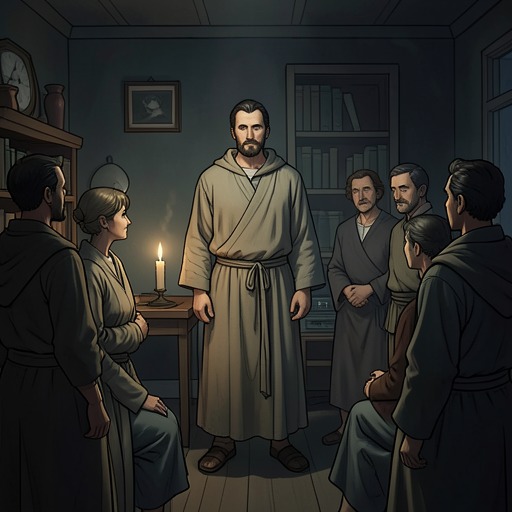
Danjel Andreasson
The EmigrantsDanjel Andreasson is a prosperous, mild-mannered farmer whose religious inheritance transforms his home at Kärragärde into a dissenting community. As the nephew of Åke Svensson, the founder of the once-condemned Åkian movement, Danjel revives its teachings, extends shelter to people rejected by the parish, and refuses to submit his faith to church authority. His journey from quiet landowner to religious leader, emigrant, and bereaved husband tests the difference between spiritual certainty and humility.
Identity and Family Background
At forty-four, Danjel is known as good-natured and, until his religious awakening, quiet and blameless. He is the nearest surviving relative of Åke Svensson, whose teachings had been associated with heresy and disorder. The parish still remembers the old hostility: Danjel’s home, Kärragärde, had once been considered tainted by Åkianism, though it was later declared cleansed. His connection to the movement is also a source of unease for Nils and Märta, whose granddaughter Kristina is related to Åke through her mother. More than fifty years after Åke’s death in Danvik asylum, people still avoid boasting of kinship with him.
Danjel’s position in the parish initially seems secure. He owns a substantial farm, is regarded as a decent neighbor, and can help Karl Oskar when debt threatens the family’s livelihood. In 1847, he promptly lends Karl Oskar fifty riksdaler toward the mortgage interest. When Karl Oskar asks again later, Danjel gives another fifty daler and says he will no longer charge interest, either on the new loan or on the old debt. That change in his dealings is an early sign that his religious commitments are altering not just his speech but the customary terms of property and obligation.
Revival and Household Community
The change becomes unmistakable when Karl Oskar visits Kärragärde and finds the house filled with people he had not expected to see there. Among them are a discharged soldier known for fighting and drinking, a disabled maid, a poor woman dependent on parish relief, and Ulrika of Västergöhl with her daughter. Danjel explains that they are not passing beggars: they will live in his home. His wife, Inga-Lena, confirms that the group has become part of the household. The farm’s welcome to the outcast is a practical expression of a faith that unsettles the parish’s divisions between respectable and disreputable people.
Danjel understands his awakening as a call to continue Åke’s work. In a vision, Åke tells him that his Saviour has awakened him to resume the mission on earth. Danjel then begins teaching the household each Sunday, giving Bible talks to his wife, children, and servants and welcoming any neighbor who happens to visit. He prays during his daily farm work, whether in the field or barn, and sometimes prays aloud with such intensity that nearby people think he needs help. His religion takes shape through repeated domestic practices—teaching, prayer, shared life—rather than through a formal position in the established church.
Inga-Lena’s response develops alongside Danjel’s leadership. At first, she struggles with the conflict between her own judgment and the scriptural teaching that a wife should obey her husband. She feels guilty when she disobeys him. The narrative describes her eventual religious rebirth as a change in how she understands their marriage: she accepts Danjel’s spiritual authority, and the estrangement between them ends. Their renewed marital life is presented as part of the household’s religious transformation, though it also shows how faith shapes authority within the family.
Conflict with Church and Parish Authority
Word of the revival spreads from household to household and village to village. People say that Åke Svensson’s supposedly dead heresy has returned through his sister’s son. Danjel does not retreat when Dean Brusander questions him. The dean warns him that his doctrines threaten church unity and the country’s order, and instructs him to remain at his calling and pursue lawful work. Danjel is allowed to leave after the interrogation, but he does not retract his beliefs.
The conflict sharpens when Danjel administers Communion at home. Those gathered at his table understand themselves as redeemed through faith in Christ’s death; they believe they have cast off their former sinful selves and been made clean. Danjel tells them that their sins have been left behind, and they believe him. The dean points to the bread and wine as evidence that Danjel is administering the sacrament without authorization, making the household gathering a direct challenge to church control over Communion. The episode brings a private religious community into open confrontation with the institutions that claim authority over worship.
Danjel’s dissent also threatens his standing as a Swedish subject. Dean Brusander later describes him as a farmer who has forfeited his right to live in the kingdom, while conceding that he remains free in what the dean calls enlightened times. The words make explicit what the warnings imply: the dispute is not only over doctrine but over whether Danjel can remain in the parish without abandoning the community and practices he has formed.
Emigration and Hopes for a New Community
Danjel interprets the call to leave as a biblical command. He tells his followers that the Lord has instructed him, as Abraham, to leave his country, kindred, and father’s house for a land that will be shown to him. Emigration thus appears not simply as escape from official pressure but as a new stage in his religious mission. He expects North America to provide room for a community governed by the pattern of the first Christians: worship together, share bread and wine, hold possessions in common, and live without interference from a sheriff.
His confidence extends to the practical obstacles of migration. Inga-Lena fears that she will be unable to speak the language of North America, but Danjel assures her that the Holy Ghost will enable the reborn to speak English upon arrival. He invokes the miracle of Pentecost as a promise relevant to their own journey. When challenged about the basis of his faith, he answers that he believes Christ died on the cross for his sins. His assurances bind scriptural precedent to a future he cannot yet know, giving the family’s departure both a material destination and a sacred meaning.
The community travels with Danjel, including his wife, their four children, and Ulrika of Västergöhl with her daughter. Aboard the ship, his response to the lice infestation continues the same pattern of interpretation. He says that even the louse is God’s created work and should be accepted rather than hated; the vermin, he explains, should remind the passengers to wash and keep clean and have been sent as a trial for their betterment. The statement turns an unpleasant shared condition into a lesson in submission and care, extending Danjel’s religious reading of experience into the crowded life of the voyage.
Crisis, Loss, and Change
A violent storm brings Danjel’s confidence to its severest test. He reads from the Psalms and the Gospel story of Christ calming the sea to comfort the passengers, locating their danger within familiar scriptural scenes. The next morning, however, he is overcome by seasickness. In the weakness that follows, doubt and prostration replace the composure of the preacher; he repeatedly asks God for mercy and forgiveness. The contrast between his public words of reassurance and his private physical helplessness unsettles the certainty on which his authority has rested.
Later, Inga-Lena tells Kristina that Danjel has confessed what he considers his greatest sin: spiritual vanity. He had believed himself free of sin, forgiven once and for all, and therefore above the law. In the experience of seasickness, he had been brought down among sinners and the unredeemed; since then, Inga-Lena says, he has changed considerably. The crisis does not erase his faith, but it alters its character. His earlier assurance that redemption had placed him beyond sin gives way to an awareness of dependence and fallibility.
When the emigrants reach New York, Danjel approaches Karl Oskar and Kristina with the news that Inga-Lena has died. She had been ill without admitting it to her husband. His bereavement stands beside the arrival’s collective joy, making the promised land a place reached at the cost of a life lost on the voyage. At her bier, Danjel speaks of Moses, who was not permitted to enter the promised land, and tells Inga-Lena that although she could not see the new country, she reached the harbor before the others. After the captain’s signal, two sailors lower her wrapped body into the sea. Danjel’s words preserve his belief in the journey’s sacred destination even as the burial makes its human cost irretrievable.