Danjel Andreasson’s conversion and revival of Åkianism
The EmigrantsDanjel Andreasson’s conversion and revival of Åkianism begins with a nocturnal vision in which Jesus Christ and Danjel’s dead uncle Åke Svensson summon him to continue Åke’s work. The experience turns a previously quiet, conventionally pious farmer into a leader guided by what he understands as the Spirit; at Kärragärde, his renewed faith becomes a lived program of prayer, preaching, hospitality, and equality. Its consequences reach beyond his household, gathering a small flock around him and setting his religious practice against the authority and social habits of the parish.
The Call at Kärragärde
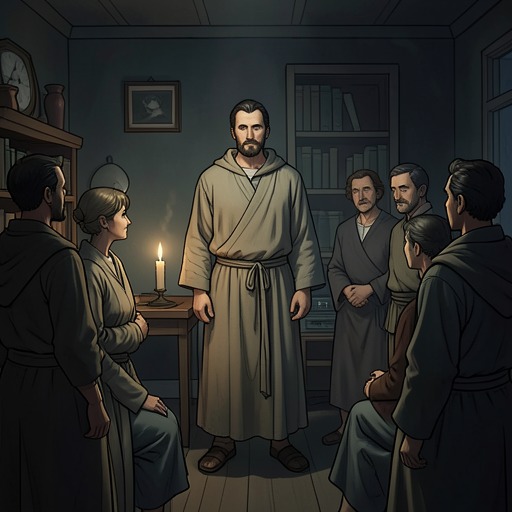
One night in the fall of 1848, Danjel went to bed troubled by a vague anxiety and a strange dizziness. During the night, a heavy knock and a voice calling his name brought him out of bed. He thought a fire might have broken out and hurried to answer. As he opened the door, a brilliant light illuminated the room. Two men stood outside: an unfamiliar youth dressed in old-fashioned wadmal, and Jesus Christ, whom Danjel recognized from the church altarpiece. Christ held a lantern whose light spread through the night; its brightness was so intense that Danjel had to lower his eyes.
The youth identified himself as Åke Svensson, Danjel’s mother’s brother, who had died young after being taken by the sheriff to Danvik asylum. Åke told Danjel that his Saviour had awakened him so he could resume his uncle’s work on earth, and commanded him to go out and complete the mission. He repeated the exhortation before the visitors disappeared and the lantern’s light went out. Danjel found himself kneeling at the threshold. Rather than fear, he felt an unfamiliar peace.
Danjel’s wife, Inga-Lena, thought he had dreamed the encounter. He insisted that he had been awake: he had heard Åke call him and seen Christ’s face and lantern, which he could describe as identical in every detail to the lantern in the church picture. The vision thus became more than an inward impression to him. He treated it as a definite summons, and the narrator marks that night as the point at which his life changed.
A Life Reordered by the Spirit
Åke had spoken only briefly, but Danjel believed he knew what to do because the Spirit spoke in his heart. From then on, he acted without his former hesitation or anxiety about outcomes, trusting that Christ had called him and that the Spirit guided his actions. He resolved to live as the apostles and first Christians had lived and to preach Åke’s teachings, which had largely faded from the neighborhood. When he read the Bible, he believed the Spirit guided his attention to its commands. The lantern’s light became an image of the path he was to follow.
He resumed the teachings through regular practice rather than private conviction alone. Every Sunday he gave Bible talks to his household—his wife, children, and servants—and welcomed neighbors who happened to come by. He continued to attend church at every Holy Communion, while also praying through the working day: in the field at plow or harrow, and in the barn with a flail in his hand. He bent his knees to pray, sometimes crying aloud so that people nearby hurried over, believing someone needed help.
His conversion also changed ordinary habits and the household’s use of its property. Danjel threw the farm’s still onto the scrap pile, stopped making and selling brännvin, and ceased drinking or offering alcohol at home. He gave up swearing and profane language; where he had once been irritable and quick to anger, his speech became mild. He retained harsh words for the clergy who had persecuted Åke, a pointed exception that connected his present mission to his uncle’s treatment by religious authorities.
Hospitality and a New Fellowship
Danjel came to regard his possessions as gifts from God that he was obliged to share with poorer fellow believers while they lasted. At Kärragärde he gave permanent shelter, food, and clothing to a few helpless people, including two of the parish’s most notorious outcasts, known for sexual misconduct, drunkenness, idleness, and debauchery. Their welcome made the farm’s religious principles materially visible: people marked as disreputable by the community received a home within Danjel’s household.
He left the doors of his house unlocked at night because he believed the Lord guarded it; human-made locks, in his view, could not protect a home better than God. The principle extended beyond security. Danjel rejected distinctions between high and low, exalted and ordinary, treating all as equal children of God. His decisive distinction was spiritual: between those still living in the flesh and those reborn in Christ. That language did not erase the difference between the established church and his household’s practice; it furnished his own standard for understanding who had entered a new life.
A small group formed around him at Kärragärde. The paupers living on the farm and several neighbors embraced the Åkian teachings and saw Danjel as a new apostle of the Lord on earth. The revival therefore took shape through a combination of domestic worship, shared resources, and a community that included both dependents and nearby converts. Its center was not a formal institution but Danjel’s home and the daily conduct he believed the Spirit required.
Inga-Lena and the Household’s Strains
The new religious order also unsettled Danjel and Inga-Lena’s marriage. Inga-Lena felt defiled and unclean when her husband withdrew from their marital bed. Alone at night, she had painful dreams and prayed for guidance, confessing that her understanding was too limited to comprehend Åke’s religion. Danjel prayed for her as well. Eventually she experienced what the narrative describes as rebirth: she came to believe that she should obey her husband rather than her own inadequate judgment, and that Danjel was right in spiritual matters. He returned to the marital bed, and their sexual relationship resumed.
Yet her acceptance was not complete in practice. Each evening, in secret, Inga-Lena locked the farm’s larder, an act the narrative presents as a continuing sin of doubt within a household that otherwise left its doors unsecured in trust in God. The contrast gives the revival a domestic complexity: shared religious conviction altered the marriage, but it did not make every private habit conform to Danjel’s absolute confidence.
Faith Tested Beyond the Farm
Danjel’s understanding of providence connects his conversion to the way other characters interpret hardship. Nils Jakob’s Son, disabled after a stone-breaking accident, accepts his broken hip as something God had preordained: a stone would roll back into its hole, he would lose his footing, and he would fall. Kristina likewise reads the chain of events that brought her to Karl Oskar as God’s will, beginning with her childhood fall from a swing. These accounts share a trust in divine ordering, though Danjel’s vision leads him not simply to accept events but to resume an active mission.
That confidence faces a severe test aboard the brig Charlotta during a storm. Danjel understands the storm as a trial of faith and reads aloud the Gospel account of Christ calming a tempest at sea. His voice rises above the waves as he tries to comfort frightened passengers, telling them through his interpretation that God is present with them and has sailed with them toward North America. Yet the seasick passengers are absorbed in their own pain; the biblical story cannot reach them, and Christ does not calm the storm. The scene places Danjel’s assurance beside the bodily suffering of people for whom neither fear nor faith is accessible in that moment.
The revival’s significance lies in this movement from a private call to a public, practical faith. Danjel takes Åke’s brief command as the beginning of a life directed by the Spirit, makes Kärragärde a refuge for the poor and rejected, and gathers followers around an egalitarian religious vision. But the narrative does not make conviction a simple guarantee of comfort: the unlocked house, the larder secretly secured, and the Gospel read amid a storm expose the continuing friction between belief, habit, authority, and suffering.