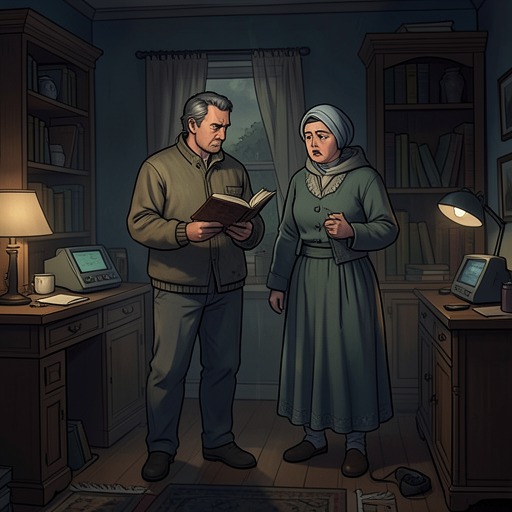
Danjel and Inga-Lena’s Marriage
The EmigrantsDanjel and Inga-Lena’s marriage is tested and remade by religious conviction, household duties, and emigration. Danjel’s conversion initially leads him to regard their marriage as spiritually false and to withdraw from his wife; Inga-Lena’s own rebirth later brings them together again. On the voyage to North America, her devotion to her family persists through illness, but she dies before reaching land. Danjel’s words at her sea burial turn their bond into a promise fulfilled in separation: she did not see the new country, yet, in his understanding, she reached the harbor before the living emigrants.
Marriage and Conversion
Before the change in Danjel’s beliefs, Inga-Lena was devoted to her husband and depended on him to make decisions. His conversion unsettled that familiar arrangement. He taught that people who had been reborn in Christ no longer belonged to the old life of the flesh, and judged marriages between people still living in that old state to be spiritually invalid. Because Inga-Lena had not yet experienced rebirth, he stopped sharing her bed and told her they could no longer have marital relations.
Danjel’s new understanding also affected how he regarded their children. He believed that a clean child must be conceived by parents who were reborn and free of sin, and he anguished over the fact that his three existing children had been conceived before his conversion. He prayed that God’s grace would purify and accept them. The conflict thus reached beyond the couple’s intimacy: Danjel’s theology made him question the spiritual status of the family they had already formed.
Inga-Lena’s Conflict and Rebirth
Inga-Lena tried to follow Danjel’s will, but she found the consequences of his faith difficult to accept. She was willing to feed a hungry visitor, yet worried when more people arrived at Kärragärde and the household’s responsibilities grew. She also struggled with Danjel’s refusal to protect the house with locks. After thieves stole pork and flour from the unlocked larder, she quietly began locking it at night, believing it was her responsibility to ensure there was enough food for everyone.
That small act of household care became a spiritual conflict for her. Inga-Lena felt guilty for disobeying her husband, and the biblical teaching that wives should submit to their husbands deepened her uncertainty. His withdrawal from the marriage left her feeling unclean and troubled; she prayed for guidance and admitted that she could not understand Åke Svensson’s teachings. Danjel prayed for her too. After a while, she experienced the rebirth that changed her understanding of their disagreement: she believed Danjel had been right about spiritual matters and that she must obey him. Their marriage was restored, and Danjel returned to their bed. Even so, Inga-Lena continued secretly locking the larder, so the reconciliation did not erase every practical conflict between her own judgment and his religious demands.
The Marriage Carried into Emigration
The couple’s later journey to North America placed their marriage within a much larger family and migration undertaking. Karl Oskar and Robert had arranged passage on the Charlotta, and Robert offered to obtain a contract for Danjel if the ship had room. Danjel expected nine people from Kärragärde, including children and household members. When the emigrants gathered at Åkerby Junction, he travelled with Inga-Lena, their children, and Ulrika of Västergöhl; two people from his household, Arvid and Elin, had to ride with Jonas Petter instead.
This departure joined a private household decision to a shared route and a practical plan. The emigrants aimed to leave in spring, when the sea would be less cold and winter storms had passed, and to arrive early enough to plant a crop before the next winter. For Danjel and Inga-Lena, the crossing therefore meant carrying their family into an uncertain future together. The group counted sixteen emigrants at the junction, nine adults and seven children, while three drivers were to return from Karlshamn. Their family life, already shaped by Danjel’s religious convictions, now depended on a crowded voyage and a passage they could not simply reverse.
Illness and Death at Sea
The crossing tested the household’s endurance. Inga-Lena had already faced doubt during a storm, when she feared she might become seasick despite the assurance associated with Åke Svensson’s teachings. Later, after the seasickness passed, she suffered dizziness, headaches, fainting, and prolonged bowel trouble. She continued cooking, caring for her husband and children, and keeping their clothes in order, even as her strength declined. Kristina noticed that she gave herself no rest and had become gaunt and weak.
Inga-Lena confided her worries to Kristina, including her fear that she might have ship sickness. The narrative names scurvy as one name for the illness affecting Kristina and others aboard, and Captain Lorentz recognized that Inga-Lena had suffered from it for a long time. Her illness was kept from Danjel: she did not want to disturb him, and he did not know how seriously ill she had been. After her death, he told Karl Oskar that she had died without admitting to him that she was sick. Her care for her family had continued even as she concealed the extent of her condition from her husband.
Sea Burial and the Meaning of Their Bond
Captain Lorentz’s funeral record identifies Inga-Lena as the wife of Danjel Andreasson, born in Kärragärde in Ljuder Parish and married on June 23, 1833. The record could establish the facts needed for the ceremony, but it could not contain the life she had shared with Danjel. The emigrants had left the parish registers behind and had not yet been recorded in another home; at sea they were, in the captain’s reflection, people with no settled place of belonging. Inga-Lena died between the old home and the destination, and the ocean became her resting place.
At the burial, Danjel stepped forward while Captain Lorentz prepared to give the crew the signal to lower the bier. He addressed Inga-Lena as his mate and recalled the biblical words that she had not been allowed to see the new land, though she had reached the harbor before them. He then remembered her promise, made when he wanted to move away, not to be separated from him: wherever he went, she would go too, and where he died, she would die and be buried. Her death made that declaration newly painful. She had followed him across the ocean, but the voyage ended with her body lowered into it while he and the children continued toward the country they had chosen together.
The marriage’s final image holds devotion and loss in the same scene. Inga-Lena’s promise had once expressed loyalty to Danjel’s decision to leave; at the ship’s rail, he used it to speak for a wife who could no longer answer. The union restored after their religious conflict did not protect them from the crossing’s hardships, but it shaped Danjel’s understanding of her death: separated from him in life, she had, in his words, arrived ahead of him at the harbor of the new land.