Debt burden at Korpamoen
The EmigrantsDebt burden at Korpamoen was not a single loan but the structure of Karl Oskar Nilsson’s precarious ownership: mortgage principal and interest, payments owed to his parents for their lifetime support, and repeated borrowing when harvests failed. The farm he had worked to acquire promised independence, yet its debts kept narrowing the family’s choices; after years of labor, the household had less livestock and more debt than when he took possession, and Karl Oskar came to see migration as the only credible chance to improve his family’s prospects.
The purchase and its obligations
In 1844, Karl Oskar took possession of one-sixteenth of a homestead at Korpamoen. The agreed price, including cattle and farming equipment, was 1,700 riksdaler, of which 800 was a mortgage. The sale also secured lifelong reserved rights for his parents, Nils and Märta: a room in the house, fodder for one cow and one sheep in summer and winter, three-quarters of an acre for their own crops, use of the farm’s team, and twelve bushels of grain each year, half rye and half barley. The agreement was marked with the crosses of Nils and Märta, who had never learned to write.
The transfer included an inheritance division. Each child received 210 riksdaler and twenty-four shillings; Robert and Lydia, still under age, left their portions as claims against their brother. Karl Oskar’s own savings from seven years in service, his wife’s dowry, and his inheritance together covered only a quarter of the purchase price. The remainder left him owing interest as well as principal: the mortgage required fifty riksdaler in annual interest.
The reserved rights were another lasting charge on the farm. They were intended to maintain Nils and Märta, not to enrich them, but they were substantial in relation to a holding of just one-sixteenth. Since his parents were only fifty-one and forty-eight when the transfer was made, Karl Oskar had to expect that this obligation would continue for many years. His new property was therefore bound to both a lender and his parents’ ongoing needs. He believed debts could be cleared by work, and at first did not let the burden deter him.
A small holding under pressure
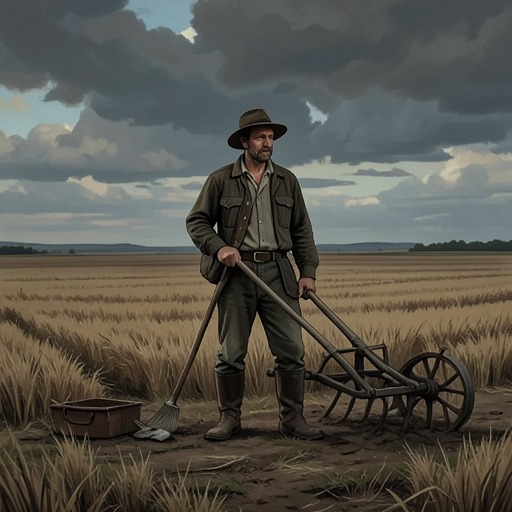
The land could not readily generate the income needed to service its obligations. Karl Oskar had seven acres, most of them poor, sandy soil, and the farm could not support a horse. A horse might have allowed him to earn money hauling timber, but it would require three additional acres just to provide winter feed. When he surveyed the unbroken ground in search of land to clear, the fields, woods, moors, and meadows offered little prospect of easy expansion: his iron bar repeatedly struck stone.
The wider parish economy helps explain why so small a holding offered so little security. Ljuder’s original forty-three homesteads had been divided into 254 independent farms by 1846, with two-thirds no larger than one-eighth of an original homestead. Over the preceding century, the parish population had nearly tripled, while the number of people outside the assessed landholding population had grown fivefold. The narrative does not reduce Karl Oskar’s hardship to these figures, but places it in a community where land had been subdivided among more people and many livelihoods depended on scant resources.
The first farming year, 1845, brought a good crop, and Karl Oskar paid the mortgage interest on time. The next year’s crop was also good, but the harvest went badly: rye sprouted in the shocks, and the bread made from it was soggy. To raise money for interest, the couple sold a calf and half their pig. Karl Oskar borrowed the twenty riksdaler he still lacked from his father, Nils.
The following year brought a succession of losses. Heavy July rain spoiled much of the hay, which the animals would not eat; Karl Oskar and Kristina had to sell a cow. Another cow had a stillborn calf, a sheep disappeared in the woods, and potato rot destroyed nearly half the crop. During the winter, there were days when the potato pot was empty. The mortgage did not pause for these setbacks: Karl Oskar borrowed the full amount of the interest, and Nils no longer had money to lend.
Borrowing, losses, and a widening deficit
At Kristina’s suggestion, Karl Oskar turned to her uncle, Danjel Andreasson, in Kärragärde. Danjel lent him fifty riksdaler for the mortgage interest. In the same year, the couple’s twins were born; the boy died within a fortnight, while the girl, Märta, survived and became known as Lill-Märta. The family’s needs and its financial liabilities grew together, even as the resources that might have met them diminished.
The arithmetic after three years was stark: Korpamoen had one cow fewer and seventy riksdaler more debt than when Karl Oskar took it over. This was not the result of idleness. Karl Oskar and Kristina had worked as hard as they could, but weather and animal losses defeated their effort to get ahead. Nils recalled the biblical teaching that people must earn bread through labor; Karl Oskar answered that even labor and sweat might not secure bread. Their exchange marks the difference between the inherited expectation that work should sustain a household and the evidence of a farm where work alone could not reliably meet the mortgage.
Later, with the family still short of land and food, Karl Oskar told Kristina that he worried about how they would live and where food would come from as their numbers increased. She was five months pregnant; there would soon be eight people at Korpamoen, while the acreage would remain seven. In the autumn he again went to Danjel for fifty daler toward the mortgage interest. Danjel provided the money, but Karl Oskar returned with the sense that something unusual was happening at Kärragärde. The loan relieved the immediate payment, not the recurring problem that had made it necessary.
Debt and the decision to leave
After four years, Karl Oskar and Kristina were several hundred riksdaler poorer than when they began. He feared that staying meant continuing to labor until they were worn out, with no reward beyond the small room reserved for his parents and the meager provision attached to it. Their experience made the farm’s obligations feel less like a temporary obstacle than a future already laid out: debt would continue, while the land and the family’s means of support would not grow.
The question of their children sharpened the stakes. If the family remained, one child might inherit Korpamoen, but the others would face farm service or life as squatters. Karl Oskar and Kristina did not want that future for them and concluded they could do no better for their children unless they left the impoverished place. His hope that land in North America would be fertile and inexpensive was a belief about the possibilities there, not a guarantee. What mattered to him was the contrast: in America, he imagined, hard work might allow a family to improve its position, whereas at Korpamoen the same exertion had brought deeper debt.
The choice met resistance at home and ridicule outside it. Nils quietly reminded his son that he was taking many people along, including descendants Karl Oskar could not yet know. The family’s departure also left the parents behind, their reserved rights now to be met by someone else. As the wagon went out through the gate, Karl Oskar saw Nils on crutches beside Märta on the porch: the young were leaving, while the old remained rooted at Korpamoen. That separation gives the debt burden its lasting human consequence. It had begun in the terms of a farm purchase, but years of interest, poor harvests, limited land, and duties across generations turned it into a force shaping where the family could live and what future they believed they could offer their children.
The burden beyond the farm
Debt at Korpamoen belongs to a wider picture of rural scarcity, but the text distinguishes contractual obligation from communal aid. Ljuder divided poor and incapacitated residents into groups for parish assistance; the most dependent might receive as much as three riksdaler a year and four bushels of barley. Such aid was limited and did not erase the difference between relief and the costs of owning a farm. Karl Oskar’s mortgage interest alone was fifty riksdaler annually, while the reserved rights required continuing food, fodder, land, and housing for his parents.
The burden also explains why inheritance and family duty cannot be separated from the economic story. Nils had already lent his son what he could, and the agreement protected both parents’ maintenance after they surrendered the farm. Their claims were legitimate provisions within the transfer, yet they intensified the pressure on an undersized holding. The tension is not between a dutiful son and grasping parents; it is between obligations that each have a human basis and a farm too small to satisfy them securely.
The family’s preparations for departure make the scale of the change tangible. Their old oak clothes chest, passed through generations and associated with weddings, births, and funerals, was brought down from the attic to serve as a sturdy packing case. They filled it with tools and hunting equipment, while provisions for the journey included rye and barley loaves, salted foods, honey, and other supplies. These objects do not cancel the debt that drove the departure. They show what the family could carry from a home whose land and obligations had constrained them, as they set out to test whether their labor might have a different return elsewhere.