Everything Is Narrow, Here at Home!
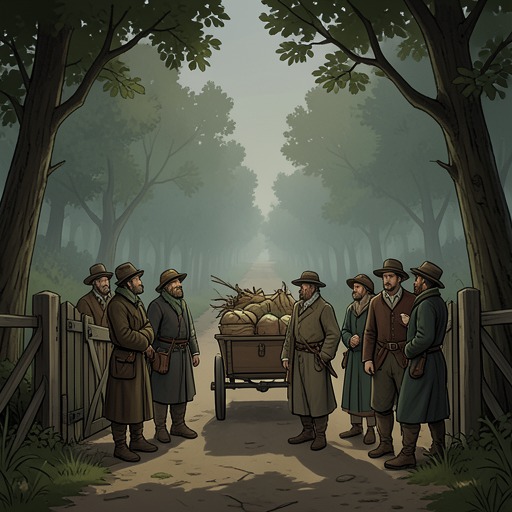
The Emigrants“Everything Is Narrow, Here at Home!” is Robert Nilsson’s brief remark as the emigrants’ wagon squeezes through the gate at his family’s home. Its immediate reference is physical, but its force extends across the journey: the emigrants leave a land of shrinking plots and scarce food for a promised abundance, only to encounter the narrow limits of their resources, the ship, and the crossing itself.
The Departure Through the Gate
The line comes during the Nilsson family’s departure from Korpamoen. Their belongings are piled high on the wagon, and the gate is so narrow that the steering shaft catches one of its posts; the team barely gets the load through. Nils’s final words to his departing sons are an instruction to drive carefully through it. Robert’s answer converts that practical obstruction into a judgment about home: “Everything is narrow, here at home!”
The scene sets the young travelers in motion while their parents remain on the porch. Karl Oskar turns back to look at them: his father is stooped and leaning on crutches, his mother stands beside him, and the younger generation rides away. The gate marks a threshold, but passing it does not erase what is left behind. As the wagon continues, the family watches familiar places with the knowledge that they may never see them in the same way again.
A Phrase for the Pressures to Leave
The remark condenses several distinct pressures without making the emigrants’ motives identical. The group from Ljuder Parish includes people driven by crop failure, persecution by civil authorities, religious dissent, personal troubles, social ostracism, and unfair employment practices. For Karl Oskar, the decision is rooted in the years of labor and mounting poverty at Korpamoen: after four years, he and Kristina are several hundred riksdaler poorer, and he sees only further exhaustion and an impoverished old age if they stay.
Kristina’s doubts expose the other side of the departure. She fears that her husband’s hopeful picture of America may be a wild-goose chase: they have no land deed, no written guarantee of tillable soil, and no reliable acquaintance who has seen North America and can describe it. The phrase’s certainty about the narrowness of home therefore stands beside uncertainty about the destination. Leaving answers the limits of one life without providing firm knowledge of the next.
Narrowness on the Road and at Sea
The journey tests the apparent openness of the phrase. Robert counts the gates on the road to America, jumping down to open them; by Åkerby Junction he has opened five. The repeated thresholds make departure feel like a sequence of passages, each one counted, rather than a single clean break. At Karlshamn, the emigrants face a sea so broad that, for the first time in their lives, they look across water without seeing land on the other side.
Yet the ship gives the line an ironic afterlife. Robert and Arvid pace the brig Charlotta and find it only forty paces long and eight wide, a confined living space for almost a hundred people. The emigrants have left the tight gate and the restricted prospects of home, but their passage takes place inside another enclosure. Contrary winds prolong the voyage; the travelers count distance in days at sea and grow suspicious that North America is farther away than they were told. Movement across the ocean brings its own forms of constraint.
From Local Complaint to Emigration Motif
The book’s chapter heading, “ALL GATES OPEN ON THE ROAD TO AMERICA,” enlarges the departure into a motif of access and passage. Against that promise, Robert’s line names the constriction from which the travelers are setting out. The contrast is not simply between a closed Sweden and an open America: migration requires money, passage, and a willingness to act without the guarantees Kristina wants, while the ship and the weather impose limits of their own.
When America finally appears, the vision of green earth restores energy to passengers worn down by confinement, illness, and the monotonous voyage. That arrival gives the earlier complaint a changed resonance. “Everything Is Narrow, Here at Home!” begins as a response to a gate that nearly will not let the wagon through; across the novel’s route from parish to port to ship, it becomes a memorable measure of why the emigrants leave—and of how much uncertainty and confinement lie between departure and the land they seek.