God
The EmigrantsGod is not a speaking character in these episodes, but a decisive presence through whom the characters interpret chance, suffering, faith, and responsibility. Their convictions give events a providential order; the storm at sea tests that order, and the emigrants’ suffering exposes the distance between trusting God and being spared pain.
Providence and the Shape of a Life
Nils Jakob’s Son understands his crippling accident through divine preordination rather than grievance. He believes God had determined that a stone in his field would roll back into its hole at a particular hour; he would lose his footing, fall, and break his hip. To question why this happened would be presumptuous toward the Creator, so he does not burden himself with questions. His acceptance is not presented as a cure for his disability: he still walks on crutches. Instead, faith gives the injury a place within an order he believes he cannot judge.
The consequences of the fall remain visible in the landscape and in the family’s work. After twenty-five years of clearing stones and building stone fences, Nils Jakob’s Son sees the heaps and boundaries he made remain in place, while Karl Oskar plows and sows the fields. The son reaps what the father cleared, even as the small farm and its poor soil leave Karl Oskar worried about debt and interest. Providence here does not erase material hardship; it coexists with inherited labor, bodily loss, and the narrow means of family life.
Kristina likewise reads her history as a sequence guided by God. She traces her marriage to Karl Oskar back to the childhood fall from a swing that injured her knee and sent her to Berta of Idemo for treatment. That encounter led, in her reckoning, to their marriage, their life at Korpamoen, and the birth of their children. She believes God directed the chain of events, while the narrative gives that belief a concrete and intimate starting point: an ox-thong swing made at her parents’ home. Even after becoming a wife and mother, Kristina secretly makes another swing in the threshing barn, holding on to a pleasure her mother-in-law considers unbecoming.
God in the Storm
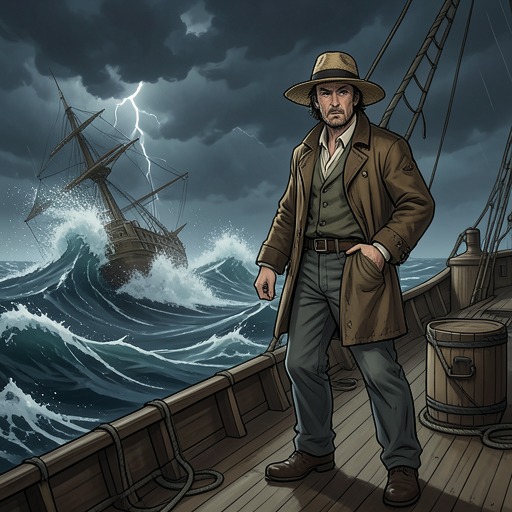
During the storm aboard the brig Charlotta, Danjel’s faith is driven to the edge of doubt. The ship is tossed on high waves, passengers suffer violently from seasickness, and fear of drowning is bound up with fear of death and judgment. Danjel searches for signs of divine protection and sees none. He recognizes that fright is overtaking him, and that the questions pressing in—whether God is near—threaten the certainty on which he relies.
Danjel opens his Bible and finds the ninety-third Psalm. Its declaration that the Lord is mightier than the roaring waters restores his confidence. He understands the words as evidence that God is present aboard the ship, as near on the ocean as at home in Kärragärde. The sea is no longer simply an alien space beyond the protection of solid houses and familiar land: Danjel believes God sails with the emigrants and that they may walk as safely on the rocking ship as on firm ground.
He carries this conviction to the people in the bunks, telling them that God is with them and that the storm is a trial of their faith. He also reads the Gospel account of Christ calming a tempest. Yet the scene refuses an easy confirmation of his assurance. The seasick passengers are absorbed in their pain; Christ does not appear to quiet their storm, and the biblical reproach of little faith cannot reach those lying helpless in their own sickness. Danjel’s reading offers comfort, but the suffering around him remains real and unresolved.
Visions, Rebirth, and Human Vulnerability
In Elin’s dream, God appears at a distance in heaven. Elin sees her mother plant a flower that grows up to the sky; the China lily blossoms, a window opens, and God looks out, breaks off the flower, and takes it away. The stalk then blackens and withers, while the hole in the flower bed deepens into something like a grave. Elin recognizes the churchyard where her little brother died and hears that the body lies in the grave; waking, she understands herself to be dead and buried there too.
The vision links growth and loss rather than resolving one into the other. God’s taking of the flower gives the dream an image of heavenly possession, but what follows is decay, fear, and the grave. Its meaning belongs to Elin’s dream, not to a confirmed event in waking life. The image also stands beside the characters’ talk of being reborn in Christ: religious language offers a way to imagine purity and transformation, while the dream makes mortality and grief impossible to overlook.
Ulrika’s prayer on the ship shows another register of religious vulnerability. She addresses Jesus as one who lives within her and asks for strength against temptation, confessing that she is sometimes wretched and that rebirth is not always easy. Her words make faith neither a settled status nor a protection from bodily and moral struggle. The crowded ship, with its perceived sexual threat and discomfort, strains the religious identity she is trying to sustain.
Providence and Responsibility
The novel’s account of providence does not simply absolve people of responsibility. After the voyage has carried Kristina into grave danger, Karl Oskar takes her cold hand and faces the thought he has tried to evade: he persuaded her to follow him and brought his wife and children across the sea. He had declared that someone must take responsibility and that he would take it; now, confronted by the price of the decision, he feels regret.
That reckoning sets human choice beside faith in divine order. Nils Jakob’s Son accepts his accident as preordained, and Kristina sees divine direction in the turns that shaped her marriage. Danjel finds God present in a storm but cannot make the suffering disappear. Karl Oskar, meanwhile, cannot place the consequences of emigration wholly beyond himself. God remains central to how the characters make sense of their lives, but belief does not cancel pain, uncertainty, or the obligation to answer for what human beings have chosen.