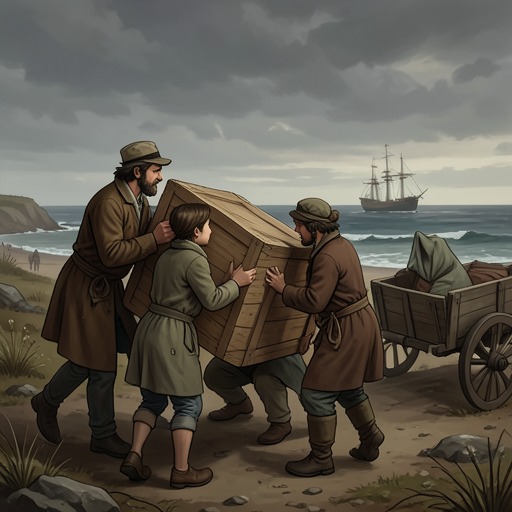
Group emigration (1845–1865)
The EmigrantsGroup emigration from Sweden to America, most common between 1845 and 1865, transformed separate household crises into collective departure. The Emigrants presents the Ljuder emigrants not as people moved by one common grievance, but as a small cross-section of a larger migration: they share a route while carrying distinct reasons for leaving, unequal confidence in the destination, and the material risks of getting there.
Historical Setting and Pressures
Nineteenth-century Swedish emigration unfolded in individual, group, and mass phases. The group movement was especially prominent from 1845 to 1865, when parties commonly numbering fifteen to two hundred people joined together to establish farming or religious settlements in America. Famine and religious persecution were among the powerful pressures behind departure, but the novel broadens the picture beyond any single cause.
The book’s opening frames migration as a disturbance in communities long associated with stability. Population grew while family plots diminished; reports circulated of fertile land available to those willing to cultivate it. Newspapers, books, pictures, and neighbors carried news into villages where no one had personally explored the distant country. The ocean and the destination therefore remained uncertain even as rumor made them imaginable. Hesitation divided the communities: the cautious questioned what could be trusted, while the bold unsettled inherited habits and set movement in motion.
The Ljuder group makes this broad movement legible through differences among its members. Crop failure, conflict with civil authorities, religious dissent, personal troubles, social ostracism, and unfair employment practices all contribute to the decision to leave. Their dissatisfaction is shared, but their motives are not interchangeable. The group thus functions as a compact portrait of an era in which distinct local pressures could converge on the same transatlantic passage.
Household Decisions and Unequal Hopes
For Karl Oskar Nilsson, emigration answers the prospect of labor without improvement. After four years at Korpamoen, he and Kristina Johansdotter were several hundred riksdaler poorer than when they began. He feared that remaining meant exhausting their youth only to end in the reserved room, dependent on meager bread like his disabled father. His case makes economic pressure more than a general wish for prosperity: it is a forecast of bodily decline and a future in which years of work leave little behind.
Kristina’s reluctance gives the decision its counterweight. She feared that America might prove a wild-goose chase. No official had promised them land; they held no deed, knew no returned emigrant who could describe the country firsthand, and could not treat printed accounts as reliable proof. She wanted written assurances before undertaking a journey whose destination and outcome they could not verify. The couple’s choice therefore emerges through argument and sustained conversation, not from an uncomplicated shared dream.
The hope of American land also had to pass the test of money. After selling Korpamoen and auctioning its belongings and livestock, Karl Oskar had about 1,200 daler left after debts. Passage for the family—three adults and three children—would cost 675 daler, leaving roughly 500 for arrival fees, inland transportation, tools, and cattle. The journey would consume nearly half the amount needed to buy a farm, and the land they hoped to obtain cheaply was still only an expectation. Kristina sewed the remaining money into a sheepskin bag that Karl Oskar could fasten to his belt and carry against his body: the imagined future depended on protecting a very tangible reserve.
Making a Collective Journey
The passage required transport arrangements as well as resolve. Karl Oskar and Robert Nilsson had written to a firm in Karlshamn and secured places for six people aboard the Charlotta, a merchant vessel carrying both cargo and emigrants. They paid a hundred daler in advance. Spring was considered the favorable season: after the winter storms, the emigrants could hope to arrive early enough to cultivate and sow, with a fall harvest to supply the coming winter. The ship was expected to sail directly to New York, without stopping at another harbor.
The plan widened through relationships. Karl Oskar, indebted to Danjel Andreasson for help with a loan, offered to help arrange Danjel’s passage in return. Robert was to seek a contract for the Kärragärde household if the vessel had room; Danjel expected nine people, including children and household members. A passage initially arranged for one family thus became a route through which another household could join, provided the ship had capacity and the fare could be found.
At Åkerby Junction, the emigrants converged in several wagons. Danjel came with his wife, four children, and Ulrika of Västergöhl; Jonas Petter of Hästebäck drove his own wagon, carrying his hired man and two people who had not found space with Danjel. Nineteen people were present, but three drivers would return from Karlshamn, leaving sixteen emigrants: nine adults and seven children. Jonas Petter joked that they made a large enough family, then asked who should head it. The question captures a practical feature of group departure: households retained their own identities, but the road required them to travel together and negotiate collective responsibility.
Passage, Risk, and the Meaning of Arrival
Leaving home did not erase the differences among the emigrants, nor did it guarantee that their hopes would be fulfilled. The crossing brought confinement, storms, illness, and hardship. Scurvy and ship fever weakened passengers, while the monotonous days aboard ship wore down their spirits. The journey’s material dangers expose the distance between America as a promise of fertile land and the vulnerable bodies that had to cross the ocean to reach it.
When the Charlotta reached New York, the sight of green earth changed the passengers’ immediate sense of what was possible. After searching the shoreline from the bay, they recognized trees, grass, and living ground. The view confirmed that they had crossed the sea and stood once more before land. The sick felt that they might recover; the exhausted found fresh energy, and the dispirited and timid regained initiative and boldness. Their renewed hope did not prove that the imagined future would match reality, but it marked the emotional culmination of the passage: a movement assembled from scarcity, doubt, money, kinship, and transport arrived at the threshold of the land that had drawn it onward.