Inga-Lena’s burial at sea
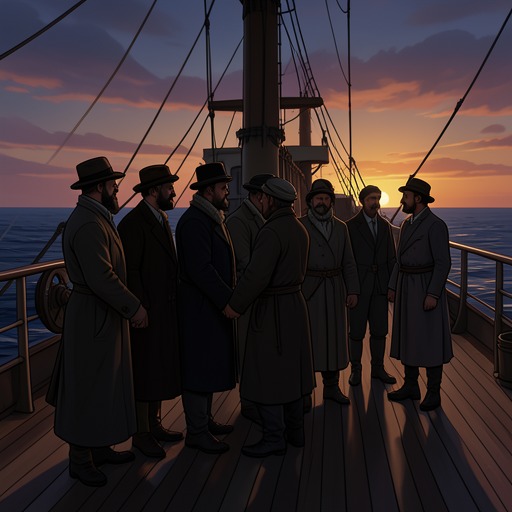
The EmigrantsInga-Lena’s burial at sea is the Charlotta’s eighth funeral and one of the voyage’s defining reckonings with what migration costs. On June 17, 1850, her husband Danjel Andreasson and their four children stand among the emigrants as Captain Lorentz conducts the prescribed ceremony. Three shovelfuls of soil carried from Sweden are scattered over her canvas-wrapped body; moments later, the bundle slips into the Atlantic. The ritual makes homeland tangible at the edge of a grave that cannot hold it, while Danjel’s final words recast his wife’s failure to reach New York as an arrival before the rest of the family.
The death behind the ceremony
The burial follows a long decline during the crossing. Inga-Lena had continued tending to Danjel and the children even as her health worsened. After prolonged digestive troubles, weakness, fainting, dizziness, and headaches, she confided her fears to Kristina. The illness was identified as scurvy, also called ship-sickness. By the time Captain Lorentz saw her during a severe hemorrhage, he recognized that she had been ill for a long time and feared that she would not survive. She died aboard the brig Charlotta while it was bound for New York.
The record Lorentz prepared for the funeral makes the loss both bureaucratic and unsettlingly intimate. It identifies her as Inga-Lena Andersdotter, born October 4, 1809, from Kärragärde in Ljuder Parish, and married to Danjel Andreasson in 1833. The captain needs a name, sex, and age to conduct the service, but the information does not settle in his mind: he has seen a dying woman who seemed younger, and remembers three children beside her although the record says she left four. The discrepancy briefly opens a gap between the person reduced to a register entry and the family life carried on the ship.
A funeral in the middle of the crossing
On a calm June morning, the emigrants gather on the Charlotta’s afterdeck around a makeshift bier: planks balanced on low sawhorses, with Inga-Lena’s body wrapped in canvas. The passengers have put on their Sunday clothes; the men stand bareheaded, and the women bow their covered heads. Captain Lorentz reads from the prayerbook, following the shipboard procedure for burying the dead. His words ask God to teach the living to remember death and gain understanding. The formal rite gives the gathered passengers a shared structure for grief, but it cannot make the ocean into familiar ground.
The most distinctive part of the burial is the soil. A wooden bushel measure, half full of earth, stands beside the bier, with a small scoop stuck in it. Three times Lorentz lifts soil from the measure and empties it over the canvas. The earth came from Sweden, the ground Inga-Lena had worked and crossed through her life: potato furrows, barley fields, barns, and household tasks. During the ceremony, some of the soil slips away from the canvas and into the sea before her body is lowered. The gesture joins a specific homeland to a burial place with no marked grave, while the drifting grains show how fragile that connection is.
Danjel’s farewell
As the service nears its end, Danjel steps forward with a baby in his arms. The scene gathers the altered shape of his family into view: he is now surrounded by four children, without his wife. Captain Lorentz yields his place at the head of the bier, allowing the surviving husband to speak. Danjel’s voice is quiet, not that of a commander, and only those nearest can hear him.
Danjel interprets Inga-Lena’s death through a biblical parallel. He says that, like Moses, she will not enter the promised land; she has not been allowed to see the new country, yet she has reached the harbor before the others. He then recalls the words she had spoken when he planned to move away: “where you go, there will I go, where you die there will I die and be buried.” Her earlier pledge to share his journey now returns as a vow fulfilled in a form neither could have intended. The emigration has carried them across the ocean together, but the destination divides them: Danjel and the children continue toward North America while Inga-Lena is committed to the sea.
Lowered into the Atlantic
After Danjel steps back, two seamen slide the canvas-wrapped body from the bier into the water. The ship’s flag is raised and lowered three times. The emigrants disperse, the crew takes apart the rough bier, and the Charlotta sails on with one passenger less. The practical resumption of the voyage follows the ceremony almost at once: the dead are buried at sea, the equipment is cleared, and the ship continues its course.
The ending holds the ritual’s two materials in contrast. The Atlantic receives the body, while Swedish soil has already begun to leave the canvas and mingle with the water. For a woman who had spent her life on land and joined the voyage after Danjel, the sea becomes both grave and the only resting place available on the route. The passengers’ act of carrying homeland soil aboard offers a remnant of familiar earth, but it cannot give Inga-Lena a grave on land or bring her to the country toward which the family sailed. Her burial turns the emigrant passage from a collective journey toward a new home into a journey marked by an irreversible absence.