Jesus Christ
The EmigrantsJesus Christ is both a figure directly encountered in Danjel Andreasson’s vision and the spiritual authority through whom several characters interpret their lives. His presence gives Danjel a mission, offers a language for enduring a storm at sea, and becomes a point of conflict when claims of Christian purity collide with the messy realities of life aboard the emigrant ship.
The visitation at Kärragärde
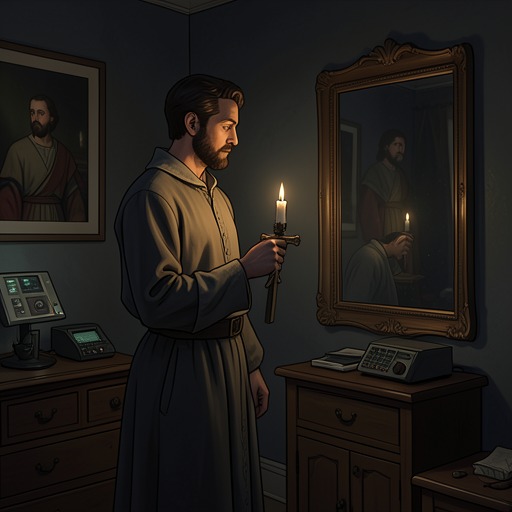
In the fall of 1848, Danjel was forty-four and had led what was described as a quiet, blameless life, accepting the established faith. One night, after feeling anxious and unwell, he woke to a heavy knock at the door. When he opened it, the room was lit by a brilliant lantern held by Jesus Christ. Danjel recognized the visitor from the church altarpiece; the light was so intense that he had to lower his eyes. Jesus studied him compassionately but said nothing.
The other visitor introduced himself as Åke Svensson, Danjel’s maternal uncle, who had died in Danvik asylum. Åke told Danjel that Jesus had awakened him to continue his uncle’s work on earth and urged him to complete that mission. The visitors then disappeared, and the lantern’s light went out. Danjel’s wife, Inga-Lena, thought he might have dreamed the encounter, but Danjel insisted that he had been awake and remembered the lantern as identical to the one in the church painting. The narrative presents the experience through Danjel’s conviction without settling the question of its supernatural or dreamlike status.
A life redirected by the call
Danjel understood the brief encounter as a command. He believed the Spirit would guide his actions, and from then on he no longer hesitated over his undertakings or worried about their outcome. He took up Åke’s teachings, which had faded from local memory, and resolved to live after the example of the apostles and the first Christians. The lantern that had illuminated the night became an image of the spiritual direction he believed he had been given.
His response took shape in repeated practices rather than in vision alone. On Sundays he held Bible talks at home for his family and servants, welcoming any neighbor who happened to visit. He attended Communion at church and prayed while working in the fields, barn, and elsewhere. He knelt to pray and sometimes cried aloud, alarming people nearby. His religious life also included gatherings at his home: at one devotional supper, with ten guests present as a snowstorm gathered outside, he announced that Jesus had arrived and began a hymn associated with Gethsemane. The gathering shows how his conviction made the sacred feel present in ordinary domestic space.
Faith, purity, and conflict
Jesus’s authority also shapes the way characters judge themselves and one another. Elin regards herself and her mother, Ulrika, as reborn in Christ and washed clean, in contrast to a man she considers wicked. This language of spiritual rebirth offers them a basis for self-understanding, but it also sharpens disputes over who can claim innocence and purity.
A quarrel aboard the emigrant ship makes the tension explicit. When Kristina and Ulrika argued over lice, Ulrika demanded that Kristina seek forgiveness from Christ’s body, and Kristina retorted that she would sooner kneel to the devil. Ulrika treated freedom from lice as evidence of having been made clean through faith, extending her claim to Jesus and his disciples while making an exception for Judas. She even began to unbutton her blouse to prove that she had no lice. The episode does not establish Jesus’s judgment; it shows his name invoked as the final warrant in a very human argument about cleanliness, shame, and religious standing.
The storm and the limits of consolation
During a storm at sea, Danjel’s confidence faltered. Looking for reassurance, he opened his Bible and found the ninety-third Psalm, whose declaration that the Lord is mightier than the waters restored his faith. He concluded that God was present aboard the Charlotta as surely as at home in Kärragärde, and told frightened passengers that the storm was a trial of their belief. He then read them the Gospel account of Jesus calming a tempest after his disciples feared for their lives.
The story’s effect is sharply limited. Some passengers were too seasick and absorbed in their immediate suffering to take comfort from Danjel’s reading. The Gospel describes a storm stilled by Jesus; the emigrants’ storm continues, and Jesus does not visibly come aboard to end it. Danjel’s faith lets him interpret the danger as a test and find courage within it, but the scene distinguishes his renewed assurance from the passengers’ bodily distress rather than presenting religious words as an easy remedy.
Providence and human responsibility
Across the story, belief in divine direction meets events whose meanings remain painful or uncertain. Nils Jakob’s Son accepts his disabling accident as preordained by God and refuses to question the Creator. Kristina, in turn, sees her childhood fall from a swing as the beginning of the chain of events that led her to meet Karl Oskar and build a family with him; she understands even this turning point as willed by God. These beliefs echo Danjel’s trust in the call he received, but they do not make every consequence benign or simple.
That tension becomes especially stark when Karl Oskar faces Kristina’s grave illness during the voyage. He recognizes that he persuaded her and their children to emigrate and had expressly taken responsibility for the decision. Now, confronting its price, he regrets what he has done. Jesus Christ is not present in this moment as a speaking or visible figure, but the crisis places the language of providence and faith beside the burden of human choice. The novel’s religious world offers characters ways to understand suffering and act within it; it does not erase the cost of their decisions or make that cost certain in advance.