Jonas Petter of Hästebäck
The EmigrantsJonas Petter of Hästebäck is a farmer from near Korpamoen whose practical kindness and long memory shape Robert’s understanding of the people and possibilities beyond his immediate home. He gives Robert a ride without demanding an explanation, then entertains fellow travelers with tales that range from local scandal to the disappearance of a man who may have found his way to America. His stories preserve the parish’s history, but their judgments also expose the biases through which that history is told.
Identity and Place in the Parish
Jonas Petter is a neighbor of the Nilsson family in Korpamoen. The narrative introduces him not through a formal account of his household but as a familiar local figure: a farmer taking grain to the mill, a man recognized by the surrounding community, and a collector of stories about people and events in Konga County. He knows accounts reaching back nearly a century and is especially ready to share them when a journey brings a group of listeners together.
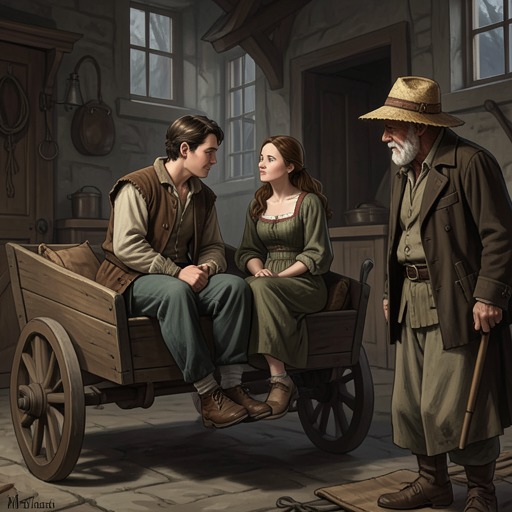
His place in village life is practical as well as conversational. On the road to Åbro mill, he encounters Robert, who has left his position as a farmhand and is traveling barefoot. Jonas Petter allows him onto the wagon, beside the sacks of grain, and comments only that it is dangerous to walk without shoes so early in spring. He does not ask where Robert is going. The omission matters: at a moment when a fugitive might expect interrogation, Jonas Petter offers a ride without turning the encounter into an inquiry.
The Ride to Åbro Mill
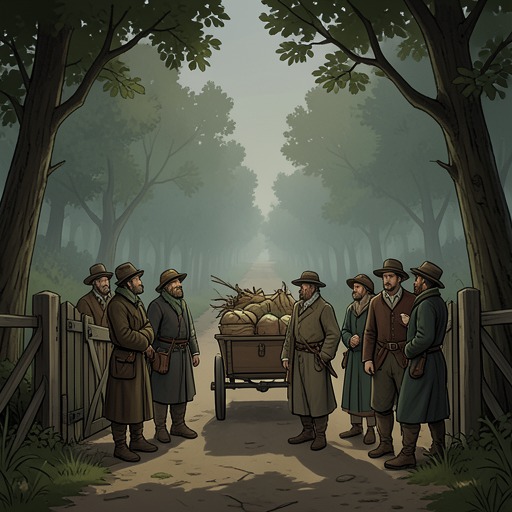
At the mill, Jonas Petter joins three other farmers waiting for their grain to be ground. Robert stays with the men in the mill room, where they eat food brought from home and drink spirits. One of the farmers gives him bread and a drink. Against this ordinary setting of shared provisions and conversation, Robert’s own sense of relief comes into focus: he is no longer on his way to work as a hired servant, and his heart feels light.
Jonas Petter’s manner helps sustain that brief refuge. He stretches out on empty sacks near the fire and speaks with the ease of someone accustomed to an audience. For Robert, the warmth and company are not merely background to the escape; they provide a pause in which he can imagine his departure as an opening rather than a return to service. Jonas Petter does not explicitly endorse Robert’s decision, but his unasked questions leave room for the young man to remain, for the moment, simply a passenger.
Storytelling and Local Memory
Jonas Petter’s stories turn the mill room and the road into informal archives. He begins one account by asking who remembers Axelina, the former owner of the mill and, as he tells it, the richest woman in the parish. When the other farmers cannot supply the history, he takes the role of teller. His version follows Axelina’s connection to Frans the Miller, the inheritance first left to their son, and the son’s death, after which Axelina inherited the mill and Frans’s remaining possessions. The tale ends by emphasizing the extraordinary wealth she acquired and the ease with which, in Jonas Petter’s telling, she had obtained it.
Robert notices that Jonas Petter repeatedly tells stories that demean women. The narration connects this habit to the troubled marriage Jonas Petter is said to have with Brita-Stafva. Their quarrels are so loud that people passing outside can hear them; horses have bolted in response to the disturbance, and Jonas Petter sometimes sleeps in the byre rather than in the same house as his wife. The contrast between his public fluency and his unhappy domestic life complicates the authority of his anecdotes. He is a storehouse of local recollection, but the stories carry personal resentment as well as communal memory.
Fredrik Thron and the Idea of Escape
While resting at the mill, Robert asks whether Jonas Petter remembers Fredrik Thron, a man who disappeared from home. Jonas Petter responds with a sharply negative portrait. He recalls Fredrik as a notorious troublemaker, accused of theft and disruptive pranks, and says that the parish had turned against him. He also recalls that Lieutenant Rudeborg had paid half of Fredrik’s fare to America and watched him board the coach at Gothenburg before later reporting him to the sheriff over stolen oxen. By the time the authorities came to fetch him, Fredrik had vanished.
Jonas Petter concludes that no one in the parish had seen Fredrik for fifteen years and that people said he had taken to the sea. The report is uncertain: it does not establish that Fredrik reached America, or even confirm where he went. Yet that uncertainty is precisely what captures Robert’s attention. Fredrik’s disappearance suggests that a person written off by the parish might nevertheless leave its reach. Robert imagines his own name entered in the church record under “End of the Parish,” his whereabouts unknown year after year. Jonas Petter’s anecdote thus gives a concrete, if unresolved, precedent to Robert’s hope of escaping the life assigned to him.
Narrative Role
Jonas Petter is neither simply a benefactor nor a neutral chronicler. His unintrusive ride helps Robert at a vulnerable point, while his stories supply the young man with examples of how the community remembers those who depart, misbehave, or fall into disgrace. His recollections carry useful local knowledge, but the novel also makes their limits visible through their gendered mockery and through Robert’s recognition that the teller’s own marriage is bitter.
As a character, Jonas Petter links everyday travel to oral history. His tales are performances addressed to whoever happens to be nearby: farmers waiting at a mill, passengers on the road, or a young man considering whether departure can remake his future. They preserve names and incidents that might otherwise fade from parish memory, even as they color them with judgment, rumor, and the teller’s temperament. The result is a double image: a neighbor capable of kindness toward a fugitive, and a loquacious storyteller whose accounts reveal as much about the speaker and his community as about the people he describes.