Kärragärde
The EmigrantsKärragärde is a farm in Ljuder Parish, owned by Danjel Andreasson and remembered as the local center of Åkianism. Under Danjel it becomes both a household and a dissenting religious meeting place: neighbors and paupers join its small congregation, private worship gives way to an unauthorized Communion service, and the authorities respond with punishment. Later, the farm’s people leave as part of the emigration to America, carrying the community’s religious history into the journey.
Farm and Inherited Reputation
Kärragärde’s religious significance predates Danjel’s leadership. The Åkian sect had adherents in Elmeboda and Ljuder Parishes, with roughly forty people counted among its members. Many belonged to the widely dispersed family of Åke Svensson, and Kärragärde—owned by Åke’s brother-in-law Andreas Månsson—served as the sect’s home in Ljuder. Its identity as a gathering place thus arose within an extended kinship network, not as an isolated household movement.
That history remained socially charged long after Åke’s death. When Kristina’s family connections became a subject of concern, her relation to the founder through her mother and her uncle Danjel’s ownership of Kärragärde were treated as grounds for suspicion. More than fifty years had passed since Åke died in Danvik asylum, and the account notes that people generally believed nothing of the old movement had survived at the farm. Yet the parish’s hostility endured: relatives of Åke did not boast of the connection. The contrast between the apparent disappearance of the sect and the persistence of its stigma sets the conditions for Danjel’s later revival.
Danjel’s Household Fellowship
Danjel’s life changes, and he resumes Åke’s teachings at Kärragärde. Every Sunday he gives Bible talks to his household—his wife, children, and servants—welcoming a neighbor who happens to call. His devotion is not limited to a scheduled gathering: he prays while working in the field, at the plow or harrow, and in the barn, kneeling even when labor is underway. At times his prayers are loud enough that people nearby come to see whether he needs help. The farm’s religious life is therefore woven into domestic routine and physical work as well as formal worship.
The congregation expands beyond the family. Paupers living on the farm and several neighbors embrace the Åkian teachings, forming a small flock at Kärragärde. They regard Danjel as a new apostle of the Lord on earth. To adherents, the farm offers a place to gather and a religious authority grounded in their shared faith; to opponents, the meetings revive what they regard as a dangerous heresy. Word of the gatherings reaches Dean Brusander, and reports describe people meeting under the pretext of devotion while Danjel preaches the Åkian faith.
The movement also shapes life within Danjel’s marriage. His wife’s conscience troubles her when she disobeys him, because she understands the biblical teaching in Ephesians to make the husband head of the wife. That scriptural principle gives religious belief a direct bearing on domestic authority: the community’s faith is not only a set of teachings circulated at meetings, but a framework through which household members understand obedience and obligation.
The Unauthorized Communion
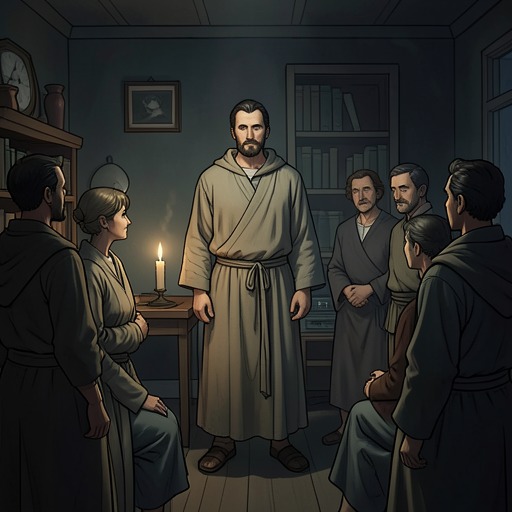
The dispute with the established church intensifies when the gatherings move from Bible teaching to the Lord’s Supper. In February, churchwarden Per Persson reports to Dean Brusander that Danjel has been holding nightly meetings behind locked doors and administering Communion to his household and neighbors. The secrecy and the sacrament make the conflict more than a disagreement over private belief: Kärragärde’s worship now directly challenges the church’s control over religious practice.
The service is prepared as a deliberate act of household devotion. Inga-Lena sets a long table in the large room, opens its extra leaves, places a polished brass candlestick at each end, and lights the tallest candles made at Christmas. She covers the table with a newly woven linen cloth, brought out for its first use, and takes the family’s finest possessions from her linen chest. The ordinary table and household furnishings are set apart for the occasion as the Lord’s table, altar candles, and altar cloth. The scene makes the farm’s domestic materials serve a religious purpose, while the service itself brings the household’s dissent into sharp conflict with church authority.
Those gathered understand Communion through a belief in redemption and rebirth. They believe Christ suffered and died for their sins, and that faith has made them newly cleansed and righteous. Danjel tells them that their sins are bound up in the linen napkin associated with Christ’s burial and left in the grave; the congregation accepts this teaching. Their certainty contrasts with the authorities’ account of Åkianism as heresy. The same gathering is, to its members, a communion of redeemed believers, and to the established church an unauthorized religious assembly.
The consequences reach beyond the farm’s immediate congregation. Elin, who belongs to the Åkians and has been confirmed by Danjel with her mother’s permission, escapes punishment because she is under age. Ulrika, by contrast, has been imprisoned on bread and water for taking part in the illegal Communion at Kärragärde. The farm is thus associated not only with belief and fellowship but with the penalties imposed on those who worship there.
Departure and Continuing Significance
Kärragärde remains a family home as well as a religious center. Danjel is identified as its homeowner, aged forty-six, and when the emigrants assemble for their journey he hires a team from Kråkesjö to carry his wife, four children, and Ulrika. The wagon is heavily loaded; Arvid and Elin, unable to find places on it, ride with Jonas Petter instead. The departure carries people from the farm into a larger migration, but the distinctions forged there—family ties, shared faith, and unequal exposure to punishment—remain visible in who travels together and who must find another place.
The farm’s associations also accompany its people as they leave. Kristina responds with delight at the possibility that her uncle will join them in America, while outsiders can describe the Korpamoen family as related to Danjel yet not tainted by his heresy. That distinction shows how the old stigma can attach to kinship even when a family is considered respectable. Kärragärde stands at the junction of these judgments: it is a place where a persecuted faith is practiced, a household where daily life is organized by scripture, and a starting point for emigrants whose histories cannot be separated from the religious conflict of their parish.
The novel also places the farm within a wider pattern of oral memory and belief. On the road, travelers point out Galtakullen and recall Lotta Andersdotter’s infamous deed, while other stories circulate around the emigrant group; at sea, when the crossing is calm, people pass time with hymns, music, songs, and true strange stories. Against this traffic of remembered accounts, Kärragärde’s own history is especially consequential: a place once associated with an older sect becomes the setting for a renewed community, and the community’s beliefs lead from private prayer to public conflict and, eventually, departure.