Karl Oskar Nilsson
The EmigrantsKarl Oskar Nilsson’s life is shaped by a stubborn mismatch between hard work and the land’s poor return. Given a one-sixteenth holding too small to support his household, he tries to make a future in Korpamoen, but mounting debt and crop failure persuade him that labor alone cannot secure his family’s survival. He chooses emigration and becomes responsible for carrying his family and fellow travelers through the journey. The decision brings neither certainty nor a simple escape: at sea, his confidence gives way to fear and regret when Kristina’s life is endangered, before the voyage ends with his family safe around him.
Identity and inheritance
Karl Oskar is the eldest son of Nils and Märta, and the brother of Robert and Lydia. His father’s farm, Korpamoen, had been separated from the larger Mjödahult homestead as a small plot of three arable acres among scattered pines. Its size reflected generations of subdivision: by the time Nils acquired his share, the holdings were only one-sixteenth of the original homestead. When he offered Korpamoen to Karl Oskar, the farm could not be divided further, and Nils wanted one of his children—not an outsider—to benefit from the years he had spent clearing it.
Karl Oskar was still young and working in service at Idemo when his father made the offer. Robert, the younger son, was eleven, and Lydia was fourteen. The choice nonetheless went to the eldest, who had already shown an independent streak: he had left home at fourteen after a dispute over hayrick slats. Nils’s willingness to entrust the farm to him suggests that, despite that earlier departure, he had come to respect the headstrong son’s capacity to act for himself.
In 1844 Karl Oskar took possession of Korpamoen. He also discarded the old-fashioned form of his name, Nils’ Son, which he had learned to write, and used Karl Oskar Nilsson instead. The sale price, including cattle and farming equipment, was seventeen hundred riksdaler, with a mortgage of eight hundred. Nils and Märta retained specified rights for the rest of their lives: a room in the house, fodder for a cow and a sheep, a small parcel of arable land, use of the owner’s team, and twelve bushels of grain a year. The arrangement gave the older couple a continuing claim on the farm even as its ownership passed to their son.
The limits of Korpamoen
The farm placed Karl Oskar under an economic pressure that diligence could not easily relieve. He had to feed his parents, his wife Kristina, and himself from seven acres, most of them sandy and poor. He believed a horse might let him earn extra money hauling timber, but the one-sixteenth holding could not provide enough oats to keep one through the winter; he calculated that he needed three more acres. The practical obstacle was therefore not lack of willingness to work, but the lack of land and resources needed to turn work into a larger livelihood.
The results deepened his anxiety. After three years, there was one fewer cow in the byre and seventy riksdaler more debt than when he had taken over. He and Kristina had worked to the limits of their strength, yet their position had worsened. Weather and animal losses lay beyond their control, and experience forced them to recognize that health and effort alone could not guarantee success.
A drought made that structural weakness visible in the fields. The early summer was the driest in thirty-one years. When Karl Oskar sowed winter rye, the soil was hard, gray, and infertile; the previous spring, four bushels of barley sown in one field had yielded only four bushels at harvest. His work had failed even to multiply the seed. The image of sowing into earth that might as well be hearth ashes condenses the crisis: the farm demanded labor while withholding the prospect of renewal.
After four years, the household was several hundred riksdaler poorer. Karl Oskar imagined the future if they stayed as a continuation of the same exhausting labor until they were physically spent, followed by old age in the reserved room already provided for his parents. Their example made the farm’s promise feel less like independence than a route toward eventual dependence and regret. Against that prospect, America appeared to offer fertile, stone-free land at little cost, where strong workers might improve their position. He did not know the conditions there firsthand, and understood that the work might be just as hard; what attracted him was the hope that labor could produce a different result.
Decision and responsibility
The decision to leave became a family choice rather than Karl Oskar’s alone. A month after Anna’s funeral, Kristina told him she was no longer opposed to emigration. She had feared endangering the children at sea, but came to believe they could be as safe there as on land if entrusted to God. She also no longer felt she could remain in Korpamoen as before. Though she could not know what awaited them, she wanted to go with her husband.
Karl Oskar made the departure public by having the church announce that Korpamoen was for sale. The news that he intended to leave the country with Kristina, their children, and Robert provoked concern among older peasants. They questioned why he would relinquish his parental home for a distant country no one in their circle had seen. Their objections sharpened the choice: he was giving up a known, inherited holding for a future based on hope rather than experience.
At his meeting with Dean Brusander, Karl Oskar was asked whether he had fully considered the risks to his wife and children and whether he knew the truth about the country that tempted him. He remained silent, twisting his cap, but was certain that persuasion would not reverse his decision. By then, he felt, it was too late. His silence did not mean that he lacked doubts; it marked the firmness of a choice he had already made despite his inability to answer every objection.
Selling the farm made the cost of that choice tangible. Karl Oskar had to accept one hundred and fifty daler less than he had paid, because he was a forced seller. The cattle fetched good prices amid scarcity after the famine-year slaughter, but the auctioneer retained a quarter of the proceeds for advancing the money. Once the mortgage and other debts were deducted, about twelve hundred daler remained. Passage for the family—three adults and three children—cost six hundred and seventy-five daler, leaving roughly five hundred before American entry fees, onward travel, tools, and livestock. Nils and Märta were dismayed that so much of the proceeds would go toward the crossing, rather than purchasing a farm.
The family’s packing joined practical preparation to inherited memory. Their old oak clothes chest, passed from one generation to the next and associated with baptisms, weddings, and funerals, was brought down from the attic and inspected. For the journey, Karl Oskar packed the tools of a timberman and carpenter, along with a disassembled muzzle-loader; Robert prepared fishing gear, and Nils contributed an old bleeding iron. The family also packed their bridal quilt and bedding. Kristina prepared a food basket for six, with durable provisions for the journey to the ship and after landing as well as the crossing. These choices show the household preparing not only to travel but to begin work and domestic life elsewhere.
At the farewell, Karl Oskar asked Lydia to look after their parents as they grew older, promising to pay her. He joked that he would return after making enough money to buy the manor at Kråkesjö and buy Korpamoen back for his sister, but no one smiled. The sons shook hands with Nils and Märta awkwardly, without having promised to return. As the wagon left, Karl Oskar looked back: his parents stood by the house, his father on crutches, while the younger generation departed. The contrast made emigration a separation between those who could still set out and those left behind.
Leader aboard the ship
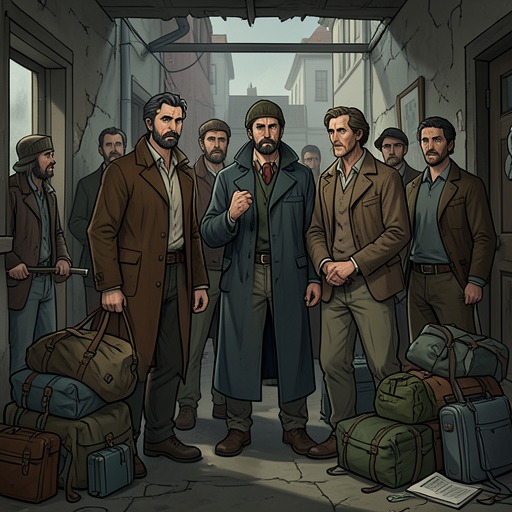
Karl Oskar had arranged passage for the party, and the other emigrants treated him as its head, asking him before undertaking anything important. That responsibility extended into the details of shipboard survival. The mate laid down rules for weekly provisions: each passenger had a fixed allotment, and the passengers had to take turns using the galley. Refuse and dishwater were to be thrown overboard on the leeward side, never the windward side. The crossing replaced the familiar constraints of the farm with a different system of shared space and regulated supplies, while Karl Oskar remained one of the people expected to manage its demands.
He did not conceal from himself that the voyage was unlike what he had imagined. He accepted that it might go well or badly, but said he would not regret a step that could no longer be changed. At the same time, he recognized the burden of being the person who had insisted on emigration: if it brought unhappiness, he alone could blame himself. This sense of responsibility accompanied his practical role as organizer; it made the outcome of the journey feel personal, not merely collective.
The long crossing also required him to think beyond arrival at New York. None of the Ljuder travelers knew where they would go after landing. Hearing an Öland farmer speak of a son who had taken a homestead in Minnesota gave Karl Oskar a possible direction, though it did not yet resolve the uncertainty of onward travel or settlement. The new country was a hope and a plan still to be made, not a destination already understood.
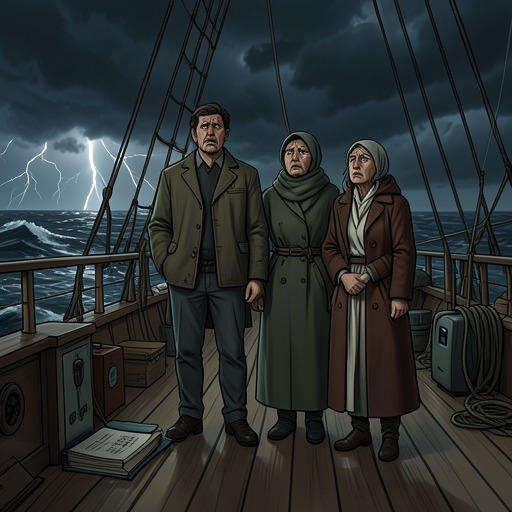
During a storm, when many of the adults from Ljuder Parish were confined to their bunks, Karl Oskar was among the few able to move about. Kristina remained in bed, so he looked after the children, who were lively and not seasick, and prepared food in the galley over a fire made unsteady by the ship’s motion. The scene recasts the farmer’s labor: he is still feeding and caring for his household, but now without land, in a shared vessel whose floor itself will not hold still.
Crisis and arrival
The voyage’s hardest personal test came when Kristina suffered severe bleeding. Karl Oskar rushed through a dark, rough ship to reach her, falling on the slippery deck as waves washed over it. The danger to the ship mattered less to him than stopping her blood. Captain Lorentz ordered him to fetch fresh seawater, then soaked towels for cold packs and tied dry towels tightly around Kristina’s limbs in an effort to retain the blood still in them. Karl Oskar’s role shifted from planner and provider to a husband forced to witness the possible cost of his decision.
At that moment, the responsibility he had tried to bear as a declaration became an accusation he turned on himself. He remembered that he had persuaded Kristina and taken his wife and children across the sea, and that he had insisted on taking responsibility. Now, with her in danger, he felt the reckoning of that promise and regretted the decision. The crisis does not erase his earlier reasons for leaving; it brings their uncertain price into immediate view.
The ending sets that fear beside survival. When the emigrants reached New York, Karl Oskar had his whole family around him and was himself healthy, satisfied that they had crossed the sea safely. The departure had severed him from Korpamoen and from his parents, but the crossing had not destroyed the family he had brought with him. The narrative leaves him at the threshold of settlement: he has reached the new country with those he meant to protect, while the work of turning hope into a livelihood still lies ahead.
Narrative role and significance
Karl Oskar’s story makes emigration an economic decision, a family obligation, and a wager whose outcome cannot be known in advance. Korpamoen is not simply a home he chooses to abandon: its tiny acreage, accumulated debt, exhausted soil, and unfavorable sale expose how little control a hardworking farmer may have over whether labor leads to security. His hope for America rests on a contrast between land that does not multiply seed and land imagined as fertile enough to reward effort, though the voyage itself repeatedly unsettles any confidence that the family can master what lies ahead.
His organizing authority also carries a moral cost. Karl Oskar arranges the passage, leads others, and accepts that the consequences may fall on his family as well as himself. That responsibility is tested most sharply at Kristina’s sickbed, where the decision ceases to be an abstract hope for a better livelihood and becomes a question of what the family might lose. His arrival with his family safe does not resolve the future; it completes the crossing while leaving the promised improvement of their lives unproven.