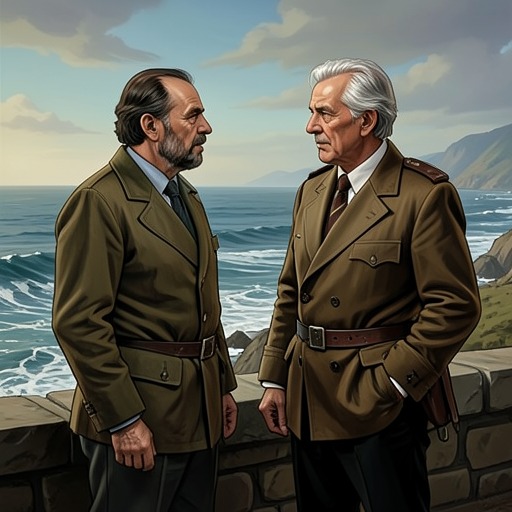
Karl Oskar and Robert’s shared decision to emigrate
The EmigrantsThe shared decision by Karl Oskar Nilsson and Robert Nilsson to emigrate to North America begins as a brother’s private request and opens into a family’s and community’s departure. In the dim room at Korpamoen, Robert asks for his inheritance so he can leave Sweden; Karl Oskar answers that he has been considering the same course. The agreement joins Robert’s escape from a life of service to Karl Oskar’s search for a future beyond a farm that has consumed years of work without improving his family’s prospects.
Two decisions meet
Robert comes to Korpamoen after hiding in a neighbor’s field and in Jonas Petter of Hästebäck’s meadow barn. The sheriff’s warning has made clear that he cannot safely remain at home, and the prospect of returning to Nybacken hangs over his movements. Late that night, Karl Oskar waits for him. Robert knocks at the window; his brother admits him, warms milk over the remaining hearth fire, and listens as the shivering young man prepares to speak.
Robert begins by acknowledging Karl Oskar’s kindness, then asks to receive his share of the farm inheritance. He intends to go to North America. The request is a decisive step toward escape for a boy whose first week at Nybacken had already convinced him that he must get away from every master, human and animal. There, Aron woke him at four in the morning with commands to hurry to work; Robert’s days revolved around the horses, and a hired hand’s service year left only one free week. His wish to leave is therefore rooted in the daily discipline and restricted mobility of farm service, not merely in the distant attraction of America.
Karl Oskar does not answer at once. Robert has spoken with the boldness of a grown man, and his older brother is startled by the declaration. Then Karl Oskar smiles: he, too, has lately been thinking of emigration, though he has told no one except Kristina. What seemed at first a request for help becomes mutual recognition. The brothers had arrived separately at the same decision, and Robert’s disclosure brings Karl Oskar’s own concealed intention into the open.
Pressures at home, hopes abroad
For Karl Oskar, emigration grows from years of frustration at Korpamoen. He and Kristina have lived there for four years and are several hundred riksdaler poorer than when they began. He sees their labor leading not to independence but to exhaustion, with only the meager security of a reserved room in old age. The example of his crippled father makes that future tangible: to remain, in Karl Oskar’s judgment, would mean spending their strength without gaining a better life for their children.
The brothers’ motives fit a broader pattern of group emigration from Ljuder Parish, but the group does not leave for one uniform reason. Crop failure, religious persecution, dissent, personal difficulties, social exclusion, and unfair employment practices press different people toward departure. Karl Oskar’s debt and Robert’s subordinated farm service are distinct pressures; the possibility of fertile land in North America gives them a shared destination, not an identical past.
Kristina’s response exposes the uncertainty beneath Karl Oskar’s confidence. She fears that America may prove a wild-goose chase: no official has promised them land, they have no deed waiting on arrival, and neither spouse knows anyone who has seen the country. Newspapers and books do not provide the trustworthy firsthand testimony she wants. Her caution makes the decision a household negotiation rather than a simple expression of her husband’s will. The same imagined future that offers Karl Oskar an escape from worsening prospects remains, to Kristina, an undertaking with no reliable guarantee.
From agreement to a collective plan
The brothers’ private understanding soon takes practical shape. Karl Oskar tells Robert that he need not travel alone: Kristina, the children, and the young people from the farm will go with him. Robert’s persistent humming ear, a lasting reminder of his injury, has been associated with the sea’s summons; after Karl Oskar’s answer, he can respond to that call with resolve. The agreement becomes his first open gate on the road to America, even though the journey ahead will require money, transport, and decisions by others.
Those requirements turn intention into a planned route. Karl Oskar and Robert write to a firm in Karlshamn and secure passage on the Charlotta, a merchant vessel bound directly for New York. They pay a hundred daler down for the transportation of six people and plan to embark in the second week of April, when spring departure should allow the emigrants to reach their destination in time to cultivate and sow. When Danjel Andreasson considers joining, Robert is asked to arrange a contract for him too, if the ship has room; Danjel’s party numbers nine, including children and household members. The brothers’ decision thus helps connect separate households to a common passage.
The scale of the resulting departure becomes visible at Åkerby Junction. Nineteen people assemble there, though three drivers will return from Karlshamn: the emigrant party itself numbers sixteen, nine adults and seven children. Danjel travels with his wife, four children, and Ulrika of Västergöhl; Jonas Petter drives his own wagon, carrying, among others, Arvid and Elin. Robert, who had once imagined slipping away secretly with Arvid, now travels beside his brother on a crowded wagon among a much larger company. His escape has become a group migration.
The cost and consequence of choosing
The choice is not secured by hope alone. When Karl Oskar sells Korpamoen and auctions its contents and livestock, debt deductions leave about twelve hundred daler. Passage for his household—three adults and three children—costs six hundred and seventy-five daler, nearly half the resources needed to buy a farm. After the fare, about five hundred daler remain for the entrance fee, onward transport over an unknown distance, tools, and cattle. Kristina sews the money into a sheepskin bag that Karl Oskar can fasten to his belt and carry against his body. The plan is a wager made with finite resources, and the hidden money embodies the family’s remaining security.
The decision also sets the family in motion through a landscape that is about to become memory. On the road, Karl Oskar and Kristina watch familiar places pass for the last time: a brook where they swam, a meadow associated with spring lilies. Robert counts openings in the winter pastures as gates on the road to America, conscious that a different departure date would have found them closed. In that recurring image, mobility is both practical and symbolic: a passage out of the familiar world, but not a promise that the destination will fulfill every expectation.
The Atlantic crossing gives the decision its harshest measure. Storms, confinement, illness, scurvy, and ship’s fever wear down the emigrants, and the months aboard ship leave many depressed and indifferent to what may come. When they finally see green earth, the sight restores energy and ambition to the weakened passengers. This change does not prove that Kristina’s doubts were unfounded or guarantee prosperity; it shows instead what the prospect of land can do after a passage in which the emigrants have been deprived of it. The brothers’ midnight agreement begins as an escape from constraint and becomes a shared commitment whose cost, risks, and consequences are borne by an entire traveling community.