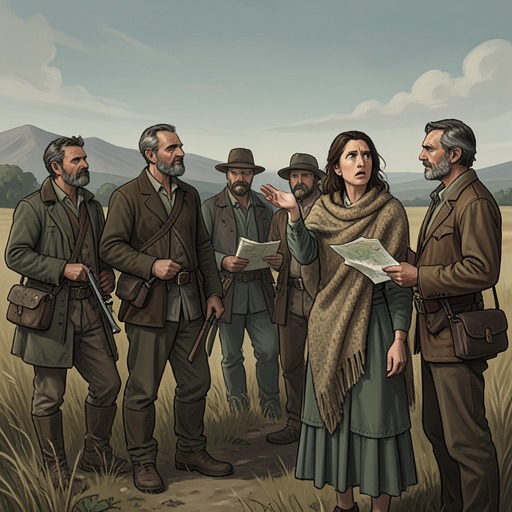
Karl Oskar’s decision to emigrate
The EmigrantsKarl Oskar’s decision to emigrate is the turning point that carries his family from the failing farm at Korpamoen into the uncertain collective voyage to America. It grows from hard economic arithmetic and a narrowing future, but it is never a simple escape: Kristina doubts the promises on which the plan rests, the family must sell nearly everything to finance passage, and Karl Oskar later recognizes that persuading them to go has made him answerable for the risks they endure.
Pressures at Korpamoen
After four years at Korpamoen, Karl Oskar and Kristina were several hundred riksdaler poorer than when they had begun. Their labor had consumed their youth without improving their position, and Karl Oskar saw no plausible end to the cycle except exhaustion. The reserved room in his parents’ house offered a grim image of their possible future: once no longer able to work, they might end their days with little more than meager bread and the knowledge that years of toil had brought them nowhere. His decision answered not merely a bad harvest or a temporary shortage, but his fear that remaining meant spending their strength without securing a better life for their children.
This household crisis belongs to a broader restlessness spreading through peasant communities. Reports of fertile land across the ocean traveled from neighbor to neighbor into villages whose people had long lived by inherited customs. The prospect of land in America offered a powerful attraction, while food scarcity, diminishing plots, and growing families pressed people to leave. The emigrants from Ljuder Parish did not share one uniform motive: crop failure, religious persecution, dissent, personal troubles, social exclusion, and unfair employment practices all helped propel different people toward departure. Karl Oskar’s economic motive was one strand in a group migration made possible by the convergence of separate needs.
His practical disposition gave the plan particular force. Young, strong, industrious, and experienced in farming, he could imagine himself making a livelihood on a frontier. Yet his confidence in America was not the same as proof that his hopes would be fulfilled. The new country reached the household through books, pictures, and reports rather than the testimony of a trusted farmer who had settled there. The promise of fertile soil was vivid; the evidence for it remained distant.
Kristina’s doubts and the household decision
Kristina did not share her husband’s confidence. If America were truly as Karl Oskar described it, she could imagine agreeing to go, but she feared that the plan might prove a wild-goose chase. No authority in the United States had promised them land, no deed waited for them, and they knew no one who had personally seen the country and could confirm what it was like. Printed words in newspapers and books did not reassure her. She reasoned that if migration were so advantageous for young families, they ought to know of at least one farmer who had already gone with a wife and children. Karl Oskar could not name such a person.
The disagreement was therefore not simply between a bold husband and a timid wife. Karl Oskar treated reports of opportunity as grounds for action; Kristina asked for guarantees, reliable witnesses, and a concrete claim to the land they hoped to occupy. Her attachment to home in Småland stood against his conviction that their future lay elsewhere. Because the decision involved a wife and children, his confidence could not remain a private ambition: it had to become a household undertaking, negotiated amid unequal certainty about what awaited them.
The wider movement likewise began unevenly. In the villages, some people hesitated while others dared; arguments set caution against hope, and youth against age. The ocean itself was forbidding because it led into the unknown. Karl Oskar’s resolve made him one of those whose choice disturbed the settled order of the parish, but the novel preserves the cost of that resolve by giving Kristina’s skepticism full weight. America could be imagined as fertile ground, yet no one in the household could turn that image into a guarantee.
Turning intention into a passage
Once the family’s decision took shape, emigration demanded precise arrangements. Spring was considered the best season for the crossing: winter storms would have passed, and an early arrival would leave time to till and sow before the fall harvest. Karl Oskar and Robert had written to a firm in Karlshamn and secured passage aboard the merchant vessel Charlotta. Karl Oskar sent a down payment of one hundred daler for six people. The planned departure was in the second week of April, with a direct voyage to New York and no intermediate harbor. Robert was to seek a contract for Danjel as well, if the ship had room; Danjel expected nine people from Kärragärde, including children and household dependents.
The plan thus widened from a family’s departure into a linked migration. At Åkerby Junction, the travelers gathered in wagons for the road to Karlshamn. Nineteen people were present, though three drivers would return from the port: the emigrant party itself comprised sixteen, nine adults and seven children. Danjel traveled with his wife, four children, and Ulrika of Västergöhl; Jonas Petter came with his hired man, while Arvid and Elin rode with him because there was no room for them on Danjel’s wagon. Robert joined Arvid, his fellow farmhand from Nybacken, after their earlier dreams of escaping alone had given way to a shared journey among families and neighbors. Karl Oskar’s decision had helped set this larger company in motion, but it did not erase the different circumstances that had brought its members together.
The material cost narrowed the family’s options further. Karl Oskar sold Korpamoen to a farmer from Linneryd for one hundred and fifty daler less than he had paid. The cattle fetched good prices because animals were scarce after the forced slaughter during the famine year, but the auctioneer, Per Persson, retained a quarter of the proceeds in return for advancing the money. After the farm sale and auction, and after the mortgage and other debts were deducted, about twelve hundred daler remained. Passage for the family—three adults and three children—cost six hundred and seventy-five daler, leaving Karl Oskar with about five hundred for arrival expenses and the onward journey to an unknown settlement. He hoped to acquire land at little cost, but understood that little would remain for farm tools and cattle. His parents, Nils and Märta, were dismayed that almost half the amount needed to buy a farm would be spent on passage.
Kristina sewed the remaining five hundred daler into a sheepskin bag that Karl Oskar could fasten to his belt and carry against his body. The money was their last security, exposed to loss or theft during the long journey. Selling the farm and safeguarding the proceeds made the decision irreversible in practical terms: the family had exchanged a known home for passage, an arrival fee, and a journey inland whose length and cost they could not yet know.
Responsibility and regret at sea
The voyage brought the consequences of Karl Oskar’s choice into the family’s most intimate life. Its storms, sickness, confinement, and long days aboard ship wore down the emigrants’ bodies and spirits. Scurvy and ship fever weakened them; monotony left many depressed and indifferent to what life might bring. The hoped-for new beginning had first to be endured as a passage through hardship, with no certainty that the land ahead would repay what the family had surrendered.
When Kristina was gravely ill, Karl Oskar could no longer keep at a distance from the burden he had accepted. Holding her hand, he understood that he had persuaded her to follow him and had taken his wife and children across the sea. He had insisted that someone must take responsibility and that he would do so; now he felt the demand of that promise as a reckoning. He regretted what he had done and asked Kristina to forgive him for wanting to leave and forcing his will through. She answered that she too had wanted to go and that he had intended to improve life for them all. Karl Oskar still feared that good intentions could spoil everything and said he was chiefly to blame. Her reassurance did not remove the danger or his responsibility; it showed how the decision had become a shared family history, even though he had been the one to press it forward.
America’s green shore eventually came into view after the voyage’s trials. The sight revived even the sick and dispirited: emigrants who had grown indifferent felt new energy and ambition when they knew the crossing was safely over and living earth lay before them again. That arrival gives Karl Oskar’s decision its double measure. The prospect that had drawn him toward departure became visible, but only after the family had paid for it in lost property, uncertainty, confinement, and fear. His choice is neither vindicated as an uncomplicated triumph nor reduced to a mistake; it remains an act of hope whose human cost he accepts as his own.