Karlshamn
The EmigrantsKarlshamn is the port town that turns emigration from a rural hope into a departure. For Robert, it first represents the sea he longs to see; for the emigrants of 1850, it is the embarkation point where passage must be arranged, provisions and lodging found, and familiar land left behind. The town’s harbor therefore marks both a practical transfer between forms of travel and an emotional threshold: the sea is visible, but the new life across it remains unknown.
The Port in Robert’s Imagination
Robert’s first connection to Karlshamn comes through work in the forest. He helps Karl Oskar fell oaks and cut tall pines, timber destined for shipbuilding and masts. The trees are to be hauled to Karlshamn, fifty miles away; the peasants transporting them need two days and a night for the round trip. While working among the trees that will travel by sea, Robert imagines making the journey with the timbermen, because he wants to see the sea with his own eyes.
That wish later becomes a direction of escape. Having fled the service at Nybacken, Robert knows he must reach Karlshamn, the town beside the sea. He hopes to find a peasant from the southern part of the parish who might give him a ride, but at the mill the miller recognizes him before he can ask. The port has acquired urgency: it is not just a distant place of ships, but the next point in a route Robert is trying to make for himself.
When Robert later plots another escape with Arvid, Karlshamn is again the hinge between service and freedom. He proposes waiting until autumn, when Aron’s oak timber is taken there. Robert expects to drive the old mare with the timbermen, then disappear once Aron can no longer see him; the mare, he imagines, will return alone to Nybacken. In Karlshamn he intends to board a ship bound for North America. The plan makes the port a means of breaking out of the farm’s authority, though his projected escape is eventually superseded by a family migration organized through the same town.
Arranging Passage
In planning the crossing with Danjel, Karl Oskar treats Karlshamn as the point at which seasonal timing, money, and transport must come together. Spring is preferred because winter storms have passed and emigrants might arrive in time to sow and harvest before winter. Karl Oskar and Robert have written to a firm in Karlshamn and secured a promise of passage on the Charlotta. A down payment of one hundred daler covers transportation for six people; the ship is expected to sail directly to New York, without stopping at another harbor, and embarkation is planned for about the second week of April. Robert offers to obtain a contract for Danjel as well, if the vessel has room. Danjel’s household expects nine people to travel, including children and other members of the household, so the plan depends on available capacity as well as conviction.
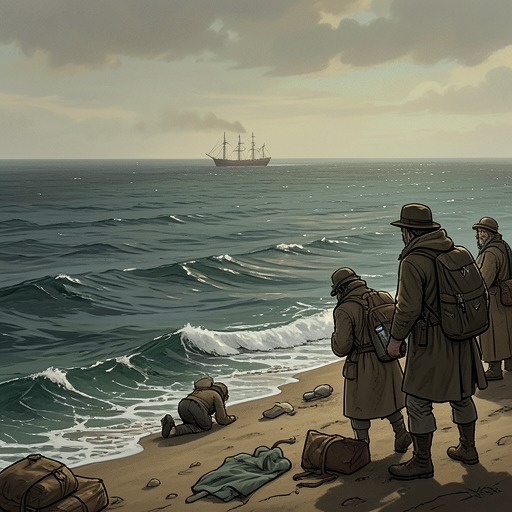
The harbor itself does not immediately deliver the passage the emigrants have paid for. The three wagons reach Karlshamn early in the morning, after a night on the road. The town is waking: fishermen bring in their catch, town maids wait for herring, and a shop clerk sweeps outside Sunesons Skeppshandel. The newcomers, stiff and cold from the ride, encounter the odors of fish, tar, hemp, herring, and salt. A sharp wind from the harbor greets them before they have had time to settle. For the first time, they look across water without seeing land on the other side.
Karl Oskar asks a herring fisherman where their America-bound ship is. The man tells him that the Charlotta, a brig, arrived two nights earlier and lies at anchor in the outer harbor. Yet the vessel has only just arrived, and freight must be loaded before passengers can board; several days may pass. With children freezing and whimpering in the wind, the emigrants need somewhere to wait. The fisherman directs them to the Maja’s Inn, in an alley near the harbor behind the Hope Tavern. The wagons move on, but Robert remains standing alone at the water’s edge, looking out to sea. The pause separates arrival at the port from departure across the ocean.
The Charlotta and the Limits of Passage
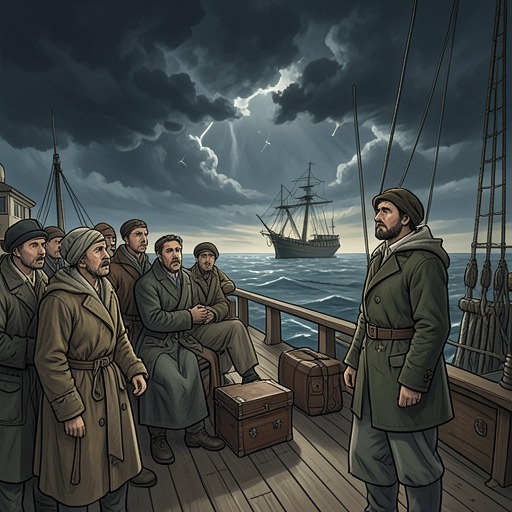
The ship waiting off Karlshamn is a working cargo vessel as well as an emigrant ship. Under Captain Lorentz, the brig Charlotta sails from the town on April 14, 1850, bound for New York. She is 124 feet long and 20 feet wide, with a capacity of 160 lasts; her fifteen crew members include two mates, a bosun, a carpenter, a sailmaker, a cook, seamen, and deckhands. Pig iron and other goods share the vessel with 78 emigrants, bringing the total aboard to 94. This is the Charlotta’s seventh voyage as an emigrant ship, not a purpose-built passenger liner but a merchant ship carrying people alongside freight.
The constraints that await the emigrants are apparent even before departure. Robert and Arvid pace off the brig and estimate her at only forty paces long and eight wide. Their measure gives the ship’s small scale a bodily reality: nearly a hundred people must live, sleep, eat, and manage daily needs aboard a space they compare to the floor of a farmhouse. The hold is divided by canvas into compartments for families, unmarried men, and unmarried women. Bedding, baskets, food, and bundles crowd the low, poorly aired space; the only daylight comes through the main hatch. There is no room for Karl Oskar in the family compartment, so he shares a two-man bunk with Robert among the unmarried men. Jonas Petter sleeps above them, and Arvid has the neighboring bunk.
Shipboard life is governed by limited stores and strict routines. Each family is to collect its share of unprepared provisions for a week at a time and take turns using the galley. The passengers must ration their food, dispose of refuse to leeward, and keep the hold clean. Fresh water is restricted to half a gallon per person per day for drinking and washing, and the daily allocation is withheld until the morning cleaning is completed. The restriction makes bodily care collective labor: men carry water, while women scrub, wash, and hang clothing to dry on deck. These rules make clear that passage is not simply movement through open space. Once aboard, the emigrants’ survival depends on rationing, shared work, and obedience to the ship’s command.
The Port as a Threshold
The harbor scene contrasts the land-bound emigrants with the maritime world they are entering. They meet the sea before they can cross it, and its cold wind seems a challenge rather than a welcome. In Karlshamn the ship remains anchored, freight is still to be loaded, and the passengers must wait ashore; their movement is governed by the schedules and capacity of the vessel, not solely by their own decision to leave. The harbor is thus a bottleneck between the road and the ocean, where desire becomes dependent on commercial arrangements, space, weather, and the ship’s officers.
For Robert, the masts also connect the port back to the forest. He wonders whether he helped fell the trees whose stripped trunks now rise above the Charlotta, carried from rooted timber into a life at sea. What he once followed only in thought—the journey of wood toward the water—has become part of the journey he shares with his family and companions. The sea that had drawn him toward Karlshamn is no longer an imagined view: it is the route by which the emigrants must leave the shore.
The crossing exposes the difference between reaching a port and reaching a new home. Contrary winds, currents, and fog prolong the voyage; the passengers measure distance in days spent at sea and grow unsure how far North America lies. After two months on the Atlantic, they understand that returning to their homeland is beyond imagining. The brig finally ties up at the pier in New York on Midsummer Eve, 1850, after ten weeks from Karlshamn. The port of departure consequently stands at the beginning of a one-way passage: the emigrants leave a known landscape for a destination they have not yet learned to inhabit.