Korpamoen
The EmigrantsKorpamoen is a small farm carved out of a divided homestead, built by a family’s labor and ultimately left behind when Karl Oskar and Kristina decide that their children need a future beyond it. Its stones and limited acreage make work visible without guaranteeing security; its debts and inherited obligations bind generations together even as the farm becomes the starting point of their emigration.
Origins and the work of clearing
Korpamoen began as a split-off share of Mjödahult, an old homestead associated with the Nilsa family. In 1819, after the larger farm had been divided repeatedly, Nils Jakob’s Son received a one-sixteenth portion: three arable acres on the outskirts, among scattered pines. The records described it as a one-sixteenth crown-assessment farm under the mother homestead. It was a small inheritance, but Nils did not leave it as he found it.
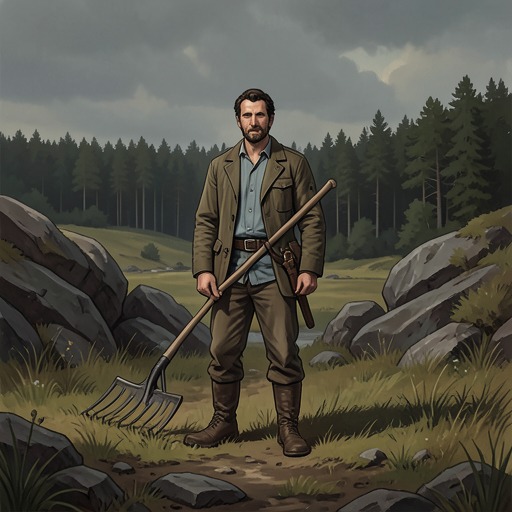
The ground was sandy and strewn with stones. Nils searched for each cultivable patch, working with an iron bar and a long lever, and using his hands to turn or roll stones out of their holes. When a stone defeated his own strength and tools, he called on his wife, Märta, who helped him lever it free. The farm’s early history is thus a history of clearing: its usable land was made, piece by piece, through sustained work by both spouses.
After twenty-five years, Korpamoen had grown beyond a mere cotter’s place. It had seven arable acres and could support seven head of cattle through summer and winter—more than twice the original plot. But Nils had been left unable to walk without crutches after an injury to his leg, and his farming life was over. The land he had enlarged could not be divided further: a one-sixteenth holding was already too small to split. Rather than sell to an outsider, he offered it to one of his children, so that a child could benefit from the years spent clearing it.
A family holding and a heavy purchase
Karl Oskar took possession of Korpamoen in 1844, after seven years working as a farmhand. He was ready to stop working for others and become master of a holding of his own. The agreed price, including cattle and equipment, was 1,700 riksdaler, of which 800 was the mortgage. His savings, Kristina’s dowry, and his inheritance together covered only a quarter of the price; the rest remained debt, with 50 riksdaler in annual mortgage interest.
The purchase also carried a continuing obligation to Nils and Märta. Their reserved rights gave them a room in the house, fodder for a cow and a sheep, three-quarters of an acre for their own crops, use of the owner’s team, and twelve bushels of grain each year. The arrangement was a customary provision for parents who ceded their farm, but it weighed heavily on a holding so small. The children each received an inheritance share of 210 riksdaler and 24 shillings; Robert and Lydia, still under age, left their shares as claims against their brother. Korpamoen therefore passed into Karl Oskar’s hands not as unencumbered property, but as a home structured by debt and obligations to the previous generation.
The strain soon deepened. In 1847, Karl Oskar borrowed 50 riksdaler from Kristina’s uncle, Danjel Andreasson, to meet the mortgage interest. After three years on the farm, the family had one fewer cow and 70 riksdaler more debt than when Karl Oskar took over, despite the hard work of both spouses. Weather and animal losses lay beyond their control, making plain that effort alone could not secure a livelihood. The small farm’s promise of independence was repeatedly checked by circumstances its occupants could not command.
The farm and the decision to emigrate
A newspaper picture gave the limits of Korpamoen a visible opposite. Karl Oskar had borrowed the paper from Per Persson, the churchwarden, and brought it home after plowing rye stubble with a poor team: an ox and a pregnant cow, after he had been forced to sell another ox. When his plow broke on a stone, he stopped work and looked at the picture titled “A Wheat Field in North America.” It showed an apparently boundless, even field, without stones or fences, heavy with grain. Against the unplowed, stone-filled ground outside his window, the image became a concrete vision of land where labor might yield more than subsistence.
Karl Oskar’s case for leaving was also a case about the farm’s future across generations. After four years, he and Kristina were several hundred riksdaler poorer than when they began. He feared that continued labor would leave them worn out with little to show beyond the reserved room and its meager provision. Korpamoen could pass to only one child; the others would face farm service or life as squatters, among a population already crowded with hired hands and people in precarious cottages. He and Kristina did not want those prospects for their children. America, as they understood it, offered land and a chance for work to improve a family’s position, as well as greater political liberty. These hopes were their understanding of the destination, not a guarantee supplied by the farm’s history.
Kristina initially feared the dangers of crossing the ocean with the children. After their daughter Anna died on land, she reconsidered: the loss had altered her view of where danger lay, and she agreed that the children could be entrusted to God on the sea as well as on dry ground. She also knew she could no longer feel as she once had in Korpamoen. The couple decided to seek passage the following spring. The choice made the farm more than a setting of economic hardship: it became the home they would leave in order to act on their responsibility to their children.
Sale, departure, and the household’s material legacy
During the year of preparation, Karl Oskar announced from the church pulpit that Korpamoen was for sale. The news drew disbelief and warnings from older farmers, who could not understand why he would relinquish a parental home for an unseen country. He was mocked and criticized, and his parents opposed the plan in silence, in part because their reserved rights would have to be met by a new owner. Nils reproached him once, quietly, for taking many people along. Karl Oskar answered that there would be six; his father replied that he was taking far more, because he could not know how numerous his descendants would be. The exchange enlarges the departure from a household decision into a break with a family future rooted in this particular farm.
The old Nilsa family chest, kept for generations and used at baptisms, weddings, and funerals, was brought down from the attic and prepared as the family’s America chest. Five feet long and three feet high, reinforced with broad iron bands, it became the strongest packing case they could find. Its journey turned an inherited household object into a container for migration. The family packed tools for farming and carpentry, hunting and fishing equipment, warm clothing, bedding, and food for six people, including rye and barley loaves, salted provisions, butter, honey, and herrings. Their choices joined the practical requirements of an uncertain journey to the skills and everyday work they hoped to carry into a new home.
Karl Oskar sold the farm to a farmer from Linneryd for 150 daler less than he had paid. The cattle fetched good prices at auction, but the churchwarden and auctioneer, Per Persson, retained a quarter of the proceeds in return for advancing the money. After debts were deducted, the family had 1,200 daler. Passage for three adults and three children cost 675 daler, leaving about 500 for arrival, entry costs, and onward travel to an unknown destination. Karl Oskar secured that remaining money in a sheepskin bag Kristina sewed for him to carry against his body. The sale released the family from the holding, but it did not make departure financially secure.
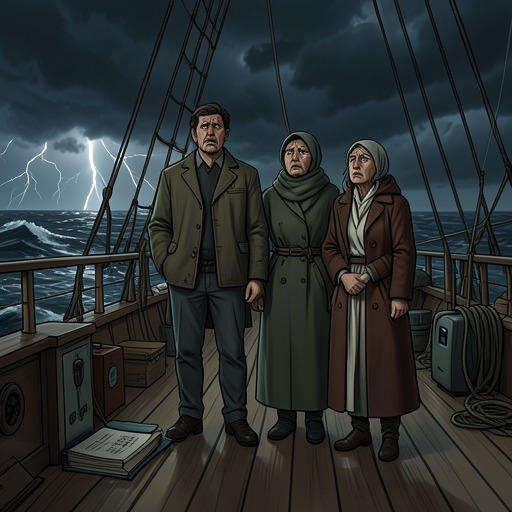
When the family left, Karl Oskar looked back at the house. Nils stood on the porch, stooped and supported by crutches, with Märta beside him. The old parents remained while the younger generation rode away; Karl Oskar remembered them as motionless, like stones or tree trunks rooted in the ground. The image reverses the farm’s earlier history: the land that Nils had wrested from stones holds the parents in place as the wagon disappears down the road. At the other end of the voyage, Korpamoen’s family arrived in America with Kristina leaning on Karl Oskar but determined to walk down the gangplank on her own legs. Korpamoen was no longer their home, yet the labor, obligations, and objects gathered there remained part of what they carried forward.