Kristina Johansdotter
The EmigrantsKristina Johansdotter is a farm wife and mother whose life is shaped by the fragile economics of Korpamoen, the work of sustaining a household, and her commitment to her family. Her arc links the hopes of marriage and landholding to repeated shortages, then carries those responsibilities onto an emigrant ship: she joins the journey while acutely aware that its risks fall not only on her but on her children.
Identity and Background
Kristina enters Karl Oskar’s life as a young woman he meets at Berta of Idemo’s home. He has brought firewood there for treatment, and Kristina is quietly winding yarn in the kitchen. When he is ready to leave, he introduces himself. The meeting is brief, but it begins the relationship that will connect her to Korpamoen and the household at the center of her later life.
Their courtship takes place under practical constraints. When Karl Oskar asks her to marry him, Kristina says they are both too young and that he should at least come of age. He claims he could seek the King’s permission, but her more immediate concern is that they have nowhere to live and no means to feed or clothe themselves. Karl Oskar cannot answer that objection. His silence reflects the weight a promise carries in their world: he has no livelihood to offer her yet, and a spoken commitment cannot simply be withdrawn.
Six weeks after Karl Oskar is accepted by her family as a serious suitor who owns a farm, they marry in Duvemåla. Kristina comes to Korpamoen with her dowry chest and takes the place in the household previously occupied by Märta. She has made her own bridal cover, blue like cornflowers, and spreads it over the marriage bed on the first evening. The handmade cover joins domestic skill to a new beginning, and remains a material link between the marriage’s hopeful start and the family’s later upheaval.
Marriage, Household, and Land
The farm’s transfer is a family arrangement as well as a change of ownership. Karl Oskar takes over Korpamoen for 1,700 riksdaler, including an 800-riksdaler mortgage, while his parents, Nils and Märta, retain rights to live in the spare room and receive provisions and access to land and equipment. Their agreement includes fodder for a cow and a sheep, three-quarters of an acre to sow, use of the owner’s team, and twelve bushels of grain each year. The deed bears the cross marks of Nils and Märta, who could not write. The older generation’s security is thus built into the new household’s obligations.
The inheritance is divided among the children: each receives 210 riksdaler and twenty-four shillings. Robert and Lydia, still underage, leave their shares as claims against Karl Oskar. Kristina’s arrival therefore does not begin a self-contained domestic life; it places her within a household shaped by mortgage debt, inherited claims, and continuing responsibility for Karl Oskar’s parents.
Kristina and Karl Oskar work hard, but effort does not produce the security they expect. After three years, the farm has one fewer cow and seventy riksdaler more debt than when Karl Oskar took it over. The couple have labored to their utmost, yet weather and the fortunes of their animals remain beyond their control. Their experience alters their understanding of livelihood: health and strength alone cannot guarantee success when the conditions of farming turn against them.
By the fourth year, they are several hundred riksdaler poorer than at the beginning. The prospect of remaining at Korpamoen is not simply continued work but a future of exhausting labor followed by dependence on the reserved room, as Nils and Märta now live in it. The contrast between the couple’s strenuous effort and their deteriorating position makes leaving a response to a narrowing economic future, not a rejection of work itself.
Motherhood and Faith
Kristina’s reflections on her life connect a small accident to the family she has built. She remembers that if she had not fallen from a swing at her childhood home in Duvemåla and injured her knee, she would not have gone to Berta of Idemo for treatment. Without that visit she would not have met Karl Oskar, married him, or farmed Korpamoen with him. In the present of that reflection, she lies beside him beneath the bridal cover she made, with Anna, Johan, and Lill-Märta sleeping nearby. The remembered sequence gives ordinary objects and family proximity the force of a life assembled through contingent events.
Prayer is part of Kristina’s daily response to hardship. In her evening prayer she asks for grace and sleep, then adds a prayer for the fruit of the earth, asking for favorable weather, protection for the crops, and a blessing on the harvest. This practice expresses a faith closely tied to subsistence: the household needs not only strength to work but conditions it cannot command.
After lightning destroys the meadow barn and drought threatens the crops, Kristina reads the Prayer Against Persistent Drought each evening. She believes the drought may be chastisement from the Lord and wants Karl Oskar to seek absolution for blasphemy before the couple take Communion together again. Her response shows how she interprets material disaster through religious obligation, while also making reconciliation with Karl Oskar a condition of shared worship.
The Emigration Decision
Preparing to leave turns Kristina’s domestic work into an inventory of what a family needs to carry. Their bridal quilt and bedding are packed into two large sacks; small utensils for the crossing go into a knapsack. For six people she prepares a roomy willow basket with a wooden lid, packed with provisions meant to keep during travel, including rye and barley loaves, salted butter, and honey. The preparations are practical, but the bridal cover also travels as a keepsake of the life the family is leaving.
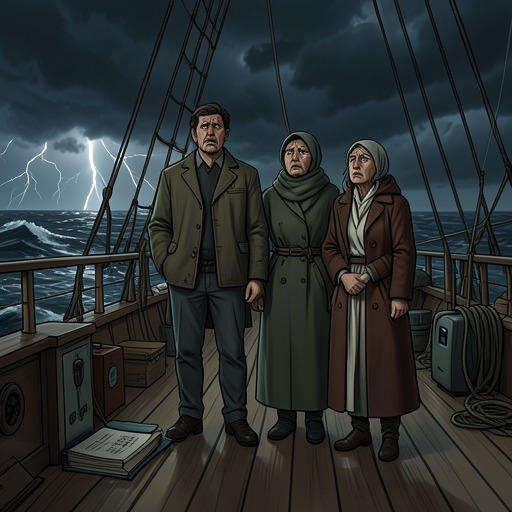
The journey’s dangers trouble her before departure. While Berta advises the emigrants about possible injuries, accidents, diseases, and sickness on land and sea, Kristina wonders whether the foreign venture is necessary at all. Reading that the ship will carry twenty-five women and twenty children intensifies her anxiety. She believes her children have been entrusted to her by God and fears that taking them onto a fragile vessel could make her responsible for their deaths. Her question is not whether she fears for herself; it is whether she has the right to expose them to danger.
Her doubts coexist with the family’s decision to go. One morning, after weakness, loss of appetite, and worry, she recognizes the familiar sequence of signs and realizes she is pregnant again. The discovery adds another child to the responsibilities she is already weighing as the family prepares to cross the ocean. It does not erase her fear; it sharpens the stakes of the choice.
When Kristina clasps Karl Oskar’s fingers, she tells him they must remain friends for all time. The appeal gives their departure an intimate dimension: they are not only leaving a farm that has failed to sustain them but trying to carry their marriage through the strain and uncertainty ahead.
Life Aboard Ship and Narrative Significance
Aboard the ship, the family’s assigned sleeping place is a roughly assembled bunk in the hold. Kristina spreads her mattress on the floor and lays the bridal cover over it; the food basket sits on top of the bunk, while the children tumble together in the limited space. The makeshift sleeping place concentrates the household into a single confined room. The cover that once marked a hopeful marriage now serves as bedding amid the practical discomforts of migration.
Kristina’s attention also extends to the labor performed by other women. Throughout the voyage she watches Inga-Lena attend constantly to her husband and children, arranging meals and keeping their clothing in order. Kristina sees that this unceasing work has left Inga-Lena gaunt and unsteady. The observation makes the costs of care visible: a household’s routine survival depends on labor that can consume the person performing it, especially when illness and the demands of travel interrupt ordinary support.
As the passengers prepare to land, the work of cleaning and repairing clothing falls to everyone available. Karl Oskar must take part in tasks he finds tedious, while damaged bedding and garments are sorted and discarded. Kristina’s earlier packing has been necessary to keep the family equipped, but the long voyage has worn, torn, rotted, or soaked many of their possessions. Their preparations for arrival therefore involve not only washing and mending but deciding what cannot be carried forward.
Kristina’s story makes migration a continuation of household responsibility under altered conditions. In Sweden, her family’s labor cannot overcome debt, poor harvest prospects, and dependence on the farm’s uncertain returns; at sea, the same labor is tested by confinement, danger, and the vulnerability of children. The bridal cover, packed food, and improvised bunk keep the household together materially, while her recurring concerns about faith, marriage, and maternal duty reveal the emotional burden of choosing a future that cannot be made safe in advance.