Land-frenzy
The EmigrantsLand-frenzy names the sudden collective revival aboard the Charlotta when the emigrants at last see the green earth of America. After a voyage that has weakened their bodies and spirits, the first visible land reverses the meaning of their confinement: the passengers feel life returning, and the prospect of a new home becomes something they can see rather than only imagine.
From imagined land to the sea crossing
The emigrants’ departure grew out of news and rumor about fertile land overseas, carried from neighbor to neighbor through communities where plots were shrinking and food was scarce. At first, America existed for those who had not seen it as pictures and stories, while the ocean itself stood for danger and uncertainty. Their movement from familiar ground was therefore both a practical response to hardship and a step into what they could not know.
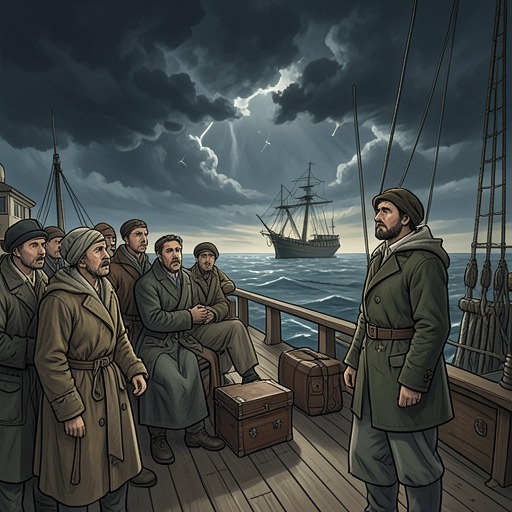
The Charlotta’s voyage made that uncertainty physical. The brig sailed from Karlshamn for New York on April 14, 1850, carrying 78 emigrants among 94 people aboard. Its cargo included pig iron and sundries; its passenger quarters were divided by canvas into cramped compartments, with bedding and belongings filling the hold until there was hardly room to step. The route that promised access to new land first confined the travelers in a narrow space at sea.
At the harbor, the emigrants had for the first time looked across water without seeing land on the other side. The contrast between the familiar shore they had left and the unbroken water before them marked a threshold: they were no longer simply leaving home, but entering a passage in which neither homeland nor destination was within reach. Once contrary winds prolonged the crossing, they reckoned distance in days rather than miles. Their Swedish home had become incalculably remote, while the land where they hoped to settle remained remote as well.
The voyage’s bodily cost
The ship’s limited space and strict routines made the crossing a daily trial, not an empty interval between departure and arrival. In the hold, dust rose from bedding as passengers made up berths for 78 people; the air was thick, the overhead low, and the crowded canvas compartments were packed with food baskets, bundles, tubs, and bedding. The contrast between the promise of open land and life inside these cramped quarters sharpened the passengers’ dependence on the ship and one another.
Their provisions and water were rationed under the ship’s rules. The mate assigned each passenger a weekly portion of unprepared food and required families to take turns in the galley. Each person received half a gallon of fresh water a day for drinking, washing, and cooking. The emigrants had to clean the hold before water was issued, removing the night’s vomit and dirt; when they complained that the ration was too small, they were warned that the voyage could last three months if the weather proved unfavorable. These conditions made the crossing’s hardships tangible in the most ordinary acts of eating, washing, and sleeping.
The contrary winds did stretch the voyage, and the passengers grew suspicious that they had been misled about the distance to North America. Winds and currents, fog, and waves seemed to hold the Charlotta back. Some imagined that, if they could only set foot on firm land once more, they would never entrust themselves to the sea again. Their longing for land was thus not merely a hope of future prosperity: it grew from exhaustion, uncertainty, and the immediate need to escape the sea’s physical grip.
The sight that changes the passengers
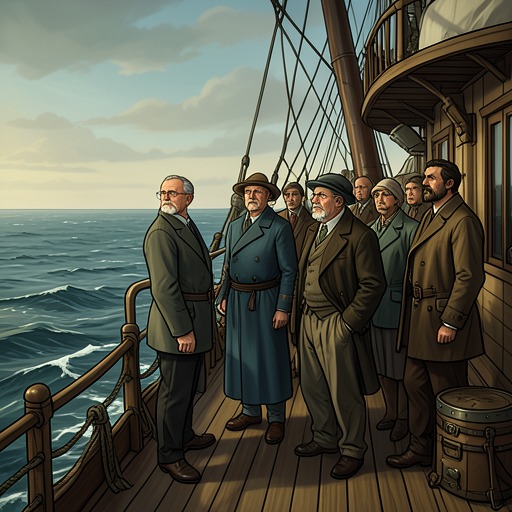
When America finally appeared, the passengers gathered on deck, including those too weak to climb up without help. The visible shore offered houses, churches, embankments, piers, streets, roads, people, and carriages. But the sight that mattered most to the emigrants was the green ground itself: beyond a large house with a round tower, morning mist lifted to reveal leafy trees and grass. The passage from the dark shore at Karlshamn to this light, green shore gave the arrival its force. The land was no longer a rumor or a picture; it lay before their eyes.
The novel connects that recognition directly to the travelers’ condition. Storms, illness, confinement, and the monotonous shipboard life had gnawed at their vitality. Scurvy and ship fever had lowered their resistance, and many had become depressed and indifferent to what life might bring. Seeing land did not erase those hardships, but it altered their immediate sense of what was possible: they knew they had crossed the sea safely and had returned to the earth.
The passengers’ posture makes the reversal visible. Crowded together on deck like cattle held through a long winter, they stretch their necks toward the opening as if at last approaching spring and fresh grass. The comparison turns the ship from a vehicle of promised passage into a place of confinement, and the shore into release. What had been a journey toward an unknown future now becomes, for the first time, a scene of anticipated freedom.
Recovery and narrative significance
The account calls the sudden change land-frenzy. Its effects spread across the group: those sick with scurvy feel they may recover; the weakened regain life, the tired feel new strength, initiative returns to the depressed, and the timid grow bold. The description makes the response more than happiness at reaching a destination. Land seems to restore capacities that the crossing had worn down, while the lifting mist over the earth echoes the departure of indifference from the passengers’ minds.
The scene also completes a recurring contrast between movement and access. On the road from home, Robert counts the gates along the route to America, turning each opening into a measure of departure. At sea, by contrast, the emigrants can travel for months yet remain enclosed in a vessel only forty paces long and eight wide. The distance crossed does not mean freedom at every point: wind, shipboard rules, cramped quarters, and illness govern the travelers until land comes into view. Land-frenzy arrives when the long passage finally yields a visible threshold beyond the ship.
The Charlotta anchors at a pier, the gangplank is lowered, and the passengers begin to disembark into a hot summer day. That physical transition confirms the emotional one without making the crossing’s suffering disappear. Land-frenzy is the moment when the emigrants’ worn-down expectation turns back toward life: after leaving the earth, enduring the sea, and fearing that the destination might never arrive, they stand again before green ground and feel capable of beginning.