Leaving home as a funeral
The EmigrantsLeaving home as a funeral is the novel’s governing image for the cost of emigration: a journey toward an imagined future also becomes a passage away from the living world of home, perhaps never to be retraced. Through the still figures of Karl Oskar Nilsson’s parents, the wagons departing from Korpamoen, and Kristina’s comparison of the travelers to a funeral cortege, the narrative gives migration the gravity of a communal farewell. Later, the image returns in altered form when Swedish soil is scattered over a body at sea: the emigrants carry their homeland with them, but cannot make the separation reversible.
The departure as a threshold
The movement begins in communities accustomed to remaining in place. News of fertile land across the ocean passes from neighbor to neighbor, unsettling households whose plots seem smaller as their children grow and whose inherited routines offer little relief from scarcity. Yet the new country is known through reports and pictures, not firsthand experience. The familiar home appears safe beside an unknown ocean, and arguments divide the cautious from the daring, as well as men from women and youth from age. Departure therefore begins not as a simple escape but as a difficult threshold: hope must contend with uncertainty before anyone can leave.
For Karl Oskar Nilsson and Kristina Johansdotter, the decision bears the pressure of years of labor without improvement. After four years at Korpamoen, they are several hundred riksdaler poorer than when they began. Remaining seems to promise only more exhausting work, declining strength, and, in old age, the reserved room and meager bread that have marked his parents’ condition. Karl Oskar sees no prospect that toil will change their lot. His case for leaving is rooted in the fear of spending a lifetime in work that yields no security.
Kristina’s resistance gives the departure its moral and emotional uncertainty. She cannot treat Karl Oskar’s hopeful account of America as proof: no authority has promised them land, they possess no deed, and they know no farmer with a wife and children who has already settled there. Newspapers and books do not replace the testimony of someone she trusts who has seen the country. Her hesitation is not simply attachment to home; it is a demand for evidence and protection against a journey whose promised destination remains unverified. The decision to leave thus places shared family life between a husband’s confidence in the future and a wife’s reasonable fear of being misled.
Family, memory, and the funeral image
At the moment of departure, Karl Oskar looks back toward his parents on the porch. His father, stooped and dependent on crutches, stands beside his tall, upright mother; neither moves as the wagon carries the younger generation away. In Karl Oskar’s memory they become like stones in a field or tree trunks rooted in the forest, fixed in the posture of watching the cart leave. The image makes the separation feel permanent even before its outcome is known: his parents will remain in his mind at that doorway, while he continues down the road.
Kristina does not tell Karl Oskar that she heard Nils describe the departing sons’ journey as a funeral procession. At the meeting of the emigrant wagons, the comparison returns to her with force. Their company looks like a small cortege, and the recollection carries the weight of an earlier family loss: Anna’s burial had involved no more than three carriages. The parallel does not make emigration identical to death; it reveals how departure can resemble a funeral to those who stay behind and to those who cannot yet know whether they will ever return.
The narrative enlarges that private farewell into a meditation on mortality. Every person, Kristina reflects, is on the way toward a grave somewhere, so that all human journeys can be understood as one long funeral procession. But the emigrants’ journey has a particular uncertainty: some might return, and Kristina imagines that most of the group, though not Karl Oskar, privately hope to come back prosperous rather than impoverished. She nevertheless suspects that none may travel the same road home again. The funeral image holds together both possibilities—the hope of return and the likelihood that the departure will become final.
A collective journey made from separate decisions
The group that leaves Ljuder Parish is not united by a single motive. Its members are brought together by different pressures, including failed crops, religious persecution, dissent, personal difficulties, social exclusion, and unfair employment practices. Their shared route makes them a group, but not a uniform one: the company is a small cross-section of the conditions pushing people to leave Sweden. The funeral-cortege image gathers these distinct decisions into one visible procession without erasing their separate causes.
The journey depends on practical arrangements as well as conviction. Karl Oskar Nilsson and Robert Nilsson have contacted a firm in Karlshamn and paid a hundred daler toward passage for six people on the Charlotta. The ship is expected to sail directly to New York in the second week of April, when the spring crossing should permit the emigrants to reach their settlement in time to plant crops. Robert offers to seek a passage contract for Danjel Andreasson too, if the ship has room; Danjel’s party numbers nine, including children and household members. The decision of one household thus opens a practical route for another, turning separate intentions into a larger migration.
At Åkerby Junction, three wagons bring the travelers together. Nineteen people meet there: sixteen emigrants—nine adults and seven children—and three drivers who will return from Karlshamn. Danjel’s party includes his wife, four children, and Ulrika of Västergöhl; two people from Kärragärde, Arvid and Elin, travel with Jonas Petter of Hästebäck because Danjel’s wagon has no room. The group must also settle who should lead it. Attention turns to Karl Oskar, the first to decide on the journey, but he objects that he is the youngest farmer; Jonas Petter is older, yet points out that he was the last to commit. The exchange shows how the procession forms through both shared movement and unresolved distinctions of age, experience, and decision.
Objects carried out of the old life
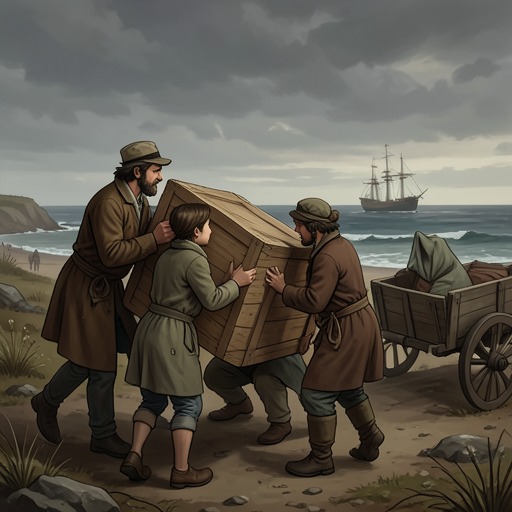
The family’s old oak clothes chest gives the departure a material history. Kept for generations and brought out for baptisms, weddings, and funerals, it has passed from father to son and accompanied the household through successive lives. Once displaced to a dark attic corner, it is drawn back into use as the strongest, roomiest packing case the family can find: five feet long, three feet high, and reinforced with iron bands. It will leave the household not as a mere container but as an inherited object entering a new role. The chest that once held finery and winding sheets becomes luggage for an uncertain future.
Packing reveals what the emigrants believe they may need in the new country and what they are forced to leave behind. Karl Oskar places heavy iron and steel tools in the bottom of the America chest: an adz, hatchet, chisel, drawknife, plane, hammer, and other equipment for work. He takes apart his muzzle-loader to pack it more easily, while Robert brings fishing tackle and Nils contributes an old bleeding iron, which he considers useful for treating illness. These objects anticipate the labor and self-reliance the emigrants expect of themselves, but they also register how little reliable knowledge they possess about life in America.
Kristina’s packing makes the loss more intimate. She brings wool cards, knitting needles, sheep shears, and the swingle Karl Oskar gave her as a betrothal gift, decorated with red flowers. She cannot take the loom, spinning wheel, flax brake, or the other implements familiar to her hands. Warm garments, sewing supplies, bedding, and the bridal quilt occupy precious space; food must also be carried for the travelers, including rye and barley loaves, salted butter, honey, cheese, smoked meat, and herrings. The household prepares against both need and separation, preserving useful skills and familiar belongings while accepting that much of its working life cannot be packed.
The road away and the crossing’s echo
The leaving begins in the half-light of a chilly April morning, with the ground still frozen. As the wagons move through known places, Karl Oskar and Kristina silently mark the brook and meadow they will see for the last time. Robert, by contrast, opens gates on roads he has never traveled and treats each opening as part of the road to America. For the adults, the landscape recedes into memory; for Robert, unfamiliar roads turn the journey into a new beginning. Their different responses make the same movement both a farewell and an advance.
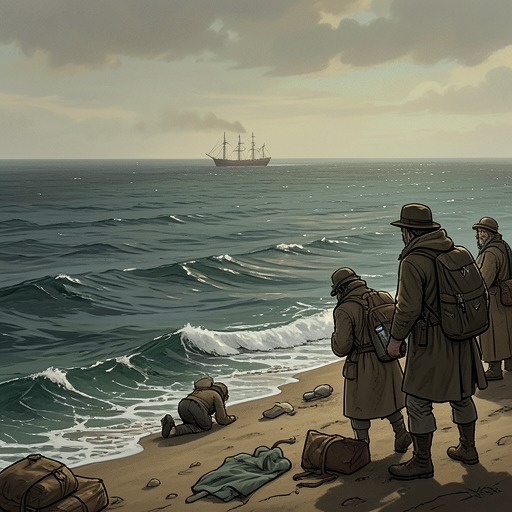
The final image of funeral departure is not confined to those left behind. At sea, during a burial, the captain takes Swedish earth from the ship’s supply and scatters three scoopfuls over the body. The gesture joins the emigrants’ present loss to the homeland they have left: soil carried across the ocean briefly covers the dead, but some of it falls into the water as the bier leans toward the rail. The ritual makes home tangible at the moment it also reveals how precarious that connection is. In this echo, leaving home as a funeral becomes more than a figure for grief at departure; it links emigration, remembrance, and death across the distance between the old land and the sea.