Märta
The EmigrantsMärta, the wife of Nils and mother of Karl Oskar, Robert, and Lydia, embodies the labor and attachments that hold Korpamoen together. Strong, practical, and deeply involved in both the farm’s making and its family life, she helps turn a small cotter’s place into workable land, cares for Nils after his accident, and watches her sons depart for America. The image of her standing beside her husband on the porch becomes, for Karl Oskar, an enduring picture of the home he has left behind.
Identity and Family
Märta is described as a strong, stately woman, a full head taller than her husband, Nils Jakob’s Son. They have three children: their sons Karl Oskar and Robert, and their daughter Lydia. The household also experiences two miscarriages; one occurs on a day when Märta has been helping Nils dig up a boulder in the field. Her family life is thus bound closely to the physical demands of the farm, where domestic and agricultural work are not separate spheres.
The family grows again after Karl Oskar marries Kristina. On the day before Christmas Eve, Kristina gives birth to twins. The sickly boy dies within a fortnight, while the surviving girl is baptized Märta, after Karl Oskar’s mother, and later becomes known as Lill-Märta. The name carries the older woman into the next generation even as the family’s losses remain part of its history.
Making a Farm at Korpamoen
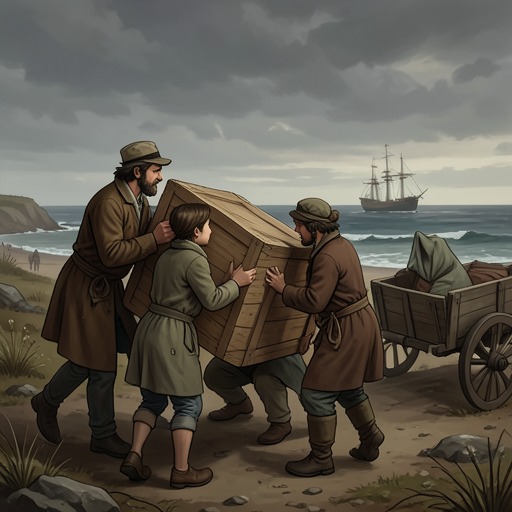
Korpamoen begins as little more than a cotter’s holding. Its sandy soil is strewn with stones, and Nils sets about finding each cultivable patch and clearing it with an iron bar and a lever: a long pole weighted at one end with a horseshoe. His hands do much of the work, but when he cannot shift a stone alone, he calls for Märta. She grips the small end of the lever while he works the bar, their strength and effort joined in the task of making the land usable.
This partnership is more than a single scene of assistance. The farm that later passes to Karl Oskar is the result of years of clearing, and Märta’s labor has helped make that inheritance possible. The physical scale of the work is set against the family’s modest circumstances: Korpamoen is too small to divide, and Nils does not want an outsider to benefit from what he and Märta have built. Their children’s future is therefore tied to the farm’s transfer, while the parents’ own security must be negotiated within it.
Care, Injury, and the Family’s Future
When Nils is injured while working, Märta goes out after he fails to return for his afternoon meal. She finds him beside the stone, lifts him onto her back, and carries him home. Berta of Idemo is summoned and identifies the broken hipbone and injured joint. Märta’s response is practical and immediate: she locates her husband and gets him back to the house, turning her physical strength toward care as directly as she had used it in the fields.
The transfer of Korpamoen to Karl Oskar establishes a changed household. Nils and Märta retain lifelong reserved rights: a room in the house, fodder for one cow and one sheep, a small area of arable land, use of the owner’s team, and an annual grain allowance. Their children receive inheritance shares, with Robert and Lydia leaving theirs as claims against their brother because they are not yet of age. The arrangement gives the older couple a place and provisions, but it also makes their later circumstances dependent on the son who takes over the farm.
Märta’s care extends to the next generation as well. When Robert returns after being flogged, she cries out in alarm and later covers his wounds with pork bile. The moment makes visible both his vulnerability and her instinct to tend him. In a separate family conflict, she warns Kristina against allowing a child to be baptized by Danjel, whom she regards as possessed by the Evil Spirit. Her concern is expressed through religious fear, but its immediate object is the child’s safety and the mother’s responsibility for it.
Departure and Farewell
Märta and Nils cannot give their foolhardy son the help he needs, and they know that attempts to influence him would only make him more stubborn. When Karl Oskar decides to emigrate, his mother regards his departure as sinful ingratitude: he has not been driven out by a whip, and she believes he discounts what he already has at home. She and Nils pray that he will change his mind. Nils reproaches him only once, quietly observing that he is taking many people along with him. Their opposition is bound to the scale of his decision: Karl Oskar is not leaving alone, but carrying his wife and children away from the parents who remain behind.
The farewells are brief. Karl Oskar asks Lydia to look after their parents, especially as they grow older and less able to manage for themselves, and promises to pay her. Märta takes each grandchild into her arms and asks God to protect the helpless child. Her blessing is a small, repeated act of care at the threshold of a departure whose consequences she cannot control. Karl Oskar jokes that he will return with enough money to buy the manor at Kråkesjö and buy Korpamoen back for Lydia, but no one smiles; neither son has promised to return.
The Parents on the Porch
As the wagon leaves, Nils and Märta stand on the stoop. Karl Oskar looks back and sees his father, stooped and leaning on crutches, with his tall mother close beside him, her back straight. The contrast is stark: the young people are moving down the road, while the old remain at the house. The parents make no visible movement as they watch the wagon depart.
For Karl Oskar, the scene becomes more than a last glimpse. In the half-mist, his parents seem fixed to the ground like stones in a field or trees in the forest, and he remembers them in that posture for years afterward. The image gathers Märta’s life at Korpamoen into a single enduring form: the strength that helped clear its soil, the care that sustained its family, and the rootedness that makes departure feel like a permanent separation. Her significance lies not in leaving the old home behind, but in remaining there, beside Nils, as the wagon disappears from view.