Måns Jacob dies at sea
The EmigrantsMåns Jacob dies at sea aboard the brig Charlotta, where his death exposes the human cost of the emigrant passage in its most confined form. His wife’s refusal to believe he is gone, Karl Oskar’s effort to give the body a final washing, and the use of Swedish earth in the burial make this more than a death recorded on the voyage: it is a passage from the familiar obligations of home into a shipboard order that must make room for the dead and the living alike.
The voyage and its conditions
The Charlotta sailed from Karlshamn for New York on April 14, 1850. She carried seventy-eight emigrants and a crew of fifteen, making ninety-four people aboard a brig only 124 feet long and 20 feet wide. For passengers below deck, space was divided by canvas into compartments for families, unmarried men, and unmarried women. The hold was crowded with bedding and belongings; its air was thick, its overhead low, and there was barely room to move. Karl Oskar had no space in the family compartment and slept among the unmarried men, while Måns Jacob and Fina-Kajsa occupied a family bunk.
The ship’s routines made that cramped environment a system of rationing and shared labor. Each family received unprepared food for a week and had to take turns preparing it in the galley. Passengers were allotted half a gallon of fresh water per day for drinking and washing, and the hold had to be cleaned before water was issued. Each morning, people cleaned their quarters and dealt with the previous night’s sickness. Against this background, a death in the family compartment could not remain private: the body, the bereaved widow, and the other passengers all had to be accommodated within the same restricted space.
Discovery and refusal
A few days after an earlier death in the family compartment, Fina-Kajsa found her husband dead in his bunk. She had awakened him in the customary way by shaking his shoulder. When he did not respond, she shook him harder, but she still believed he might wake: she recalled that his heart had sometimes seemed to stop and that he was a very heavy sleeper. Married to him for more than forty years, she trusted the experience of a lifetime and insisted that he had lain this way before.
Danjel Andreasson came when Fina-Kajsa called for help and told her that Måns Jacob was dead. The other passengers agreed that he could not be brought back by shaking him. The cause remained uncertain. Some thought his heart had stopped; Karl Oskar wondered whether he might have choked while sick during the night. He had been found face down, and no one had heard him call for help. The narrative offers these possibilities, not a definitive medical explanation.
The second mate’s appearance signaled to the passengers that a death had occurred. When he began to take Måns Jacob from the bunk, Fina-Kajsa pleaded for more time, asking him to wait because her husband might awaken. The mate refused to leave the body there, and she clung to one of her husband’s legs as he was removed. Only after considerable difficulty could the mate free the body from her hold. Her resistance makes the practical urgency of shipboard burial inseparable from the intimate fact of a wife being made to part with her husband.
Washing and the last service
Danjel and Inga-Lena stayed with the widow, while Karl Oskar helped the second mate with the body. Karl Oskar was troubled that Måns Jacob’s face should be left unwashed before the funeral. He recalled having heard that a funeral service ought not to be read over an unwashed corpse. Danjel, speaking of people’s responsibility when they awoke on the Day of Resurrection, agreed that the dead man was owed this final service: his body had been the shell of a human soul created by God.
With no women available to help, Danjel and Karl Oskar soaked old scrub rags in seawater and cleaned the face. Their washing was limited, but it removed the dark marks before the body was enclosed in its canvas shroud. The scene sets two kinds of necessity beside one another. The ship’s mate must remove the body from a crowded bunk; the men who remain with it insist that necessity need not cancel care. Their small act cannot undo death, but it preserves a human obligation within the ship’s impersonal schedule.
The grindstone and the sea burial
The mate placed a weight in the canvas, as was customary. Karl Oskar thought of Måns Jacob’s grindstone, kept in the storeroom, and of how persistently the old man had spoken about getting it to America. Now there was no owner to care for it in the new country. Karl Oskar wondered whether Måns Jacob might have wanted the stone beside him at the bottom of the sea, where it would be safe until the Day of Doom. The thought joins the immigrant’s practical cargo to the unfinished hopes attached to it: the grindstone had been meant for work on the far shore, but its owner would never reach that shore.
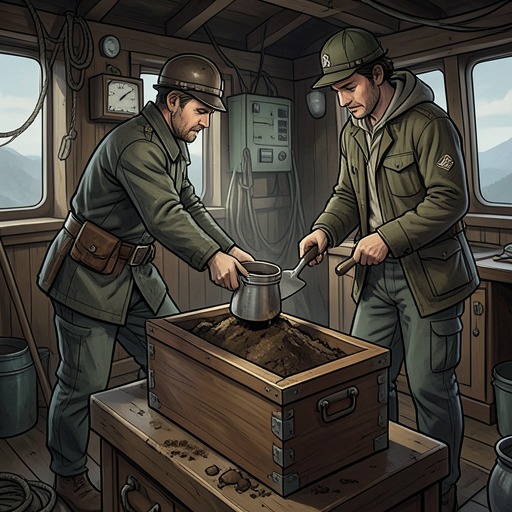
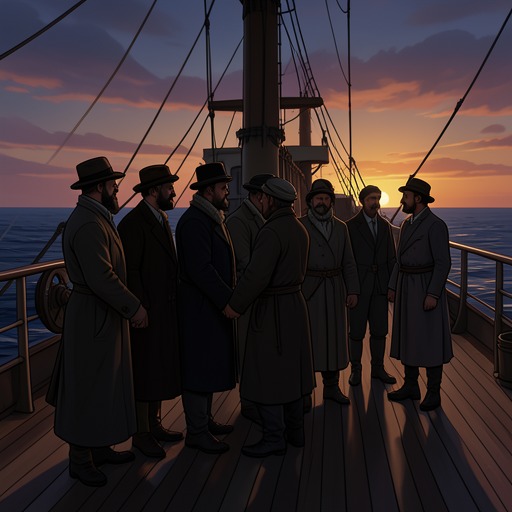
At the burial, three shovelfuls were taken from the bushel of Swedish earth carried aboard. The captain used a small scoop to scatter the soil three times over the canvas-covered body, then spoke the words, “Dust thou art, to dust thou shalt return. Jesus Christ shall awaken thee on the Day of Judgment! Let us pray.” The soil made the homeland materially present at the moment of farewell, but it could not keep the body on land: the lighter earth began to slip from the canvas and fall into the sea before the service was finished.
A death that changes the living arrangement
Måns Jacob’s death altered the passengers’ sleeping arrangements at once. Fina-Kajsa, now widowed, moved to the other side of the sailcloth, among the unmarried women. Karl Oskar and another married farmer were allowed to leave the unmarried men’s compartment and move in with their families, taking the bunk vacated by Måns Jacob and his wife. The vacancy was therefore both a practical relief for a crowded ship and the direct consequence of a family’s loss.
Karl Oskar slept in the dead man’s former place. He remembered the saying he had heard on the Charlotta’s first day: “There’s more room in the hold the farther out we get.” In this instance, the phrase comes true through a death, not through any easing of the ship’s conditions. The new space does not signify arrival or abundance; it is the narrow margin created when one passenger is gone. Måns Jacob’s burial thus becomes a measure of the voyage itself, in which the emigrants’ movement toward a hoped-for future repeatedly depends on accommodating illness, bereavement, and the irreversible departure of fellow travelers.