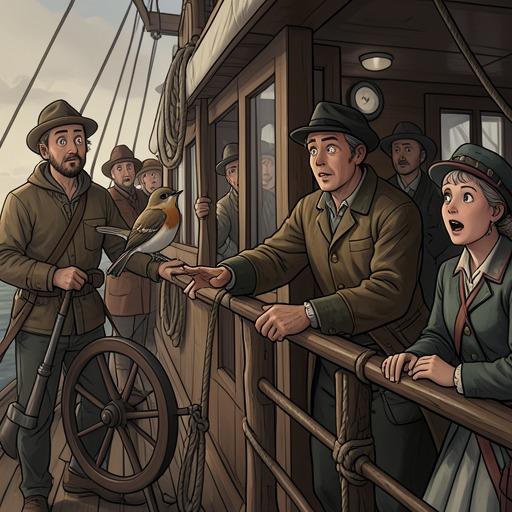
Mysterious bird visits and leaves the Charlotte
The EmigrantsThe mysterious bird’s visit and departure from the brig Charlotta becomes a rare shared source of hope during the emigrants’ long Atlantic crossing. After two months at sea, when the passengers feel cut off from both the Swedish land they left and the American land they seek, the small, unidentified creature seems to bring the earth aboard with it. Its brief stay comforts the emigrants; its unexplained disappearance leaves them mourning and unsettled, with the next storm giving weight to the sailors’ fear that its departure was an ill omen.
The bird appears amid isolation
By the time the bird is spotted on the afterdeck, the emigrants have sailed for two months. Since the English shore disappeared, they have seen only one other ship, flying the Swedish flag, and no human life beyond their own vessel. The ocean has made them feel like vagabonds forgotten by the world: perhaps someone still misses them in the country they left, they imagine, but no one waits for them in the country ahead. In that loneliness, the sudden announcement that there is a bird aboard spreads rapidly through the ship.
The passengers and crew cannot identify it. It is a small bird, scarcely larger than a wagtail, with blue-black head and tail, green back and wings, and a white throat and breast. Its appearance stands out because even the seagulls that had followed the Charlotta early in the voyage have vanished from the open ocean. With other signs of life gone, the little visitor seems to the emigrants less like an ordinary animal than a miracle, a messenger from land.
The ship’s crowded conditions make the bird’s arrival a contrast as well as a wonder. The hold is packed with bedding, food baskets, and bundles, and the passengers’ living space is divided by canvas partitions. In that confined world, the bird carries in their imagination the open places they cannot see: trees where birds nest, fields in bloom, and forests. The passengers read its earth-colored feathers as a reminder that solid land and growing life still exist beyond the sea.
A shared companion and image of home
The emigrants respond by feeding the bird, offering bread and ship’s biscuits until it becomes choosy and no longer bothers with crumbs on the deck. It wanders among its human feeders without fear, darts away when waves wash over the deck, and sometimes flies beyond the rail before returning. Though the passengers do not know what kind of bird it is or where it came from, they make it a place among them: the Charlotta becomes its home for the days it stays aboard.
The crew shares the passengers’ concern for the visitor. A sailmaker makes it a soft nest from sewn-together pieces of wadmal, tucked behind a sail near the mainmast, where the bird takes shelter at night. During the day, people follow its movements with their eyes. This attention turns the bird into a focus of collective care across the ship’s community, and the sailors, too, are careful that it should not come to harm.
For the emigrants, watching the bird is a way of remembering that the ship is not the whole world. Its presence recalls trees, fields, and the home landscapes from which they have been separated, while also assuring them that their imprisonment aboard the vessel will not last forever. Some passengers fear that the visitor could bring harm as well as good, but they still hope to befriend the messenger from the earth and are inclined to feel that its arrival is a blessing. The creature becomes a shared sign of belonging: in their isolation, they see in it something of their own connection to land.
Departure, mourning, and foreboding
One morning, the bird is gone. The passengers search the ship but find no trace—not a feather or other sign—and conclude that it has deserted them rather than died aboard. They do not fear for its ability to reach land, because they have come to believe it is no ordinary bird, unconstrained by weather, wind, or distance. The same uncertainty that made its arrival miraculous makes its departure impossible to explain.
The bird never returns. Its loss is felt not as the disappearance of an animal alone but as the loss of a near relative, and sorrow lasts for many days. The emigrants ask why it did not remain long enough to witness the fulfillment of the miracle and what message it meant to deliver. They cannot resolve either question. With the visitor gone, nothing aboard reminds them of the green earth as vividly as it had.
Experienced sailors, some of whom have spent thirty or forty years at sea, call the departure an evil omen. The day after the bird vanishes, another storm breaks. The narrative does not establish that the bird caused or foretold the storm, but the sequence gives the sailors’ interpretation force within the passengers’ anxious world. What had seemed a blessing is now followed by renewed danger, and the bird’s unexplained coming and going remains balanced between natural possibility and supernatural meaning.
Narrative significance
The episode gives physical form to the emigrants’ precarious position between two homes. The bird arrives after an extended stretch in which the passengers have seen almost no life beyond their own ship; it makes land imaginatively present without bringing them any nearer to it. For a few days, a creature associated with trees and fields opens a view beyond the cramped vessel and sustains the passengers’ sense that another life awaits them.
Its departure reverses that comfort without supplying an explanation. The emigrants mourn, the sailors anticipate misfortune, and the subsequent storm intensifies the sense of threat, yet the bird’s identity and purpose remain unknown. The episode therefore holds the passengers—and the reader—between an ordinary explanation and a miraculous one. The bird is at once a living visitor on a working ship and a symbol charged by loneliness, faith, and the desire for land; its brief presence cannot settle what awaits the emigrants, but its loss makes the sea feel empty again.