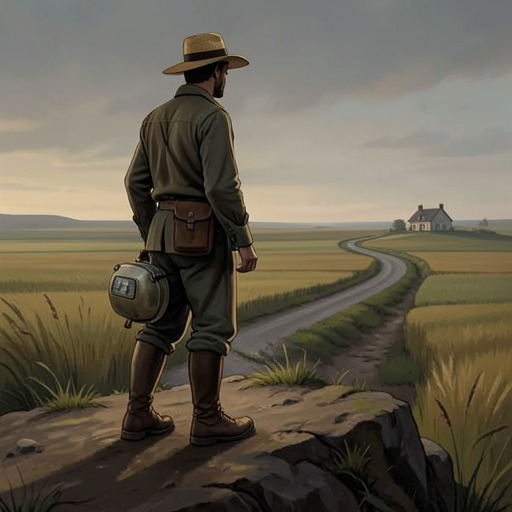
Nils clears the land at Korpamoen
The EmigrantsNils clears the land at Korpamoen through decades of patient work, transforming a one-sixteenth share of a homestead into a working farm. The labor is both practical and generational: he searches out cultivable patches, moves stones with tools and with Märta’s help, and leaves fields whose stone heaps record the effort long after his own strength has diminished.
A Fragment of the Mjödahult Homestead
Korpamoen began as a split-off piece of the old Mjödahult farm. In 1819, two brothers, Olov Jakob’s Son and Nils Jakob’s Son, received equal shares after the property had been divided repeatedly; their farms amounted to only one-sixteenth of the original homestead. Nils’s share consisted of three arable acres on the outskirts, where he built a house among scattered pines. The assessment book recorded it as a one-sixteenth crown-assessment holding under Mjödahult.
The tiny plot belonged to a wider pattern of subdivision. Ljuder Parish had 1,925 inhabitants in 1846, nearly three times its population a century earlier, while the number of people outside the assessed landholding population had grown fivefold. Of 254 independent farms, two-thirds were one-eighth of an original homestead or smaller. Korpamoen’s limited acreage thus reflects not an isolated circumstance but a landscape where expanding families shared increasingly fragmented holdings.
Turning Stones into Fields
The soil at Korpamoen was sandy and strewn with stones. Nils searched for every patch that could be cultivated, working with an iron bar and a long lever, a pole with a horseshoe fixed to its heavy end. He also used his hands to reach stones lodged deep in the ground, wrestle them loose, and roll them away. When a stone exceeded his own strength, he called for Märta; she held the small end of the lever while he worked the iron bar.
The clearing proceeded slowly, in increments that made persistence measurable: each year Nils broke a new quarter of an acre. Over the span of his farming years, the work produced more stone piles than could be found on any other farm in the parish. When he plowed, he had to steer around them, making the field’s repeated circuits a visible consequence of the labor that had opened it to cultivation.
Work That Outlasts Its Worker
Clearing the land was part of a broader effort to make a livelihood from Korpamoen. Nils had mortgaged the farm so his brothers and sisters could receive their inheritance in cash, and the interest required him to take work as a timberman and carpenter. Skilled with wood, he built his own house and made farming tools at his workbench through the winters. The land’s improvement and his craft work were therefore connected parts of the same effort to sustain a small, encumbered holding.
After Nils was injured in a fall and could no longer farm as before, the work remained visible in the stone heaps and fences he had made. He spent summer days sitting beneath an old maple with a view across the fields, while on weekdays he continued making spokes, rakes, and tool handles in the woodshed. His hands remained dexterous, and he taught Karl Oskar what he could of his craft. The landscape preserved one measure of his labor; the skills passed to his son preserved another.
An Inheritance of Labor
Nils’s clearing helps explain both the possibilities and limits of life at Korpamoen. A small share of land could be made productive through sustained work, but it did not offer enough acreage or security to solve the pressures facing the next generation. When Karl Oskar later considered leaving, he imagined fertile, stone-free American soil as a contrast to the difficult ground at home; the novel sets that hope against the fields Nils had spent years making workable.
The cleared land also gives material weight to the family’s departure. As Karl Oskar’s household left, Nils and Märta remained behind, watching from the porch while the wagon carried the younger generation away. The stone-strewn fields were not merely a hardship to be escaped: they were the enduring result of Nils’s work, and the home from which his descendants’ migration began.