Overcrowding and unsanitary conditions aboard the Charlotta
The EmigrantsOvercrowding and unsanitary conditions aboard the Charlotta make the emigrants’ passage a test of bodily endurance and personal space, rather than an open road to a new life. The brig’s crowded hold, restricted provisions, inadequate ventilation, and routine cleaning duties leave passengers vulnerable to discomfort and illness; for Kristina and her family, their sleeping pen comes to feel like a place of confinement, even a grave.
The ship’s design and crowded quarters
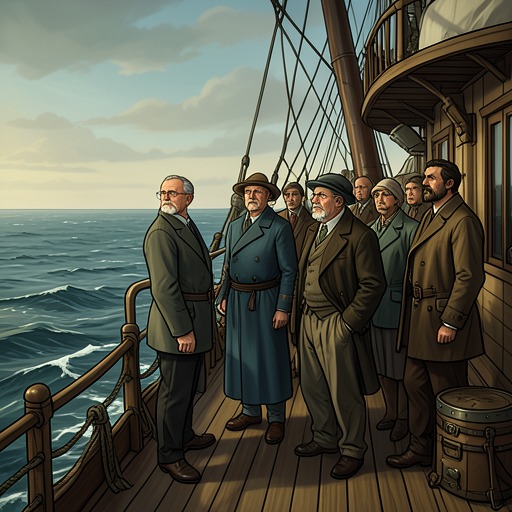
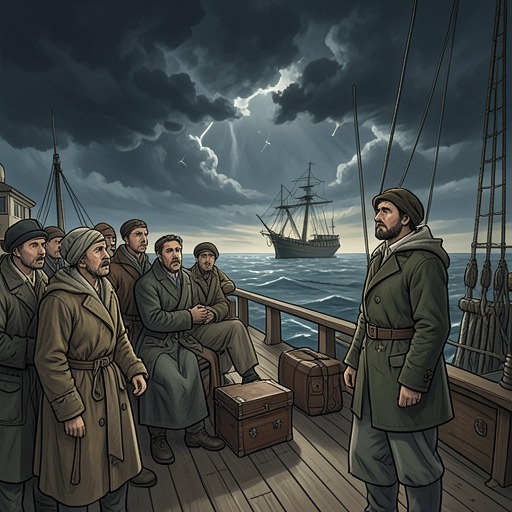
The Charlotta sailed from Karlshamn for New York on April 14, 1850. The brig was 124 feet long and 20 feet wide, carried 78 emigrants among 94 people aboard, and was making its seventh voyage as an emigrant ship. These figures establish the scale of the passage, but the passengers’ sleeping arrangements show what those numbers meant in daily life. Canvas dividers split the hold into separate spaces for families, unmarried men, and unmarried women. Families slept in small enclosures made from rough boards; other passengers used bunks suspended between the ship’s supports. Mattresses and loose straw covered parts of the deck, and belongings were kept beside each berth.
The hold’s limited capacity was overwhelmed by people and possessions. Bedding, baskets, food, and bundles filled the narrow compartments and crowded the spaces between bunks. Light reached the hold mainly through the hatch; at night, a few smoking kerosene lanterns provided what little illumination there was. The low overhead and thick air intensified the sense of compression. The arrangements did not simply restrict comfort: they made ordinary acts of sleeping, moving, and tending a family difficult.
Karl Oskar could not sleep in the family compartment with Kristina and their children. He shared a two-man bunk with his brother Robert in the area for unmarried men, while Jonas Petter slept above them and Arvid occupied the next bunk along the same side. There was scarcely a foot of width for each man. Robert and Arvid found the air so foul that they tried to go above deck, but reaching the hatch meant forcing their way through fellow passengers, bedding, and luggage. Small holes in the hatch covering admitted little fresh air, so escape from the hold offered relief without solving the underlying lack of ventilation.
Family life under confinement
Kristina’s sleeping place was a rough bed-pen in the family compartment. She laid her mattress on the floor and spread her bridal cover over it; the family’s large willow food basket had to stand on top of the bunk because there was nowhere else to put it. The children tumbled and tussled in the same confined space. The bunk was not just where they slept: it was their only room, containing the family and what they had brought with them.
More than thirty people shared the family compartment, a space no larger than Kristina’s room at Korpamoen. She could scarcely rise without bumping into someone, and she was uncomfortable having to dress, undress, or nurse her baby in view of strangers. At night, the children’s movements repeatedly woke her, while the noise of the ship and its passengers kept her from resting. She slept uneasily and rose more tired than she had been before going to bed. The close quarters made privacy and rest scarce at precisely the moment when she had to care for her children.
The family’s needs were complicated by illness and the lack of familiar household resources. Lill-Märta caught a cold in the windy harbor town and developed a fever, but the ship had no milk; Kristina instead had to prepare warm water with honey. Johan was well, but wet his bed, adding to the clothes that needed washing and drying in an overcrowded shipboard setting. The children’s soiled clothing, their limited sleeping space, and the absence of milk turned routine care into a continual practical problem.
Rules, provisions, and sanitation
The ship’s officers imposed a system intended to manage supplies and keep order during the crossing. Provisions were allotted in unprepared portions for each passenger, with each family expected to make its weekly ration last for the week. One person from each family was to collect food, and passengers had to take turns using the galley and its utensils. Refuse, bones, dishwater, and sweepings were to be thrown overboard on the leeward side, not the windward side. The rules organized shared resources, but they also meant that families had to manage food preparation within a crowded ship and according to a fixed schedule.
Fresh water was issued once a day, half a gallon per person for drinking and washing. Passengers had to clean the hold themselves, and the daily water was withheld until the morning cleaning was done. Men carried water in buckets; women scrubbed, washed clothing, and hung it to dry on deck. Only after the quarters had been cleaned could passengers drink or wash. The routine made sanitation a collective duty, but the scarcity of water made it difficult to meet the combined needs of cooking, drinking, washing themselves, and caring for babies.
The passengers complained that half a gallon was too little. The second mate explained that the ship’s supply could not support larger rations and that, if weather prolonged the voyage, they might have to manage with still less. The women tried to wash woolens in seawater, but the soap would not lather. When heavy rain came, the sailors stretched a sail to collect water and washed themselves and their clothes; some passengers followed their example. Danjel Andreasson interpreted the rain as a provision from heaven, while the practical scarcity remained visible in the need to save each drop.
Illness and the human cost of the passage
For Kristina, the hold’s conditions were difficult from her first days aboard. She found the air and surroundings so oppressive that she wanted to leave the ship. Over time she grew accustomed to the odors, but continued to breathe shallowly to avoid the air. Karl Oskar attributed the poor atmosphere to inadequate ventilation: below deck, he said, passengers were breathing one another’s air. When the weather was calm, they could go on deck for fresh air during the day, but this offered only temporary relief from their nighttime quarters.
The close quarters also enabled lice to spread through clothing. Kristina discovered them throughout the seams and folds of her wool garments, with nits in the creases and bites on her body. She stripped off her clothes and broke down in tears. The infestation made the ship’s lack of clean, private space especially consequential: the passengers’ clothing and bedding were packed together, while washing and drying depended on scarce water and limited room.
Illness continued across the voyage. Inga-Lena, after suffering seasickness, developed recurring dizziness and headaches, fainting during cooking or heavy work, and prolonged bowel trouble that left her increasingly weak. She confided her symptoms to Kristina and worried that she had contracted ship-sickness. The narrative identifies scurvy as a disease suffered by Kristina and several others in the hold. Captain Lorentz, consulting his Medical Adviser for Seafarers when Kristina suffered a severe nasal hemorrhage, recognized that she had been ill with scurvy for some time. The ship’s medical reference offered measures for attempting to stop serious bleeding, but the episode underscores the limited means available when sickness became dangerous at sea.
The crossing’s losses made that vulnerability more than a matter of discomfort. Of the nineteen children aboard when the Charlotta left Karlshamn, two had died during the voyage: a one-year-old boy from whooping cough and a five-year-old girl from ship’s fever. The deaths, together with the illnesses affecting Kristina and Inga-Lena, show how the passage joined crowded accommodation, constrained care, and sickness in a setting from which the passengers could not simply depart.
Confinement and the meaning of migration
Karl Oskar regarded the accommodation as a breach of what he had expected to receive for the passage. He had not expected luxury, but objected that the emigrants were packed together as if penned in, with at least twenty people too many below. He believed the shipowner had prioritized profit: each adult had paid 150 riksdaler, described to him as 43½ dollars in the currency of their destination, yet passengers were left to endure crowded and unhealthy quarters. The mate threatened to call the captain, and Kristina urged Karl Oskar to stop speaking, but he persisted because he considered the arrangement unjust. His protest connects the material conditions below deck to the unequal power passengers had once they had paid and sailed.
Once the ship began to move, Kristina saw the crowded hold as the home where she and the children would have to live for weeks, perhaps months: they would eat, sleep, and remain there together. The thought she had had upon first entering the hold returned—she feared she would never get away alive and that the place resembled a grave. This image reverses the promise implicit in migration. The emigrants had crossed to the sea after looking across water with no land visible on the other side; aboard ship, movement toward North America coincided with confinement in a dark, crowded space.
The Charlotta’s conditions therefore make the voyage’s risks concrete. The emigrants’ hopes of reaching a new country did not suspend the ordinary requirements of care, privacy, clean water, and breathable air; instead, the ship’s cramped architecture and strict management of supplies made those needs harder to meet. The contrast between a journey imagined as passage to freedom and a life organized around narrow bunks, daily cleaning, rationed water, and sickness gives the crossing its central tension: the passengers were moving toward a new land while, aboard the ship, their lives were sharply restricted.