People of the Soil
The Emigrants“People of the Soil” is the novel’s defining expression for the emigrants’ rooted way of life and the rupture caused by leaving it. They come from farms where land is familiar and labor has shaped their bodies and skills; aboard the brig Charlotta, those same people discover that the ground beneath them no longer holds still. The phrase therefore describes not simply an occupation but a relationship to land—one that gives migration its material urgency and makes the passage across the sea an unsettling loss of control.
The Land and Its People
In Ljuder Parish, the pressure to leave has a long demographic and economic history. On January 1, 1846, the parish had 1,925 inhabitants, and its population had nearly tripled since 1750. At the same time, the number of people without assessed property—including servants, cottagers, squatters, parish dependents, retired people, and those without permanent homes—had increased fivefold. The contrast is not merely between a settled past and a restless present: more people must make a living in a countryside where independent holdings have become increasingly small.
The parish’s land had been divided generation by generation. Its 43 original full homesteads, shared among 87 owners in 1750, had become 254 independent farms by 1846. Two-thirds of those farms consisted of one-eighth of an original homestead or less; only four still included more than one homestead. The farmers’ rootedness thus coexists with diminishing plots and expanding families. The ground sustains life, but access to enough of it is increasingly constrained.
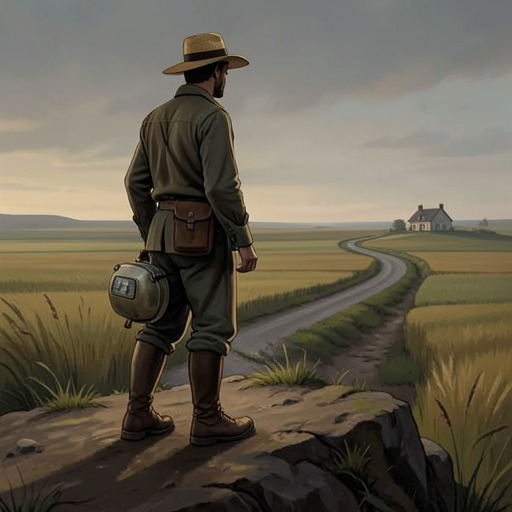
The emigrants are shaped by work specific to that terrain. The novel describes people from a kingdom of stones and junipers, whose muscles were strengthened by breaking stones and twisting juniper branches into wattles. Their strength and practical knowledge belong to an environment they know intimately. They have made their living on solid ground, through agriculture and cattle raising, and their competence there has no automatic equivalent on a ship.
From Rumor to a Shared Journey
Migration begins not as a mass movement but as news moving between households. Reports of fertile land across the ocean travel from neighbor to neighbor through hamlets, valleys, parishes, and counties. For the people at home, America is known through pictures and rumors, not direct experience; the ocean is an unknown barrier, while the home community remains familiar and seemingly safe. The idea of departure takes root privately before it becomes visible to others, and the first people willing to risk the journey unsettle communities accustomed to remaining in place.
The decision acquires practical form through linked arrangements. Karl Oskar and Robert write to a firm in Karlshamn and secure passage for six people aboard the Charlotta, a merchant vessel carrying both cargo and emigrants. Karl Oskar sends a down payment of one hundred daler; their planned departure is in the second week of April, with a direct voyage to New York. Spring offers a narrow practical advantage: the winter storms are past, and an early arrival leaves time to till and sow before the harvest needed for winter. Robert also undertakes to seek a passage contract for Danjel if the ship has room. An aspiration to reach fertile land becomes a collective undertaking through money, information, timing, and available transport.
At Åkerby Junction, separate household journeys gather into one party. Danjel has hired a team from Kråkesjö and travels with his wife, four children, and Ulrika of Västergöhl. Jonas Petter of Hästebäck drives his own wagon, with a hired man who is to return the horse from Karlshamn; Arvid and Elin, who cannot fit on Danjel’s wagon, ride with Jonas Petter. Robert joins Arvid there, bringing together the two former farmhands from Nybacken on the road to the New World. Nineteen people meet at the junction: three drivers will return from Karlshamn, while the emigrant party numbers sixteen—nine adults and seven children. The movement is collective, but it is assembled from distinct households, obligations, and relationships.
What the Soil Can Carry
The move is constrained by what a family can transport. At Korpamoen, the Nilsa family’s old black oak clothes chest is brought down from the attic and prepared for reuse. It has passed from father to son through generations and been opened at baptisms, weddings, and funerals; now, five feet long and three feet high, with broad iron bands, it becomes the strongest and roomiest packing case available. A piece of household furniture associated with the major passages of family life is itself sent into a new passage across the sea.
Packing makes the emigrants’ knowledge of home concrete. At the bottom of the Korpamoen chest go the heaviest tools: an adz, hatchet, chisel, drawknife, plane, hammer, horseshoer’s tongs, auger, knives, rule, and yardstick. Karl Oskar takes apart his muzzle-loader to fit it into the chest; Robert packs fishing gear, anticipating streams and fish in America, while Nils contributes an old bleeding iron that he believes may be useful to his sons. These are not tokens of a life already discarded. They are equipment for carrying familiar skills into an unknown place.
Kristina’s choices reveal what cannot travel as clearly as what can. She packs wool cards, knitting needles, sheep shears, and a swingle Karl Oskar gave her as a betrothal gift, painted with red flowers. She cannot take the loom, spinning wheel, flax brake, and other implements of household production that her hands know. Instead, she packs wool clothing, yarn, needles, and thread, preparing to mend and make do when replacement garments may be difficult to obtain. The emigrants preserve pieces of their working life while leaving behind many of its tools and routines.
Their bedding, bridal quilt, utensils, and food are packed for a journey whose duration and conditions are uncertain. A knapsack holds cups, plates, spoons, knives, and forks; a willow basket holds rye and barley loaves, butter, honey, cheese, smoked meat, and salted fish, along with coffee, sugar, and dried apples. Soap, salve, and brass combs are included to help the family maintain cleanliness. Such provisions reflect the practical limits of the crossing: the ship will supply food, but the emigrants cannot be sure they will be able to eat it, and their journey extends beyond the voyage itself, both before embarkation and after landing.
Land People at Sea
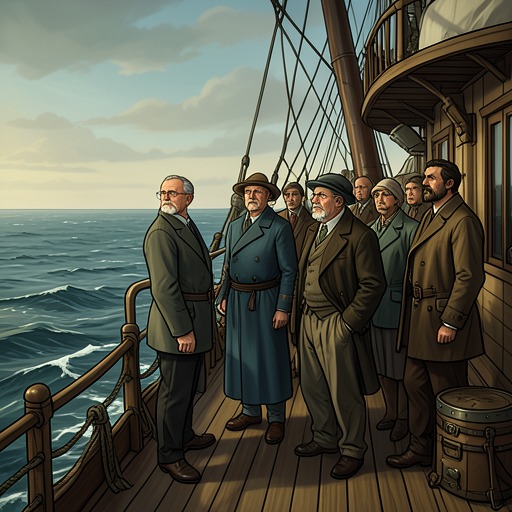
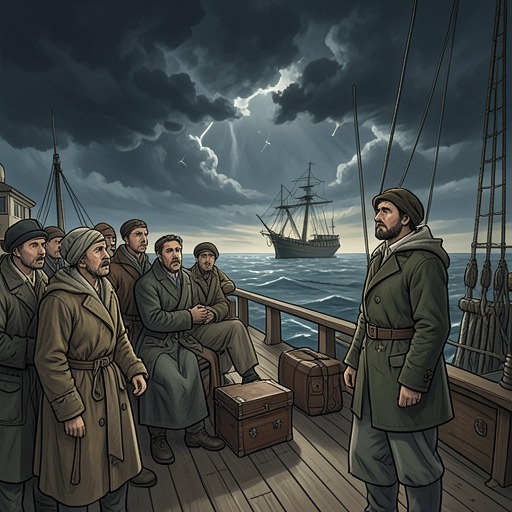
When the emigrants board the Charlotta at Karlshamn, they move from one kind of life into another: land occupies one-quarter of the globe, sea three-quarters, and the passengers have known only the first. Their feet, accustomed to fields and cottage floors, meet a deck that slopes and moves. Their heavy leather shoes and high boots, useful on solid ground, become awkward on the ship’s slippery surface. The farmers and farm wives who could order their movements and work effectively ashore must now adjust to a floor that cannot be trusted to stay still.
The change is social as well as physical. On land, the emigrants’ strong arms and backs are the result of breaking stone and working juniper; at sea, that strength offers little mastery. The narrative emphasizes that even the most capable among them are equally helpless before a medium they do not know. Their mistrust of the sea is inherited, and its danger feels more intimate because the ship has brought them out of the familiar world before delivering them to another continent. They have not yet reached new land; for the time being, they are confined to a vessel and dependent on the power carrying it.
The captain’s view sharpens the contrast between the passengers’ hopes and the risks of their choice. Captain Lorentz pities the farmers who have left their safe homes for weeks at sea, but he also insists that the decision was theirs, not his. He recalls that passengers may remain quiet during calm days in inland waters and become difficult to manage once the ship reaches open water. His perspective does not undo the emigrants’ reasons for leaving; it reveals how little their previous experience prepares them for the crossing they have chosen.
Leaving Home and Carrying It Forward
Departure makes the cost of migration visible in a final look backward. As the wagon carrying Karl Oskar’s family leaves, his father and mother remain on the porch, his father stooped on crutches and his mother standing beside him. In Karl Oskar’s memory they will remain there, motionless as stones or trees, watching the wagon disappear. The image gives the emigrants’ attachment to land a human counterpart: the old people stay rooted at home while the younger generation travels away, and the departure becomes a separation that will endure in memory.
The phrase “People of the Soil” holds together this rootedness and the act of leaving it. The emigrants are not freed from their agricultural past simply by boarding a ship: they carry tools, clothing, food, and inherited practices in a crowded chest and limited stores. Yet the crossing strips those skills of their familiar ground and places them at the mercy of the sea. Even the Swedish earth carried aboard for burials returns to the novel’s central contrast when Captain Lorentz scatters three scoopfuls over a dead passenger; some of the soil slips from the canvas into the water. The homeland travels with the emigrants, but it cannot remain intact or keep them on land.