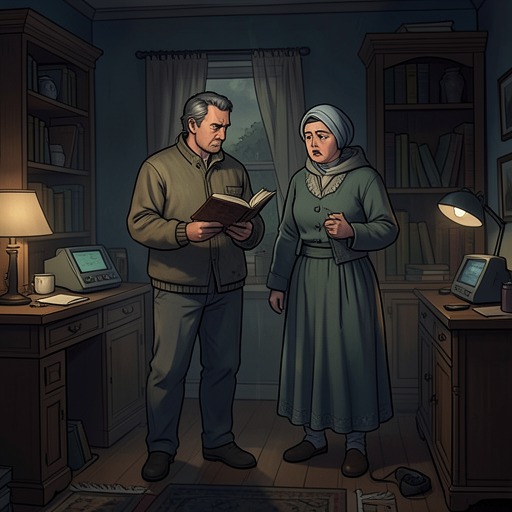
Rebirth in Christ among Danjel’s household
The EmigrantsRebirth in Christ among Danjel’s household is the spiritual change that turns a farm family into the center of a dissenting religious community. After a night vision of Christ and his dead uncle Åke, Danjel Andreasson believes that the Spirit has called him to resume Åke’s work. His new life reorganizes daily conduct and household relationships around the distinction between life in the flesh and life in the spirit; when Inga-Lena eventually experiences rebirth too, their marriage becomes legitimate again in his eyes. The belief offers strength in the storm at sea, even as the narrative sets spiritual assurance beside bodily suffering and the consequences of human choices.
The Call and a Changed Life
Danjel’s transformation begins at his threshold. After seeing Christ with Åke, he finds himself kneeling in prayer, calm rather than frightened, and filled with a peace he has never experienced before. He tells Inga-Lena that Christ has visited, but she supposes he has been dreaming; Danjel insists he was awake, and recalls seeing the same lantern carried by Christ in the picture above the church altar. The vision becomes the dividing line in his life: at forty-four, he understands his former existence as life in the flesh and his new existence as life in the spirit.
Åke’s brief exhortation gives Danjel his purpose. He believes he knows what to do because the Spirit speaks in his heart, and thereafter treats his actions as guided by that call rather than governed by fear of their outcome. He resumes Åke’s teachings, which have been forgotten in the neighborhood, and turns to the Bible as a source of direction. His conversion is not simply a changed opinion: it becomes an authority by which he understands his work, speech, and obligations.
The change is enacted in routine. Danjel gives Bible talks to his family and servants every Sunday, welcomes any neighbor who happens by, and prays while working in the fields, barn, and home. At times he bends his knees or cries aloud in prayer, so that people nearby mistake his cries for a call for help. He abandons the farm’s still, stops making and selling brännvin, gives up drink and profanity, and speaks with a gentleness that contrasts with his former irritability. Faith reaches beyond formal worship into work, language, and household practice.
A Household Reordered
Danjel’s belief makes possessions an obligation of care. He regards what he owns as gifts from God that should be shared with poorer brethren, and takes in helpless people at Kärragärde, providing food and clothing. His rejection of locks follows the same logic: he believes the Lord guards the house better than any human-made device. When thieves enter the unlocked larder and steal pork and flour, Danjel interprets the loss as evidence that the household had kept more food than God allowed. Inga-Lena, responsible for making provisions last, secretly locks the larder each evening. The disagreement makes visible the pressure exerted by Danjel’s faith on the practical work of keeping a household.
For Danjel, the decisive boundary is no longer social rank but spiritual state. He sees all people as equal members of God’s family, distinguishing instead between those who remain in their old bodies and those reborn in Christ. At the household Communion table, the believers understand redemption as a bodily transformation: Christ has taken possession of them, and their former sinful selves have been shed. They believe that their sins are bound up in the linen napkin Christ left in his grave. Though the church no longer receives them at its altar, they hold that Christ is present wherever they gather—whether in a byre, woodshed, or barn—and that Communion can be celebrated there.
This household practice becomes the nucleus of an Åkian community. The poor who live at the farm and some neighbors embrace the teachings and regard Danjel as a new apostle. His authority rests not on formal office but on the conviction that Christ acts through him. When he explains that he no longer lives in himself, he means that Christ has taken his place and is responsible for him; even worldly courts and judges, he believes, cannot harm the self that no longer lives in the flesh. The claim binds spiritual confidence to a sharp rejection of ordinary sources of authority.
Inga-Lena’s Rebirth and Marriage
At first, Danjel’s conversion divides the marriage. Because Inga-Lena has not been reborn, he believes that they no longer constitute a true married couple and refuses marital relations. He treats marriages between people still living in the flesh—or between a reborn person and an unreborn spouse—as joined by the devil. He also fears that children conceived in lust cannot be clean. Their three children were born before the couple’s conversion, and Danjel grieves over what he takes to be their spiritual condition, praying that God’s grace will purify and accept them.
Inga-Lena remains devoted to her husband but is distressed by the demands his beliefs place on her. She worries about feeding the increasing number of people he welcomes, feels uneasy when he refuses to lock the house, and finds it hard to accept his separation from her bed. The theft from the larder sharpens her conflict: she knows that the household must retain enough food, yet feels guilty for secretly disobeying Danjel. She also understands the biblical command that a wife should be subject to her husband, and prays for help because she believes her own understanding inadequate.
The change comes when Inga-Lena too experiences rebirth. She accepts that Danjel is right in spiritual matters and that she must obey him rather than rely on her own judgment. Within this shared belief, the marriage becomes a true marriage again: Danjel returns to their bed, and the couple resume marital relations. Their reconciliation does not erase the differences in their earlier experience; it resolves them by drawing Inga-Lena into the spiritual framework that had first separated them.
Faith Tested Beyond Kärragärde
The novel presents rebirth not only through doctrine but through the way belief meets suffering. Danjel’s conviction that human life unfolds under divine direction resembles Nils Jakob’s Son’s acceptance of his crippling accident as preordained, while Kristina sees the chain of events beginning with her childhood fall from a swing as guided by God. Yet the story also distinguishes such explanations from the physical consequences of hardship. Belief can give suffering a meaning without preventing the hurt itself.
Aboard the brig Charlotta, the storm tests Danjel’s faith in precisely this way. Fear threatens him, and he turns to the ninety-third Psalm, whose words restore his confidence that God is mightier than the waves. He then reads the Gospel account of Christ stilling the tempest to frightened passengers, insisting that God is with them on the ship. But the seasick passengers are so absorbed in pain and discomfort that the story does not reach them as consolation. Their suffering makes the biblical storm seem remote, and the account leaves open the tension between Danjel’s confidence in divine presence and the passengers’ immediate bodily distress.
That tension also bears on emigration and responsibility. Danjel can understand the storm as a trial of faith and trust that God has accompanied the emigrants from Kärragärde to North America. But at the voyage’s later reckoning, Karl Oskar recognizes that he persuaded Kristina and the children to leave and had declared that he would take responsibility. The physical price of the journey brings regret into view. Set beside Danjel’s rebirth, this moment prevents spiritual assurance from becoming a simple escape from consequence: faith may orient people amid uncertainty, but the choices that carry a family across the sea remain human choices, with human costs.