Robert Nilsson
The EmigrantsRobert Nilsson is the younger son of Nils and Märta, ten years younger than Karl Oskar, and a boy whose instinct to flee eventually becomes a plan to cross the ocean. Denied an inheritance of land and driven into farm service, he imagines America as a world without masters; his movement toward it turns childhood restlessness into a determined, costly pursuit of freedom.
Identity and Early Life
As a child, Robert slipped away whenever he could, vanishing among the junipers and woods until his parents spent hours searching for him. A cowbell tied around his neck did not always reveal where he was: when he sat quietly, they could not hear it. As he grew older, his parents stopped using the bell, ashamed to treat their son like an animal, but his habit of hiding or running from chores remained. His later longing to escape service has roots in this early pattern: confinement and supervision have always pressed against his desire to disappear into open country.
After his parents ceded Korpamoen, Robert spent summers herding cattle for Åkerby rote. The work brought little money—two daler a year, along with food and, each autumn, a cheese and woolen stockings—but the wastelands gave him room to be alone. While the animals grazed, he lay in a clearing looking at the sky, whistled, and sang without thinking. Only later did he recognize the feeling beneath those habits: he had been free. That memory gives his later resistance to hired service a concrete measure. He has known a life, however modest, in which no master directed his time.
For six weeks in each of three successive years, Robert attended Rinaldo’s school. He learned to read and write in his first year, and on completing his schooling received a copy of History of Nature. Rinaldo gave it to him so that he would keep reading after school ended. At first Robert left it unopened for more than a year, occupied with confirmation classes and with helping Karl Oskar fell oaks and saw timber that would be hauled to Karlshamn for shipbuilding. Yet the distant sea entered his thoughts as he worked on wood destined to become ships. He wanted to go with the timbermen and see it for himself.
His parents also gave him a leather-bound Bible for his first Communion, buying it with money earned by churning and selling butter. The two books came to stand for distinct realms of knowledge: the History of Nature for earthly things, the Bible for spiritual ones. But Robert’s first concern was the world he could see and enter. The timber he helped prepare for ships, and his wish to reach Karlshamn, began to connect reading and labor with a horizon beyond the parish.
From the Farmhand’s Road to the Sea
Robert’s father arranged a year of service at Nybacken, about a mile from Korpamoen. Robert objected that he did not want a master and asked whether he could avoid going. His parents rebuked him: the household could not support another dependent, his sister Lydia already worked as a maidservant, and the servant contract could not simply be cancelled after Nils had accepted earnest money. His promised wages—thirty daler, a wadmal suit, and short-legged boots—were presented as good terms for a healthy boy who needed food and clothing. To the parents, service was necessary; to Robert, it meant surrendering his freedom.
At sunup one May morning in 1848, Robert left home for Nybacken carrying a woolen kerchief bundle of clothes and three books: the Bible, the History of Nature, and his mother’s prayerbook. The books were wrapped in paper to keep them clean. Though the spring road was bright after overnight rain, he felt no pleasure in the green birches, new grass, or birdsong. He had not chosen this destination and dreaded arriving. He understood himself as a younger son without a portion, pushed from the family home like a fledgling from its nest. He did not envy Karl Oskar, whose inheritance was a stony farm and the burden of mortgage interest; the brothers faced different constraints, but neither inheritance represented effortless security.
Robert’s thoughts turned repeatedly to the sea, which he learned about in his nature book. Water seemed vast and unowned, unlike land divided into farms and fractions, where a person without land became another man’s servant. At the mill-brook bridge, the road itself made the choice visible: the right fork led to Nybacken, while the left went toward Åbro mill and away from the farm. He also knew the story of Fredrik Emanuel Thron, a farmhand from Kvarntorpet whose whereabouts had been unknown since 1833 and whose name the dean still called at the yearly examination. The parish record’s repeated notice of the missing man gave Robert a model of disappearance—and a warning that leaving could mean being lost to the community as well as escaping it.
After he ran from service, Robert reached the mill and fixed on Karlshamn as his destination: he had to get to the town by the sea. He hoped to ask a passing peasant for a ride part of the way, but the miller entered and recognized him as Nils of Korpamoen’s son. The possibility of flight was not an abstract wish; it depended on roads, transport, and the risk of being identified before he could reach the coast.
Imagining a New World
At Nybacken, Robert’s wish to escape became a plan shaped by reading as much as by the work he endured. He kept a copy of Description of the United States of North America hidden beneath the straw of his bed, consulting it for information about the country across the sea. As he forked manure, scythed at harvest, stacked hay, and chopped straw, his thoughts carried him toward America. The destination grew in his imagination like a flower rising from dark soil: the Old World appeared worn out, bound to inherited routines and obedience, while the New World seemed young, rich, and open to people who had left masters behind. To Robert, America offered not merely a different place but a way out of the social condition that had made him a servant.
The prospect of escape met the realities of his master’s control. When oak timber wagons began their autumn journey to Karlshamn, Robert expected a chance to get away, but Aron of Nybacken went with his team, unwilling to leave his young farmhand unwatched. Although Robert had worked obediently through the summer, Aron had once kicked him in the groin for not fetching water quickly enough; the injury left him walking with difficulty for several days. The denied journey made the road to America seem marked by closed gates, while the small act of violence showed what obedience under a master could entail.
The daily labor also pressed Robert toward despair. Sent to clean a deep ditch near Michaelmas, he worked without hearing a call to breakfast, growing hungry, thirsty, and sore from bending over the earth. Looking at the clouds from the ditch’s bottom, he imagined the uncompleted year stretching into endless future years of farm service and wondered whether life was worth living if he must remain a farmhand. Yet the posture recalled his herdboy summers, when he had lain for hours under the open sky. Even in the ditch, the memory of uncommanded time remained available to him.
Robert eventually disclosed his escape plan to Arvid, his fellow farmhand, asking him to keep the secret. He intended to wait until the autumn timber journey, when he might drive Aron’s old mare to Karlshamn; once out of sight, he would leave the mare to return alone and continue to the port. There he hoped to board a ship for North America. He even invited Arvid to come with him, promising that the journey could shed the nickname Bull. The plan joined practical calculation to youthful daring: Robert had chosen a time, a route, a means of transport, and a destination, while the book under his bed supplied a picture of the life he hoped to claim.
Injury, Departure, and a Shared Decision
Robert’s master’s violence turned his wish to escape into an immediate refusal to return. While bringing home a wagonload of rutabagas, Robert struck a gatepost and broke the wagon shaft when the mare failed to obey at a bend. Aron seized a fence stake and beat him repeatedly across the back; its knots tore his flesh. Robert had also been struck so hard on the ear that it still rang and buzzed. After leaving Nybacken without telling anyone, he told his family what had happened and declared he would never go back. Karl Oskar inspected the red marks and said that no one in their family had to accept flogging: they were as good as Aron. The injury made the conflict about more than Robert’s dislike of service: the master’s authority had become physical, and the family’s response affirmed his dignity against it.
Robert then asked Karl Oskar for his inheritance from the farm because he intended to go to North America. The request was a decisive change from a boy trying to evade a year of service to a young man naming a destination and seeking the means to leave. Karl Oskar agreed that Robert would not have to go alone. His brother, sister-in-law, their children, and the young people of the farm would accompany him. Robert’s damaged ear hummed loudly as he answered yes; the answer felt like a response to a challenge he had been waiting to accept. He had opened his first gate on the road to America.
The plan brought both excitement and vulnerability. At Hästebäck, Jonas Petter poured Robert a drink, treating him as a man now. Robert was eager for brännvin because it seemed to quiet the humming in his left ear, where he had almost entirely lost his hearing. He feared the sound might remain for life, an echo of Aron’s blow. On the emigrant journey he continued to interpret the injury through the terms of obedience: he wondered whether his earache was punishment for not listening to his master, yet believed that the healthier air of North America would cure it. His hope in the New World thus extended even to the possibility of recovering what violence had taken from him.
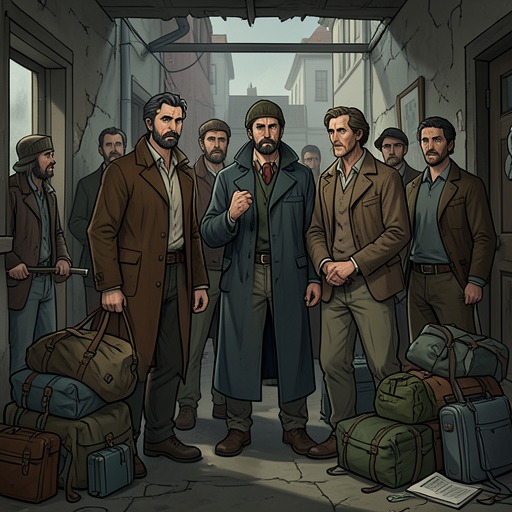
When the emigrants assembled for the journey, Robert was listed as a seventeen-year-old farmhand. The departure did not erase the precariousness of his position: he had escaped service and could not safely approach the dean for papers, unlike Karl Oskar, who wanted to leave the parish openly and requested the necessary documents. Robert’s freedom began in flight, while his brother’s began through formal separation.
Life Aboard the Charlotta
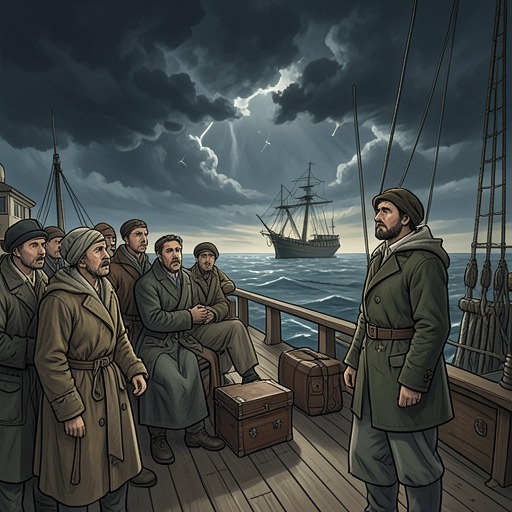
During the journey, Robert remained alert to the ship as a world that could be studied and mastered. He followed the officers’ orders and the sailors’ work, learning the names of sails, rigging, and deck equipment from an old sail-maker who answered his questions. He learned that the Charlotta carried pig iron in her bottom to keep her deep in the water, and that peas and sauerkraut helped guard against scurvy. He also questioned the passenger known aboard ship as the American about the United States; some answers came, others did not, and Robert wondered at the man’s claim that the President had forbidden him to reveal the country’s secrets. The farmhand who had once watched ships only in thought was now gathering practical knowledge aboard one.
His attention to the ship did not quiet his private hopes or fears. During the first storm on the North Sea, Robert awoke beneath Karl Oskar, whose body had rolled onto him in the bunk. The phrase dead sea had entered his dream, and the cramped, dark berth seemed to sink with the brothers toward the ocean floor. He clutched Karl Oskar’s shoulders and whispered to him. The episode turns the sea he had imagined as open and unowned into a force capable of terrifying confinement; the crossing that promised escape also exposed the emigrants to helplessness and danger.
Robert’s curiosity and his hopes for America also shaped his growing companionship with Elin. As the wagons traveled toward Karlshamn, he felt sorry for the girl, whose possessions seemed reduced to a small berry basket, and considered how he might speak kindly to her. He wanted her to know about the country they were approaching and thought about the government, laws, religion, and railroads he had read of. When she admitted she was afraid of America, his impulse to instruct her met a fear his books could not simply dispel.
Aboard the Charlotta, the two began studying English together on the afterdeck, sitting close over a small textbook Robert had bought in Karlshamn. After weeks at sea he had managed only three pages; that afternoon he started the fourth, and Elin joined him. She believed that the Holy Ghost would give the Åkians the ability to speak English once they landed, but was curious about the language and willing to practice. Robert thought a little preparation could do no harm. Their shared lesson makes the crossing more than a passage toward a distant shore: it is a period in which Robert’s plans meet another passenger’s uncertainty, and the imagined New World begins to require learning, conversation, and mutual attention.