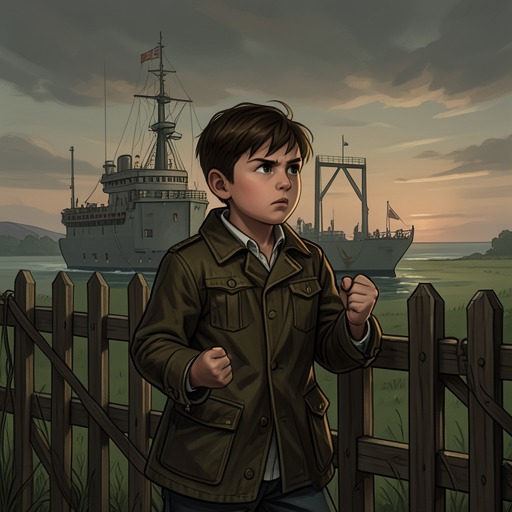
Robert’s Attempted Escape from Service
The EmigrantsRobert’s Attempted Escape from Service is Robert Nilsson’s first effort to evade the farmhand contract arranged by his father. On the May morning in 1848 when he is supposed to begin work at Nybacken, he turns aside at a mill brook, leaves clothing and shoes in the water to make others believe he has drowned, and takes the road to Åbro mill. The plan briefly gives material form to his desire for a life without a master, but it does not secure his freedom: the miller recognizes him, Aron of Nybacken retrieves him, and Robert is taken back to the farm. The episode’s central contrast is between the brook’s unowned movement and a servant’s legally restricted mobility.
The Service Arranged for Robert
Robert’s attempt begins in a constrained position. Still a minor, he has been assigned by his father, Nils, to spend a year as a farmhand at Nybacken, about a mile from Korpamoen. Robert tells his parents that he does not want a master and asks whether he can avoid the service. They reject the appeal: the household cannot keep another dependent, his sister Lydia is already serving elsewhere, and Nils has accepted earnest money from Aron under the servant law. The arrangement is therefore not simply a choice of work but a binding obligation made on Robert’s behalf.
On the appointed morning Robert leaves home at sunrise carrying a woolen kerchief bundle of clothes and three books: the Bible, the History of Nature, and his mother’s prayerbook. The books are wrapped to protect them. Although spring has come, he feels no pleasure in the morning landscape; he dreads the service and resents being pushed out of the family home as a younger son without a portion. His departure turns an abstract dislike of having a master into a journey he does not want to complete.
At the Brook and the Crossroads
Robert stops at the bridge over the mill brook and sits beside the water, delaying the start of his service. Watching the stream pass beneath the bridge, he imagines a freedom unavailable to a hired hand: the water belongs to no one, stays nowhere, and can flow all the way to the sea. The thought gives the scene its governing image. Land is divided into holdings, and those without land must serve landowners; the brook, by contrast, moves without contract or permission.
The place also holds a darker memory. In a deep pool near a large stone, Robert once drowned a cat; years earlier, a maid from Nybacken had slipped into the same pool and drowned while washing clothes. Robert remembers the marks her fingernails left on the stone as evidence of her terror. The memory brings death close to his thoughts of escape, but the scene does not present his plan as a genuine attempt to drown himself. Instead, he turns the brookside setting into a means of disappearing from the service expected of him.
Robert knows that the road divides at the bridge: the right-hand route leads to Nybacken, while the left leads to Åbro mill. He also knows of farmhands who vanished from the parish, including Fredrik Emanuel Thron, whose whereabouts had remained unknown for fifteen years. The possibility of taking a road away from Nybacken is thus connected to the parish’s record of people who leave and are never heard from again.
Staging the Drowning
As Robert prepares to leave, one wooden shoe has floated out of reach and caught in the willows. Startled by its movement, he imagines himself in the water. He then deliberately makes the apparent accident more convincing: he stuffs his stockings into his remaining shoe and throws it into the brook, removes his jacket and lets it float after the shoe, and takes his two bundles with him. At the crossroads beyond the bridge, he turns left instead of taking the right-hand road to Nybacken.
The jacket remains caught in the willow branches, its sleeves moving as the water shifts them. To anyone passing, it suggests that the young farmhand on his way to Nybacken has drowned, like the maid before him. The abandoned garments make the deception legible to the village, while Robert’s actual route carries him away from the appointed service. His decision is an improvised escape rather than a prepared journey: he leaves with the possessions he can carry, and the plan depends on the appearance of his death.
Recognition and Return
The escape lasts only until Robert reaches the mill. There, a farmer tells him that a farmhand on the way to service in Nybacken has drowned in the creek; the jacket has been found, but the body has not. The report shows how effectively Robert’s abandoned clothing has conveyed the intended story. The farmer also identifies the supposed victim as Nils of Korpamoen’s son, recently confirmed and remembered as a boy who used to run away from home.
The miller, however, recognizes Robert. He asks whether the barefoot boy without a jacket is Nils of Korpamoen’s son, and the intended disappearance ends. Aron arrives, speaks gently as though Robert has merely lost his way, grabs him by the shoulder, and orders him to collect his bundles. Robert is legally hired and bound to Aron; the physical return to Nybacken restores the obligation he had tried to escape. On the road back, the wagon takes the right-hand route at the same bridge where Robert had turned left.
The episode closes by naming the attempt as Robert’s first step on the road to America, even though he has not reached the sea or left the parish. The phrase casts the failed diversion as an early expression of a desire that will persist beyond this particular day. For now, however, the attempt ends with Robert returned to the service his parents arranged.
What the Attempt Reveals
At Nybacken, Robert’s days are governed by work and by the demands of multiple masters. He tends the farm’s four horses, rises early, and is hurried or corrected by the people on the farm; even the animals claim his attention. The service year lasts 358 days, with only one free week. During his first week he decides that he must escape his human and animal masters. The attempted flight at the brook gives that resolve its first concrete action.
The return does not end the pattern of constraint. Later, after Aron strikes him for laziness, Robert does not complain. He understands the punishment as authorized by the servant law and by the religious doctrine of a master’s authority; he regards himself as having earned it. That later acceptance throws the first escape into sharper relief: Robert can imagine a way out, but the social and legal order teaches him to treat his subordination as legitimate.
The novel also revisits the episode’s contrast between land and sea. When Robert is eventually aboard ship, he compares a seaman’s confinement and dangerous work with farm service and concludes that a farmhand on land has more freedom than a sailor at sea. The early image of the brook flowing toward the sea therefore does not amount to a simple promise that every departure brings liberty. In the escape episode, water represents movement beyond ownership; later experience complicates that hope by showing that work and confinement can follow a person into a new setting.