Sweden
The EmigrantsSweden is the emigrants’ homeland and the point of departure for a migration that breaks with centuries of rural continuity. In the novel, it is at once the land of family farms, inherited skills, and remembered attachments, and a place where limited land, debt, poverty, and authority narrow people’s prospects. The travelers leave for North America not from a single motive but from different forms of pressure; even as the coast disappears, they carry Sweden with them in memory, household objects, and the soil reserved for burial.
A Homeland Organized Around the Farm
The opening account presents a rural world in which the farm supplies nearly everything: rye and cattle provide food, while wool, flax, and animal skins become clothing and shoes. Generations succeed one another at the plow and loom, and the same cottage shelters births, weddings, christenings, and funerals. Its routines follow the seasons and the weather, which can bring either abundance or scarcity. That apparent self-sufficiency gives Sweden’s departure its force: leaving means breaking from a durable way of life, not merely changing residence.
This inherited order is under pressure from population growth and the division of property. On January 1, 1846, Ljuder Parish had 1,925 inhabitants, while the number of people without assessed property or a permanent home had risen much faster than the population over the preceding century. The parish’s 43 original homesteads, divided among 87 owners in 1750, had become 254 independent farms by 1846; two-thirds were one-eighth of an original homestead or smaller. The figures give material form to the contrast between a society built around the farm and the increasingly limited ability of each household to live from the land.
By the middle of the nineteenth century, new forms of transport and the circulation of printed information disturb the old expectation that people will remain where they were born. Reports and images of North America reach communities whose inhabitants have not seen or explored it. Rumor travels from neighbor to neighbor, and the prospect of land draws those who have land to spare nowhere at home. For some, emigration promises freedom or a new livelihood; for others, it is chiefly a way out of debts, subordination, or unsatisfactory circumstances. The book stresses that the answers to why people leave are varied.
Leaving as a Chain of Decisions
The movement begins not as a single communal resolution but as a succession of private decisions and practical arrangements. News of a distant country enters the parish gradually; uncertainty about the ocean and the unfamiliar destination competes with the safety of home. In the Nilsson household, Karl Oskar’s plan to sell Korpamoen and emigrate provokes older farmers’ attempts to dissuade him. They point out that he is not being forced off his farm and that others are in worse financial circumstances. He insists that he has reached his decision through his own judgment, rejecting the idea that a lifetime spent in familiar furrows necessarily makes a person wiser.
His parents respond differently from the neighbors who challenge him. Nils understands that his own years of clearing Korpamoen may seem futile if the land does not secure a future for his sons; Märta regards Karl Oskar’s departure as ingratitude toward what he has gained at home. They pray for him to change his mind, but after a summer, autumn, and winter without any apparent change, they conclude that God may have a hidden purpose in their son’s and daughter-in-law’s emigration. Sweden therefore remains more than a setting: it is a family inheritance whose meaning is contested by the generations preparing to leave and those who must stay.
The departure of Danjel and his household joins religious persecution to this developing migration. Facing another court summons after continuing Bible meetings and Communion in his home, Danjel interprets his journey through the biblical call to leave his country and kindred for a land God will show him. He comes to Karl Oskar for help, and the two households’ plans become connected. Karl Oskar is willing to assist him both out of obligation for earlier help and as part of arranging the crossing. A decision that began in one household thus enables another family’s departure, turning scattered choices into a group movement.
Transport and money make that movement possible, but also set its limits. Karl Oskar and Robert have secured passage on the Charlotta, a merchant vessel sailing from Karlshamn directly to New York, and paid a hundred daler in advance for six people. Spring is chosen so that the emigrants can arrive in time to sow and prepare for a harvest. Danjel asks Robert to arrange a contract for his own passage if there is room; nine people from Kärragärde are expected to join. These arrangements transform the imagined distance to America into a route, a ship, a date, and a shared undertaking.
Household Memory Packed for the Journey
The material culture of the departure shows what the emigrants expect to need and what they cannot take. The Nilsa family’s black oak clothes chest, long passed from parent to child and associated with weddings and funerals, is brought down from the attic because it is the largest and strongest packing case available. Its old life as a keeper of family possessions gives way to a new task: carrying belongings across the ocean. The household’s break with Sweden is therefore enacted through an object that also embodies continuity across generations.
The contents are selected for both work and survival. Karl Oskar packs carpentry and timber tools, hunting equipment, and a disassembled muzzle-loader; Robert brings fishing tackle, while Nils contributes an old bleeding iron. Kristina packs wool cards, knitting needles, sheep shears, and a red-flowered swingle given to her by Karl Oskar. She must leave behind the loom, spinning wheel, flax brake, and other implements that have been familiar to her hands. Warm clothing, yarn, needles, and thread are included because the family expects the old garments to last, while camphor and lavender are placed among the clothes to protect them during storage.
Food and bedding make the practical calculations still more explicit. The bridal quilt, sheets, mattresses, and bolsters go into two large sacks; a separate basket holds provisions for the journey, including rye and barley loaves, salted butter, honey, cheese, smoked meat, and salted herrings. The ship is expected to provide food at sea, but the family cannot be certain it will suit them, and they must travel both before embarkation and after landing. The packed household is thus a bridge between the known conditions of Sweden and an uncertain destination, assembled from what can be carried rather than from any assurance about what awaits.
The Last Glimpse and What Remains
As the wagons leave Korpamoen, Karl Oskar’s parents stand together on the porch while the younger generation departs. In his memory they remain fixed in that position, like stones or tree trunks rooted in the ground. The contrast makes the separation feel larger than a journey: the family divides into those who move and those who remain bound to the place. On the road, Karl Oskar and Kristina look back at familiar brooks and meadows, knowing they will not see them again in the same way. Their attention to these places is an effort to remember a landscape that is becoming inaccessible even before it is distant.
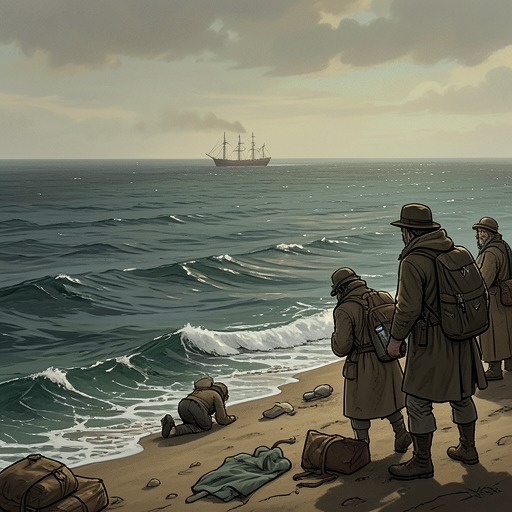
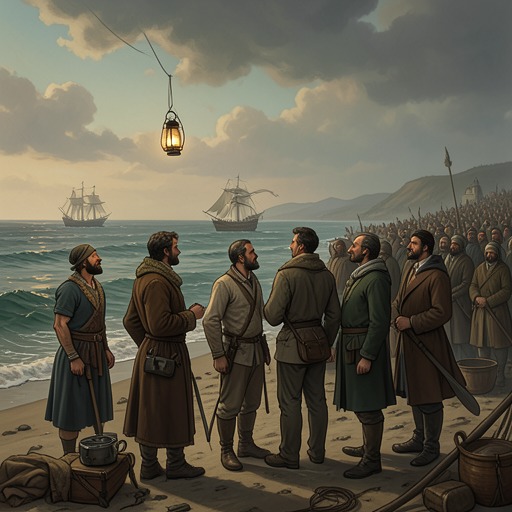
At the harbor, Sweden becomes a visible shore that the emigrants have chosen to reject. As the Charlotta leaves Karlshamn, the island at the harbor entrance disappears into April fog; it is the travelers’ last outpost of their homeland. Their reasons differ. One emigrant remembers a farm lost to foreclosure and the impossibility of escaping debt; another recalls exhausting labor and contempt from employers; another leaves after conflict with a minister; still another describes leaving because hard work at home offered no advancement. Alongside these grievances, the departing people acknowledge relatives, parents, youthful happiness, and places they will remember. Their farewell is neither uniform hatred nor unqualified hope.
The narrative preserves that doubleness in the treatment of Sweden as both rejected country and remembered home. Karl Oskar refuses to feel indebted to a homeland where his struggles have repaid him so little, yet he wants to appear neat and respectable before Americans, representing Swedish peasants as orderly and decent despite their poverty. The clothing he discards is associated with the troubles of the crossing, but the family keeps Kristina’s blue bridal cover, which she made and which has accompanied their married life. Its stains and holes do not erase its value: she hopes to wash and mend it and use it again in their new home. Sweden’s material past is not carried intact; it is sorted, reduced, and selectively preserved.
The most literal remnant of the homeland appears in the burial ritual at sea. Captain Lorentz takes three scoops of Swedish earth and empties them over the dead emigrant before the body is committed to the water. The soil came from the land where she spent her life in work and care for her family. As the canvas-covered body leans toward the sea, grains of earth slip from the cloth and fall overboard. The detail binds the emigrants’ old and new worlds at the moment of burial: Sweden’s earth travels with them, but cannot remain on the ship. In this way the homeland accompanies the voyage as both a physical fragment and an irretrievable place of origin.